YouTube hook generator: write video intros that stop the scroll

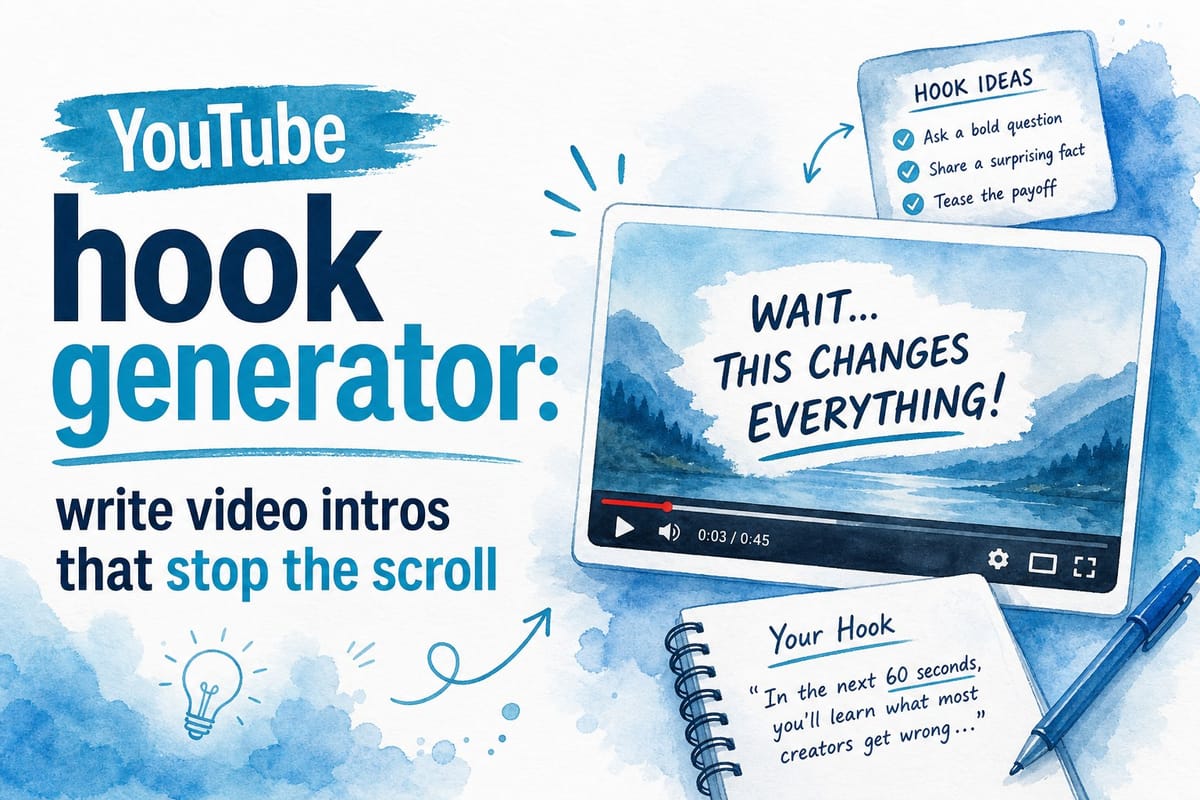
Table of contents
1. What a strong YouTube hook actually does
2. How to use a youtube hook generator effectively
3. Building a hook system for faceless channels that scale
I have watched thousands of YouTube videos over the years, and I can tell you the first 30 seconds decide everything. Viewers decide almost instantly whether they are staying or scrolling, and that decision happens before most creators have even finished their opening sentence. That is a brutal reality, but it is also a massive opportunity. If you can write a hook that grabs attention and holds it, you have already won half the battle. A youtube hook generator can help you get there faster, especially when you are running a faceless channel and producing content at scale. In this article I want to break down exactly what makes a video hook work, how AI-powered tools can help you write better intros without sacrificing quality, and how to build a repeatable system that turns good hooks into consistent views.
What a strong YouTube hook actually does
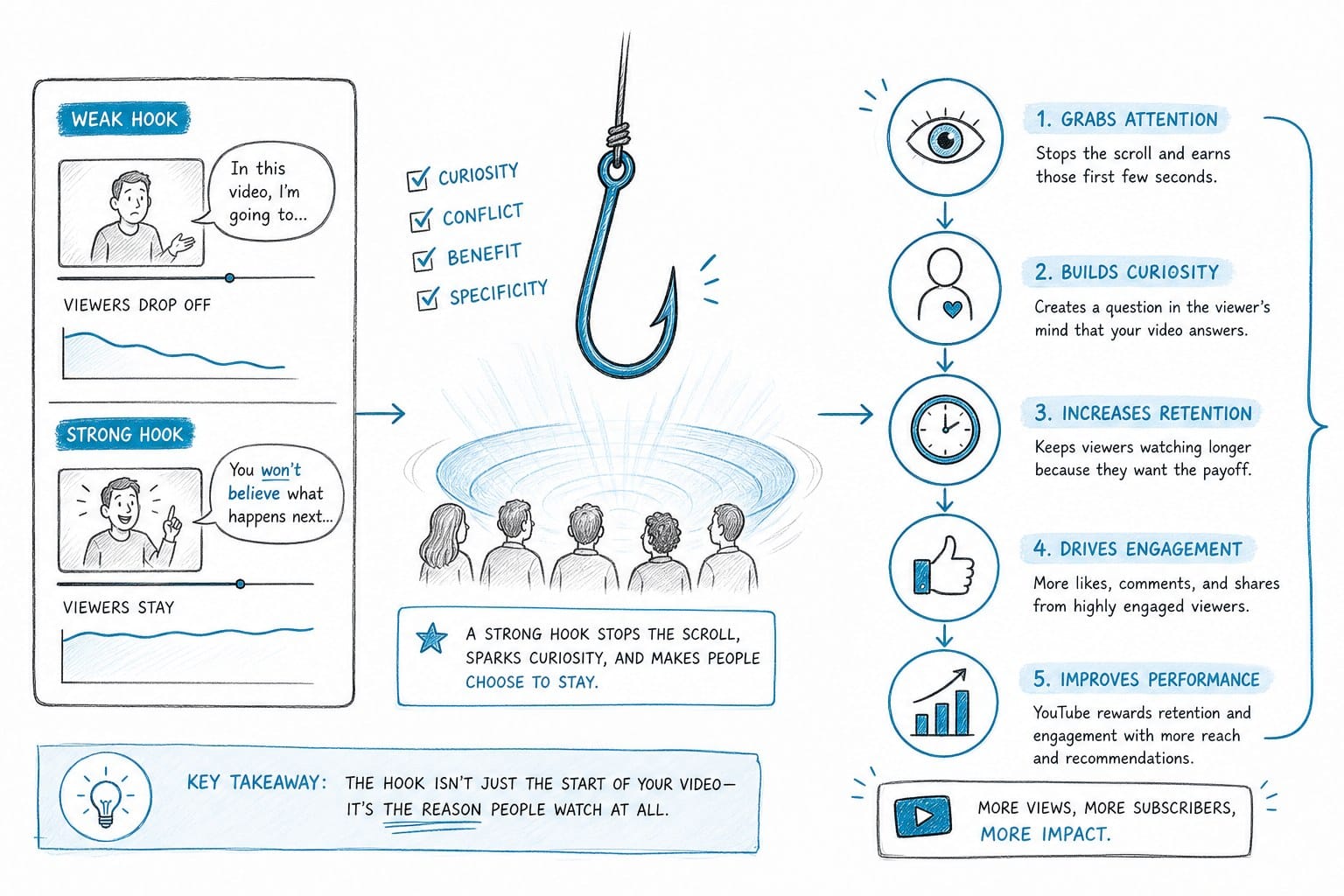
Let me start with something most creators get wrong. A hook is not just a flashy opening line. It is a small contract between you and the viewer. It promises something specific, creates a reason to stay, and sets the emotional tone for everything that follows. When that contract feels solid, people watch. When it feels vague or slow, they leave.
Think about the last video you actually watched all the way through. Chances are it opened with a scene, a question, a surprising fact, or a problem that felt personally relevant to you. It did not open with the creator saying their name, thanking you for clicking, or explaining what their channel is about. Those things kill momentum before it ever starts.
There are a few core jobs a hook needs to do in those first 30 seconds.
First, it needs to establish a clear subject. Viewers want to know immediately what this video is about. Not approximately. Not eventually. Right now. If someone clicked on a thumbnail about abandoned ghost towns in Nevada, they want to hear about that within the first few seconds, not a long preamble about how the creator got into history.
Second, it needs to create tension or curiosity. The best hooks do not just describe a topic, they introduce a gap. There is something the viewer does not know yet, and the video promises to fill that gap. That gap is what keeps people watching. A hook that says "In 1956, a Nevada town with 3,000 residents disappeared overnight, and no one knows exactly why" does something powerful. It raises a question before the viewer has even thought to ask one.
Third, it needs to signal quality. Viewers make snap judgments about production value, confidence, and credibility in the first few seconds. A muddled opening or a slow start tells viewers that the rest of the video is probably not worth their time.
For faceless channels specifically, the hook carries even more weight. You do not have a face on screen to create a personal connection. You do not have a recognizable personality the viewer has come to trust over time. You have your words, your visuals, and your audio. That means every sentence in the first 30 seconds needs to be doing real work.
I want to be direct about something: writing consistently strong hooks is hard. Even experienced creators struggle with it. You can know exactly what makes a hook work and still stare at a blank page for an hour trying to write the opening line for a video about water infrastructure in the American Southwest. That is not a failure of creativity. It is a mechanics problem. And mechanics problems are exactly the kind of thing AI tools are built to solve.
A youtube hook generator does not write your video for you. What it does is give you a starting point, a structure, or a set of options that you can refine based on your topic and your audience. That is genuinely useful, especially when you are producing multiple videos per week and you need to move fast without letting quality slip.
Here is a practical example. Say you are making a video essay about the decline of American shopping malls. A generic hook might start with something like "Shopping malls were once the center of American culture." That is true, but it is boring. It does not create tension. A better hook might be: "In 2001, there were more than 1,100 enclosed shopping malls in the United States. Today, fewer than 700 remain, and analysts say that number could drop by half within a decade. What happened, and is it actually a problem?" That version does three things at once. It introduces a specific fact, it signals a downward trend, and it ends with a question that the viewer now wants answered.
The difference between those two openings is the difference between a video that holds retention and one that loses half its audience in the first minute. A good youtube hook generator helps you get to that second version without spending 45 minutes rewriting your intro from scratch every single time.
You also want to think about the relationship between your hook and your thumbnail. These two elements work together. The thumbnail creates a click, and the hook earns the watch. If your thumbnail promises something dramatic or surprising, your hook needs to deliver on that promise immediately. If there is a mismatch, viewers feel tricked, and they leave. Worse, they might not click on your next video because they remember feeling misled.
For faceless channels doing documentary-style content, listicles, or explainer videos, the hook is often where the script lives or dies. The rest of the video can be well-researched, well-edited, and genuinely informative, but if the first 30 seconds do not land, the viewer never gets there. That is why I think spending real time on your hook structure is one of the highest-leverage things you can do as a creator.
How to use a youtube hook generator effectively
Using an AI tool to generate hooks is not about handing off your creative process. It is about removing the blank-page problem so you can spend your energy on judgment and refinement rather than on starting from zero every time.
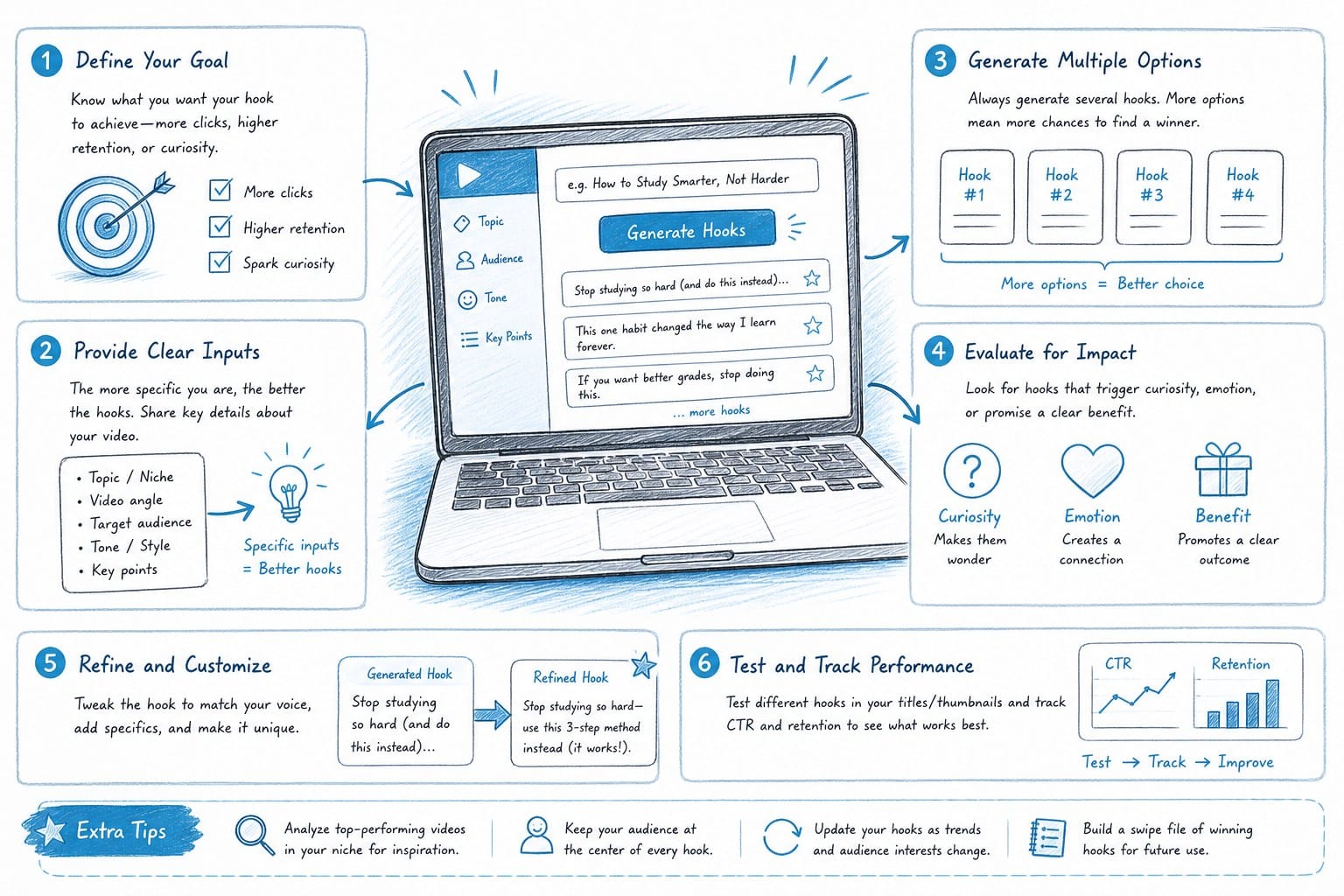
Here is how I think about it. When you use a youtube hook generator, you are essentially giving the tool a brief and asking it to produce options. The better your brief, the better your options. A vague prompt like "write a hook for a video about history" is going to produce vague, generic results. A specific prompt like "write a hook for a 15-minute video essay about how the construction of the interstate highway system destroyed Black neighborhoods in American cities, targeting viewers who like documentary-style content" is going to produce something much more usable.
There are a few things you should always include in your prompt when using any kind of hook generation tool.
The specific topic of the video, as narrowly as you can state it. Not "business history" but "the rise and fall of Sears as the dominant American retailer."
The intended audience. A video about the same topic can be framed very differently depending on whether your audience is entrepreneurs, history enthusiasts, or people interested in urban planning.
The emotional tone you want to establish. Some hooks work best when they open with awe or wonder. Others work best with urgency. Others work best with a kind of quiet dread. Telling the tool what feeling you want the viewer to have in the first 30 seconds helps it choose language and structure accordingly.
The format of the video. A listicle hook is structured differently than a mystery-style documentary hook. A how-it-works explainer opens differently than a character-driven narrative. Being specific about format helps the generator match its output to what you actually need.
Once you have a few hook options from the tool, the real work begins. You are not looking for a hook you can copy and paste directly into your script without reading it. You are looking for a hook you can react to. Read each option and ask: does this create tension? Does it promise something specific? Does it match the energy of my thumbnail? Does it feel like something a real person would say, or does it feel like a machine generated it?
That last question matters a lot. AI-generated hooks can sometimes be technically correct but feel flat or over-polished in a way that sounds impersonal. Part of your job is to inject your channel's voice into whatever the tool gives you. Even on a faceless channel, your videos have a personality. They have a pace, a tone, a way of framing information. The hook should match that.
One thing I find helpful is to generate five or six options at once and look at them side by side. Sometimes none of them are exactly right, but together they give you a clear picture of the territory. One might have a great opening fact but a weak question. Another might have a strong question but start too slow. You can take the best elements from two or three of them and combine them into something that works better than any single option.
For creators running faceless channels at scale, this kind of workflow is genuinely practical. If you are producing four or five long-form videos per week, you cannot afford to spend two hours on each hook. But you also cannot afford to write lazy hooks that kill your retention. A youtube hook generator cuts that time down dramatically while still giving you something to work with rather than a blank page.
I also want to mention the relationship between hooks and scripts more broadly. The hook is the beginning of your script, but it is not separate from it. The strongest hooks plant seeds that the rest of the video pays off. If your hook raises a specific question, your script needs to answer that question clearly and satisfyingly. If your hook makes a bold claim, your script needs to back it up with evidence. This is why I think about hook generation and script generation as connected parts of the same process rather than separate tasks.
If you are interested in going deeper on the full scripting process for long-form content, I wrote about this in more detail in Free YouTube script generator for long-form video content. The same principles that apply to hooks apply to the broader structure of a well-built script: specificity, tension, a clear promise, and a consistent voice.
Another practical consideration is testing. If you are serious about improving your hooks over time, you need data. Watch time graphs in YouTube Studio will show you exactly where viewers drop off. If you consistently see a sharp drop in the first 30 to 60 seconds, your hooks are not landing. If viewers are making it through the first minute but falling off around the two-minute mark, your hook is probably fine but your early body content needs work. Being able to read that data clearly is a skill in itself, and it directly informs how you prompt your hook generator and what you refine in the output.
For a deeper look at reading your channel's performance data, Best YouTube analytics tools for tracking growth and revenue covers the key metrics worth tracking and how to actually use them to make better content decisions.
There are also a few hook structures worth knowing by name because they come up again and again in high-performing videos.
The open loop. You introduce something without resolving it. "Before I tell you what actually caused the collapse of Enron, I need to show you something most people completely misunderstand about how the company was structured." The viewer is now waiting for a payoff, and they will watch to get it.
The surprising statistic. You lead with a specific number or fact that challenges what the viewer assumed they knew. This works especially well for documentary-style channels because the unexpected fact signals that the video is going to tell them something genuinely new.
The direct question. You ask the viewer a question they suddenly realize they do not know the answer to. "Why do we drive on the right side of the road in America but the left in the United Kingdom, and does it actually matter?" Simple, specific, and immediately curious.
The provocative claim. You make a statement that the viewer wants to argue with or understand. "The city of Detroit did not collapse because of crime or poverty. It collapsed because of a deliberate policy decision made in Washington in 1956." That kind of claim creates immediate tension because it challenges a narrative the viewer thought they understood.
Knowing these structures means you can prompt your youtube hook generator more precisely. Instead of asking for "a hook," you can ask for "an open loop hook" or "a surprising statistic hook" and get output that matches the structure you actually want.
Building a hook system for faceless channels that scale
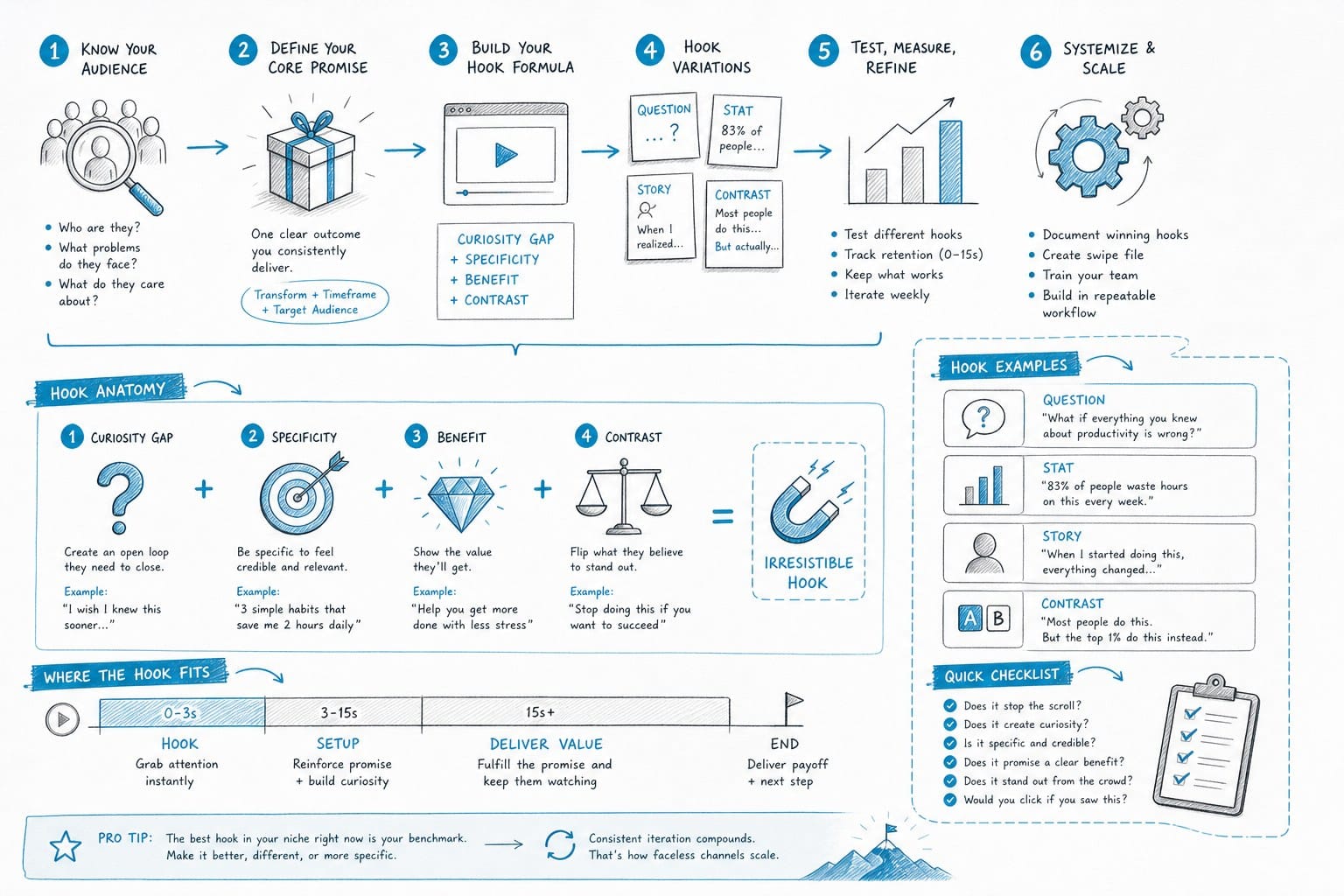
Individual hooks matter, but if you are running a faceless YouTube channel at any kind of volume, what you really need is a system. A system means you are not starting from scratch on every video. You have a process, a set of templates, a feedback loop, and tools that connect to each other.
Let me walk through what that actually looks like in practice.
Start with your content pillars. Most successful faceless channels have two or three core topic areas they return to again and again. A channel about American history might cover political scandals, infrastructure failures, and forgotten disasters. Each of those pillars has its own audience expectations and its own natural hook structures. Political scandal videos do well with provocative claims. Infrastructure failure videos tend to do well with the surprising statistic format. Forgotten disaster videos work well with the open loop structure because the viewer probably does not know the story yet.
When you understand which hook structures work best for each pillar, you can prompt your youtube hook generator much more precisely. You are not asking for a generic hook. You are asking for a specific type of hook for a specific type of video within a specific content pillar. That kind of precision produces dramatically better output.
Next, build a hook swipe file. A swipe file is just a document where you save examples of hooks that you think work well, whether they came from your own videos, from other channels in your space, or from a generator. You do not use these directly. You use them as reference material. When you are prompting a hook generator, you can describe the structure or energy of a hook in your swipe file to help the tool understand what direction to go.
For example: "Write a hook in this style: here is something that happened in America in the 1970s that we have completely forgotten about, and it is about to matter again. The hook should feel slow-building but ominous." That kind of prompt gives the tool a much clearer target than "write a hook about 1970s American history."
Another part of building a system is creating feedback loops. Every video you publish is a data point. After each video has been live for 30 days, pull the retention data and note two things: where viewers dropped off in the first 60 seconds, and what the average view duration was across the full video. Compare that to your hook structure. Did you use an open loop? A provocative claim? A surprising statistic? Over time, you will start to see patterns in what your specific audience responds to.
This is genuinely useful data. Most creators look at views and subscribers and miss the more actionable insights sitting in their retention graphs. The goal is not to chase any metric obsessively. The goal is to understand your audience well enough to write better hooks for them specifically, not just for a hypothetical average YouTube viewer.
For faceless channels specifically, there is another layer to think about: consistency of voice. Because you are not on camera, your channel's identity is carried almost entirely by the writing and the production style. The hook is the first impression of both. If your hooks feel wildly different from video to video in terms of tone and pacing, viewers do not build a strong sense of what your channel is. They do not develop the kind of expectation that makes them click on your next thumbnail as soon as they see it.
This is why I think the youtube hook generator conversation is really a conversation about systems and consistency, not just individual videos. The tool is useful because it helps you produce hooks that are structurally sound quickly. But the discipline of reviewing the output, matching it to your voice, and refining it to fit your specific audience is what turns a decent tool into a real competitive advantage.
Let me also be honest about the limits here. A hook generator is not going to save a video with a weak concept. If the underlying idea for the video is not compelling, no opening line is going to hold viewers long enough to matter. Strong hooks live inside strong concepts. If your video idea is genuinely interesting, a hook generator helps you communicate that interest efficiently. If your video idea is flat, a great hook will just deliver viewers to a disappointing experience faster.
So the hook system sits inside a larger content strategy. You need good ideas, good research, good scripts, and good production. The hook is where the script begins, but it draws its power from everything that follows it.
For creators using Kliptory, this is where the platform's integrated approach to video production becomes directly relevant. When your scripting, your voiceover, your B-roll, and your editing are all part of the same workflow, your hook is not an isolated element you write in a vacuum. It is the opening of a complete piece of content that gets built out end to end. That integration matters because the best hooks promise something your video is actually capable of delivering, and when your production pipeline is efficient, you have the time and space to make sure those two things stay aligned.
If you want to see how Kliptory approaches faceless channel production more broadly, including how it handles the scripting side of things alongside the production workflow, it is worth spending some time at https://kliptory.com to get a clear picture of how those pieces fit together.
One more thing worth mentioning: hook writing gets easier with practice, but it never gets automatic. The most consistent creators I have seen are the ones who treat every hook as a separate creative problem worth real attention, even when they are using tools to speed up the process. They do not treat AI output as finished work. They treat it as a first draft that needs their judgment applied to it.
That mindset is the difference between a creator who uses a youtube hook generator to save 20 minutes and one who uses it to level up their entire scripting process. The tool is the same. The difference is in how seriously you take the refinement step.
For faceless channels trying to scale content without scaling costs, this matters even more. You are already working with fewer resources than a traditional production team. The advantage you can build is in process quality: being more thoughtful about hooks, more consistent about testing, more disciplined about connecting your hook data to your content decisions. Those habits compound over time in ways that raw volume never will on its own.
If you are also thinking about how your channel strategy fits into a broader toolkit for growth, the comparison between different optimization tools is worth understanding. TubeBuddy alternative for faceless YouTube creators lays out some of those considerations in a way that is directly relevant to channels in the faceless format specifically.
At the end of the day, a great hook is a promise. It tells the viewer: I have something worth your time, and I am going to make the next 10 or 15 or 30 minutes genuinely worthwhile for you. A youtube hook generator helps you make that promise quickly and consistently. But keeping it is still on you.
Ready to take the next step?
If you are building a faceless YouTube channel and want to produce documentary-style videos faster without sacrificing quality, Kliptory was built for exactly that. From scripting to voiceover to editing, the platform handles the production pipeline so you can focus on your content strategy. Visit https://kliptory.com to see how it works and start building your channel at scale.