AI B-roll sourcing for YouTube: automatically match visuals to your script

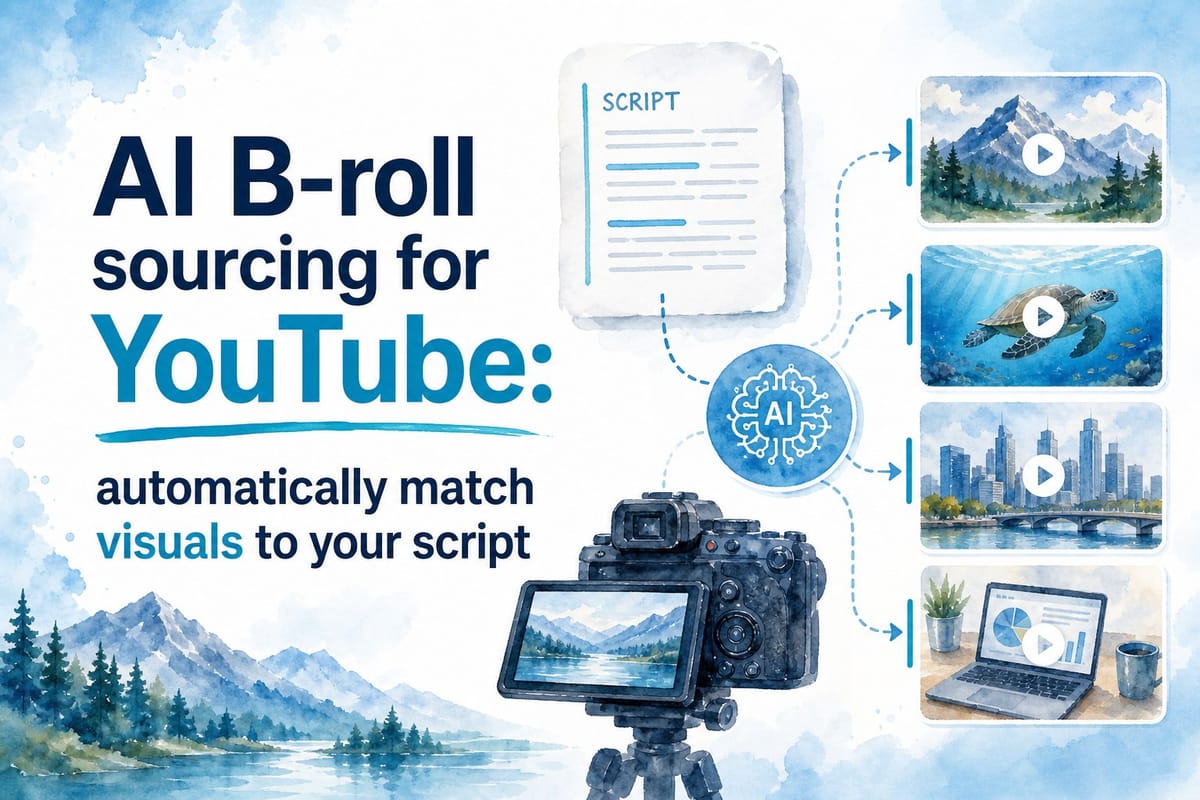
Table of contents
1. What AI B-roll sourcing actually does (and why it beats doing it yourself)
2. How the matching process works inside a modern AI video platform
3. Choosing the right platform for automated B-roll sourcing on YouTube
Finding the right B-roll footage for a YouTube video used to take hours. You would scrub through stock sites, download clips, check licenses, and still end up with visuals that only kind of matched what the narrator was saying. AI B-roll sourcing for YouTube changes that whole process. Instead of hunting down footage manually, the right tools now read your script and pull visuals that actually fit the moment. This article breaks down how that works, why it matters for faceless channel operators, and what to look for when picking a platform that does it well.
What AI B-roll sourcing actually does (and why it beats doing it yourself)
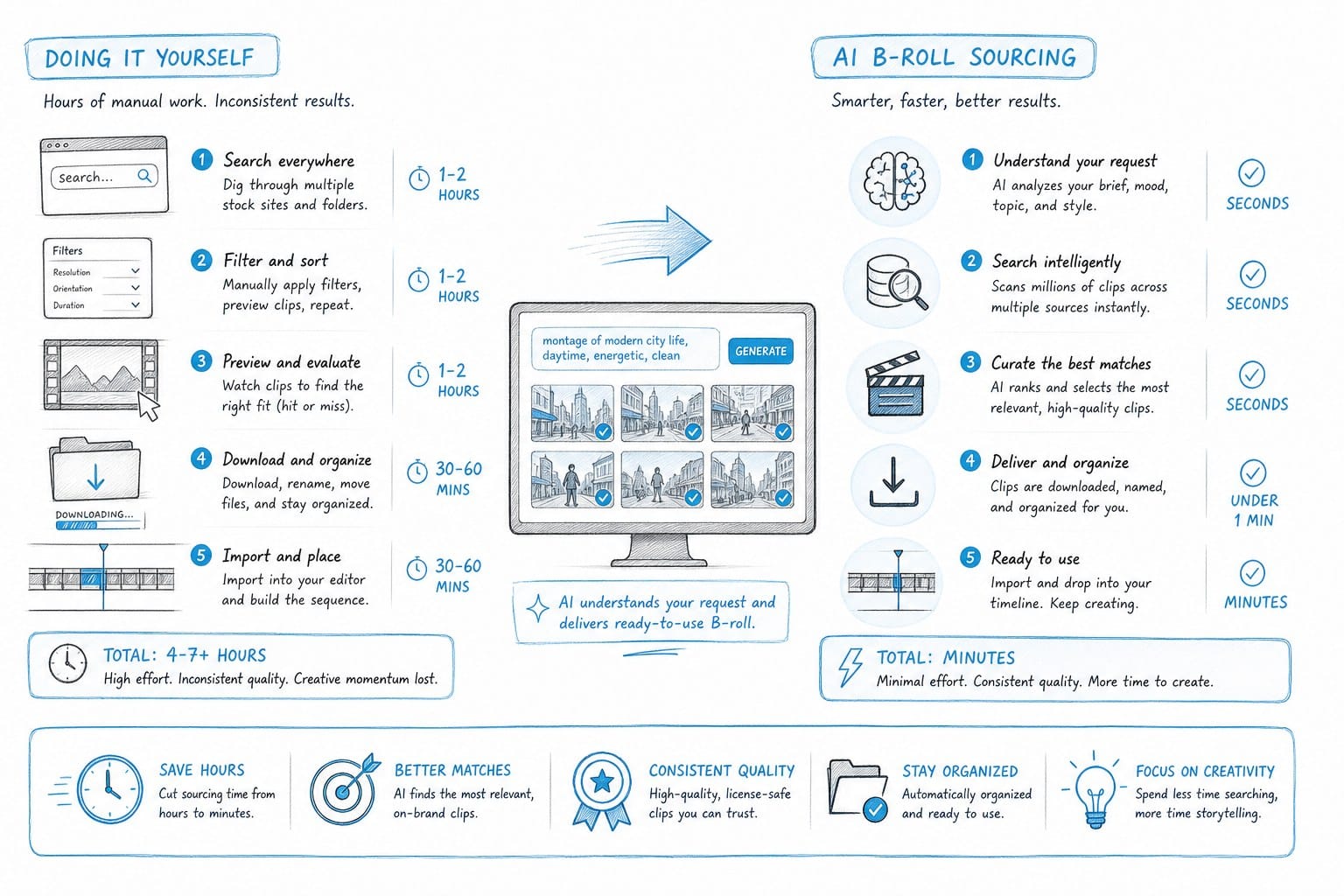
Start with what the traditional workflow looks like. You finish a script. You open a stock footage site, type a keyword, scroll through dozens of clips that are close but not quite right, and eventually grab something that works well enough. You repeat that process for every sentence in a five-minute video. For a twenty-minute documentary-style video, that process can easily eat up a full day — sometimes more if the topic is specific and the generic options are thin.
AI B-roll sourcing for YouTube takes a completely different approach. Instead of asking you to search, the system reads your script and decides which footage fits each line. It analyzes the meaning of the words, not just the surface-level keywords. So when your script says "the city's population doubled in under a decade," a smart AI system does not just pull a generic cityscape. It looks for footage that conveys growth, density, or urban expansion — clips that make the point visually instead of just sitting next to the narration.
Here is the core difference between old and new. Keyword-based search is shallow. You type "city" and you get any clip someone tagged with that word, including slow pans of empty plazas and aerial shots of small towns. Semantic matching goes deeper. The system understands that "a crumbling economy" calls for very different visuals than "a booming economy," even though both sentences are about economics. That contextual layer is what separates a video that feels professionally edited from one that feels assembled from leftover clips.
For faceless YouTube channels, this distinction matters more than it does for creator-led content. When there is no on-camera presenter to carry the viewer through the material, the B-roll has to do the heavy lifting. Every clip has to reinforce what the narrator is saying. A mismatched shot — construction footage over a script line about financial markets, or a crowded beach over a line about solitude — breaks immersion immediately. Viewers notice even when they cannot name exactly what is wrong, and they click away. Strong, well-matched footage keeps them watching through longer videos.
There is also the licensing question, and it is a real one for anyone running a monetized channel. Manually sourcing B-roll means tracking down usage rights for every clip you download. Stock sites vary widely on terms. Some prohibit use in monetized videos. Some require on-screen attribution. Some offer tiered licensing where the commercial option costs significantly more. If you are running a high-volume channel and pulling footage from multiple sources in a given week, keeping track of all those terms becomes its own unpaid job. AI platforms that integrate licensed footage libraries into the sourcing step handle this automatically. The clips they surface are already cleared for the type of use you need, so you are not reading the fine print on twelve different sites before you can finish an edit.
Speed is the other obvious benefit, and the gap is larger than most people expect. A human editor who is experienced at sourcing B-roll might work through a twenty-minute script in four to six hours if they know the stock sites well and have good search instincts. An AI system that reads the script and matches footage can cover the same ground in minutes. For creators running multiple channels or publishing more than one video per week, that time difference is the difference between a sustainable operation and a burnout situation.
A concern that comes up often: AI-sourced footage will look generic. That concern is reasonable if you are imagining a system that pulls the top result for a basic keyword and calls it done. The better systems work differently. They match tone, pacing, and emotional register alongside subject matter. A script section about loss or hardship will pull darker, quieter footage. A section about discovery or momentum will pull something brighter and more kinetic. That kind of tonal alignment is what experienced human editors do instinctively after years of practice. The best AI tools are getting close to replicating it at scale, which is why the output from a well-configured automated pipeline can be hard to distinguish from a manually edited video.
One thing worth understanding: the quality of AI-sourced B-roll depends partly on how the script is written. Vague sentences produce vague matches because the system does not have enough to work with. A line like "things changed rapidly" gives very little visual direction. A line like "within five years, empty storefronts were replaced by restaurants, co-working spaces, and boutique hotels" gives the system specific, concrete imagery to match against. The more visually specific your writing, the better the automated sourcing performs. This is a habit that takes a little time to develop, but it pays off immediately in output quality.
How the matching process works inside a modern AI video platform
Understanding the mechanics helps you make better decisions about which tools to use and how to write scripts that get the best results out of them.
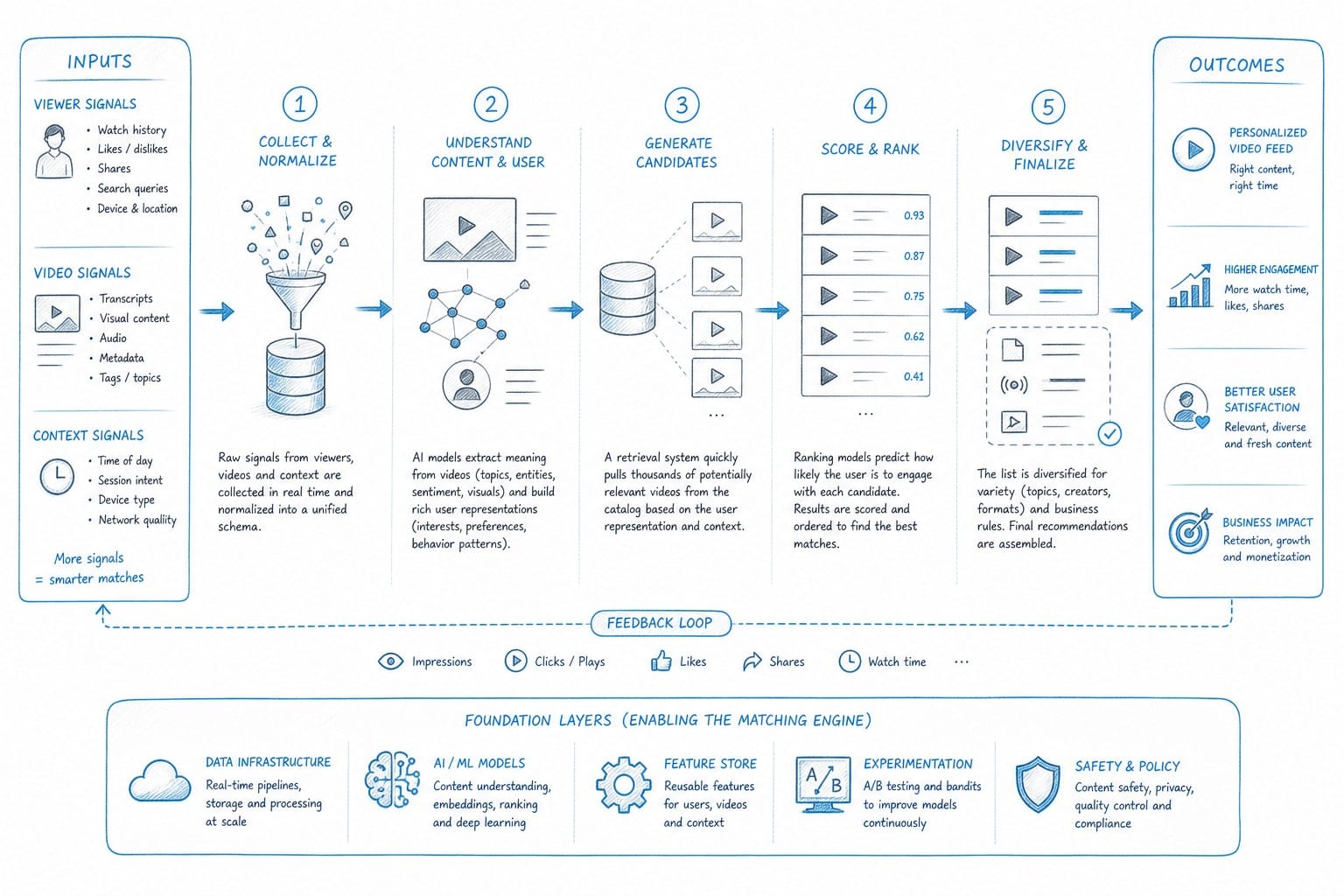
Most AI video platforms that offer B-roll sourcing use some version of natural language processing to read the script. The system breaks the script into segments — usually sentence by sentence or clause by clause — and generates a semantic representation of each one. That representation captures meaning rather than just cataloging words. Then the system compares each segment against a database of tagged footage and surfaces clips whose content aligns with the semantic meaning of that line.
The footage database is critical to how well this works. A platform with a small or poorly organized library will struggle to find strong matches no matter how sophisticated its language processing is. The best platforms have licensing agreements with major stock footage providers, giving them access to millions of clips across a huge range of subjects, locations, and visual styles. When the library is large and well-tagged, the matching gets noticeably better because the system has more options to work with for any given segment.
Some platforms go further and factor in clip duration and pacing alongside subject matter. If a sentence is short and punchy, a fast-cut clip fits better than a slow pan that the narration will have already moved past. If a paragraph is long and explanatory, a slower or more static shot gives the viewer time to absorb what they are hearing without visual distraction. Matching clip rhythm to script pacing is a detail that early AI tools often missed, but it makes a substantial difference in how finished videos feel. A video where every clip change feels timed well holds attention much more effectively than one where the editing feels random even if the subject matter is correctly matched.
For documentary-style content specifically, there is another layer that matters: factual and contextual alignment. If your script covers the construction of a specific bridge in a specific city during a specific decade, generic construction footage from a different continent in a different era is technically a match for the keyword but wrong for the content. The most advanced systems factor in geographic specificity, time period, and subject detail when selecting clips. That precision matters for video essays and explainer content where accuracy is part of the value proposition. An audience watching a history video about 1970s New York will notice if the footage shows a different city or a different era, and that kind of mismatch damages credibility.
Kliptory handles this by integrating B-roll sourcing directly into its production pipeline rather than treating it as a separate step the creator manages after the fact. When you input a script, the platform processes the content and sources footage as part of building the video. The visuals and narration are aligned from the start, which means you are not spending post-production time manually syncing clips to the audio track or fixing mismatches between what is being said and what is on screen. That tight integration is what makes it practical to produce long-form documentary-style videos — in the five-to-forty-minute range — without a post-production team making constant manual corrections.
For creators running faceless channels focused on video essays, listicles, or explainer content, that level of integration changes what is possible at a given production pace. You can read more about what end-to-end automation looks like in practice in this piece on how to automate YouTube video production end-to-end with AI, which walks through the full pipeline from script to finished video and explains where automation handles the work and where human review still adds value.
The practical implication for scripting is worth repeating with more specificity. Compare these two versions of the same idea:
Weak version: "The situation got worse over time."
Stronger version: "Unemployment climbed, tent cities appeared under highway overpasses, and food bank lines stretched around the block."
The second version gives an AI sourcing system three distinct visual cues — labor statistics context, visible homelessness, and food insecurity imagery — that it can match against footage with genuine specificity. The first version produces a shrug. Concrete, visual writing is not just better for your audience; it is better for automated production.
Another thing worth knowing: most serious platforms include a review step before the video is finalized. The AI handles the initial sourcing pass — correctly matching eighty to ninety percent of segments on a well-written script — and the review step lets you swap out anything that missed the mark. For fact-sensitive content or any situation where a specific visual matters for accuracy or tone, that review pass is important. But even including that manual review step, the time savings compared to fully manual sourcing are significant for anyone producing content at volume.
B-roll sourcing also does not exist in isolation from the rest of production. It works alongside scripting, voiceover, captions, and editing. When all of those elements are handled by the same platform, they stay synchronized automatically. The voiceover timing aligns with clip duration. The captions match what is on screen. The pacing stays consistent across the full length of the video. When these steps are handled across different tools — one for scripting, another for voiceover, a third for editing — keeping everything aligned requires constant manual adjustment that adds up to hours of extra work per video. Integrated platforms eliminate most of that overhead, which is part of why the per-video production time drops so substantially.
Choosing the right platform for automated B-roll sourcing on YouTube
Not every AI video tool handles B-roll sourcing the same way. Some treat it as a surface feature: a handful of stock clips pulled by keyword, placed on a timeline, done. Others build it into a deeper production system that considers context, tone, pacing, and licensing from the start. Knowing the difference will save you significant frustration, especially if you are trying to produce long-form content at scale.
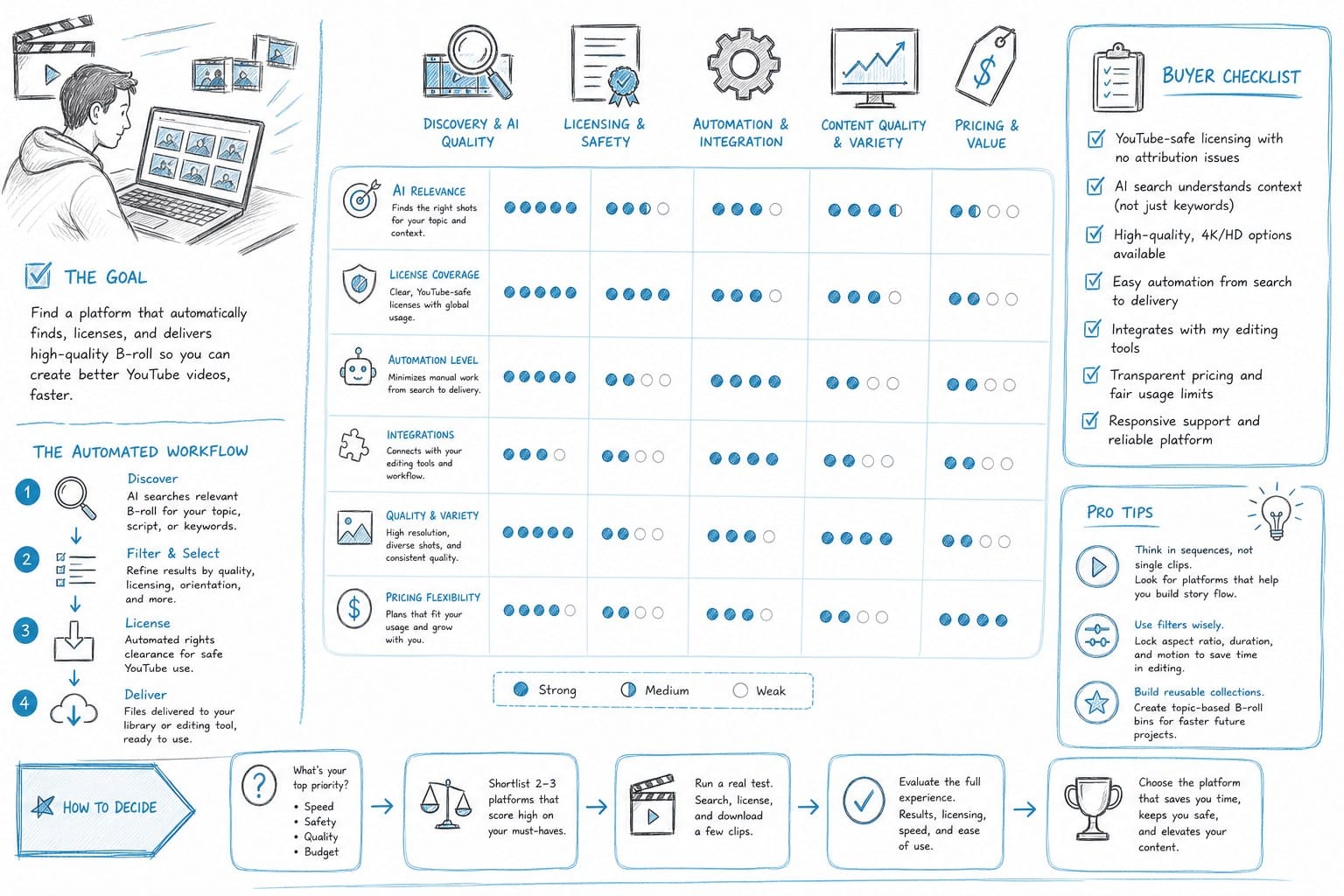
The first thing to look at is footage library size and licensing clarity. A platform that sources from a large, well-licensed library gives you more options and fewer headaches around copyright. For YouTube creators who want to monetize their channels, footage cleared for commercial use is not optional — it is the baseline. When evaluating a platform, ask specifically whether clips sourced through the tool can be used in monetized YouTube videos. The answer should be a clear yes with no conditions buried in the fine print.
Second, look at how the platform actually matches footage to the script. Keyword-based matching is the basic version and it shows in the output. Semantic or context-aware matching is meaningfully better. If a platform lets you test before committing, run a real script through it — not a generic sample — and see whether the footage choices make sense in context. A good system will occasionally surprise you with how well it understands what a sentence is reaching for visually. A weak system will give you the same five clips for every line about cities or money or people talking.
Third, consider how well the platform handles long-form content. A large portion of AI video tools are designed for short clips — sixty seconds to three minutes, optimized for social media formats. If you are making ten- or twenty-minute documentary-style videos, those tools will show their limits quickly. They may hit clip count ceilings, produce inconsistent pacing as the video gets longer, or require so much manual correction that the automation stops saving time. Look for platforms that are explicitly built for long-form content and have demonstrated results at that length.
Fourth, think about what else the platform handles. B-roll sourcing is one piece of video production. If the same platform also manages scripting, voiceover, captions, and editing, your workflow gets dramatically simpler. You are not stitching together five different tools and spending time making sure everything stays in sync across all of them. You are working inside one system that manages the full pipeline and keeps all the pieces aligned automatically. For solo creators or small teams trying to publish consistently, that consolidation has real operational value.
Kliptory is built specifically for this use case. It handles the entire production process for faceless YouTube channels — B-roll sourcing, voiceover, scripting support, captions, and editing — within a single platform. The explicit focus on documentary-style long-form content means it is designed to handle the complexity that comes with a forty-minute video essay, not just a short clip optimized for a vertical feed. Creators producing video essays, listicles, or explainer content at volume find that specialization useful because the tool understands the format they are working in and makes decisions accordingly.
If you are comparing platforms and want a concrete look at how tools differ for listicle-format content specifically, the piece on the best AI tool for making YouTube listicle videos faster covers what to actually evaluate around production speed, output quality, and format support rather than just comparing marketing claims.
Fifth, think about your editing preferences and how much control you want to retain. Some creators want full automation: the platform makes all sourcing and editing decisions and delivers a finished file. Others want to review footage choices and swap out specific clips before export. Both workflows are valid depending on your content type and quality standards. A platform that locks you into one approach — full auto with no review, or so much required manual work that the automation is cosmetic — is less useful than one that matches how you actually work.
The cost efficiency angle is worth examining directly. Hiring a freelance video editor in most markets costs between twenty-five and one hundred dollars per hour for quality work. A twenty-minute video with manual B-roll sourcing, clip syncing, and editing might take five to eight hours of editor time. At the low end of that rate, you are spending one hundred twenty-five dollars per video before you account for the time you spend communicating direction and reviewing drafts. Publish three videos per week and that becomes a significant recurring cost. AI platforms that handle sourcing and editing automatically bring that per-video cost down considerably, which makes them worth serious evaluation for anyone treating YouTube as a real business rather than a casual hobby.
For creators who have already done research on AI video tools, you have probably come across platforms that market themselves as comprehensive solutions but struggle when content gets longer and more complex. The comparison in Pictory AI vs InVideo: which tool wins for long-form YouTube videos is a useful reference for understanding exactly where tools diverge when the runtime increases and the subject matter requires more precise visual matching.
A few practical things to check when you are testing any platform:
Run your actual content, not a demo script. Use a topic, tone, and length that represents what you actually publish. A platform that performs well on a two-minute lifestyle clip may fall apart on a fifteen-minute historical explainer. You will not know until you test with real material.
Look at the worst clips in the output, not the best ones. Every platform will surface some strong matches. The question is how it handles the hard lines — the abstract concepts, the emotionally specific moments, the geographically or historically precise references. The quality floor tells you more than the ceiling.
Time the full workflow, including any review and correction steps. The goal is total time per finished video, not just how fast the automated pass runs. If the automation is fast but the output requires two hours of manual correction, the net time savings may be smaller than expected.
For faceless YouTube channels where the visual experience carries the entire video, getting B-roll sourcing right is not an optional upgrade. It determines whether a viewer stays through a twenty-minute documentary essay or leaves in the first two minutes because the footage feels random or lazy. AI tools that handle this well give you a real production advantage over channels that are still sourcing manually. The best ones do it in a way that feels considered — where the footage appears chosen rather than assigned — and that quality difference is visible in audience retention data over time.
The creators building durable faceless channels in 2024 and beyond are not spending their days on stock footage sites. They are working at a level of abstraction where the content strategy and scripting are the creative work, and the production pipeline handles the rest. AI B-roll sourcing is a core part of what makes that model viable at scale.
Ready to take the next step?
If you are ready to stop spending hours hunting down footage manually and start producing long-form YouTube videos at a pace that actually scales, Kliptory is built for exactly that workflow. Visit kliptory.com to see how automated B-roll sourcing fits into a full end-to-end production pipeline designed for faceless channels and documentary-style content.