TubeBuddy alternative for faceless YouTube creators

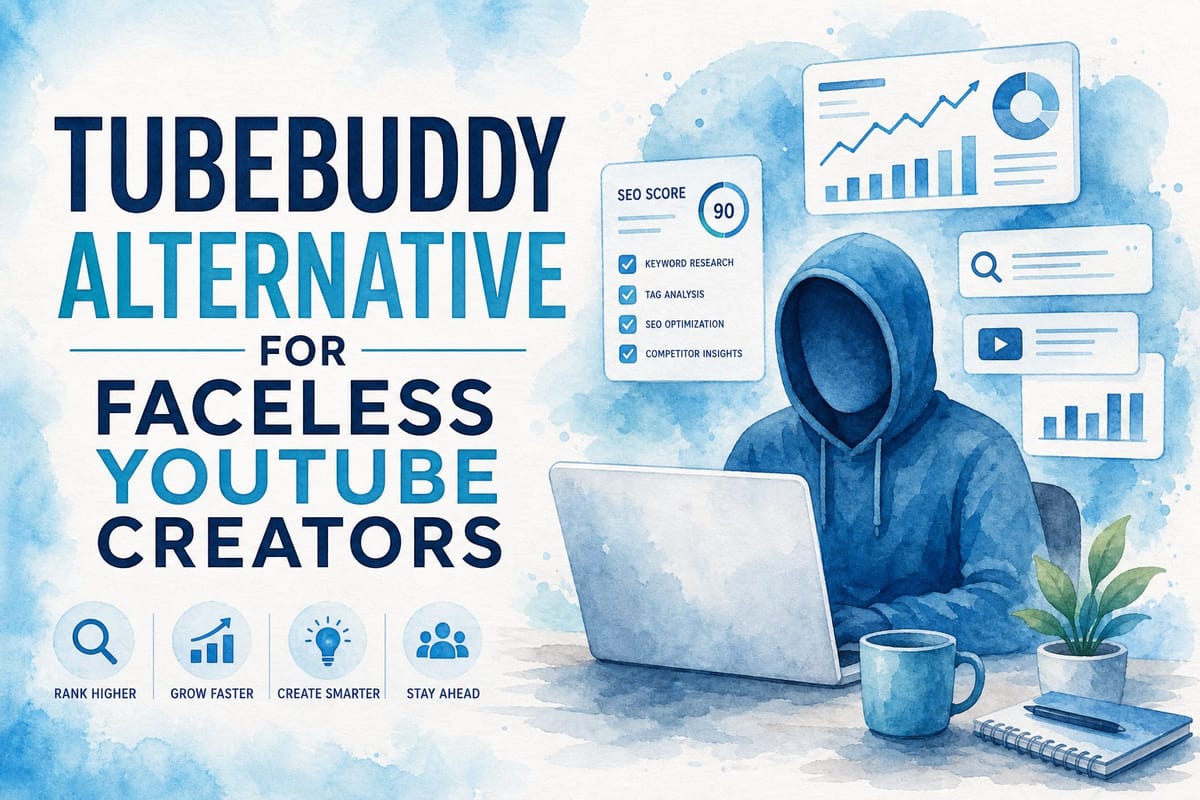
Table of contents
1. What TubeBuddy does well and where it falls short for faceless creators
2. What faceless creators actually need from a production platform
3. How Kliptory fits into the faceless creator workflow
If you run a faceless YouTube channel, you have probably heard of TubeBuddy. It is a browser extension that plugs into YouTube Studio and helps creators with keyword research, tag suggestions, A/B thumbnail testing, and channel analytics. For optimizing videos you have already published, it is a solid tool. But here is the problem: optimization is only one piece of the puzzle. Before you can optimize anything, you need to actually produce the video. And for faceless creators, that production process is where most of the time, money, and frustration gets swallowed up.
This guide walks through why so many faceless YouTube creators are searching for a TubeBuddy alternative, what they are really looking for when they search that phrase, and how a platform like Kliptory addresses the part of the workflow that TubeBuddy was never designed to touch. If you have been stuck in the production grind and keyword data has not moved the needle, this is worth reading.
What TubeBuddy does well and where it falls short for faceless creators
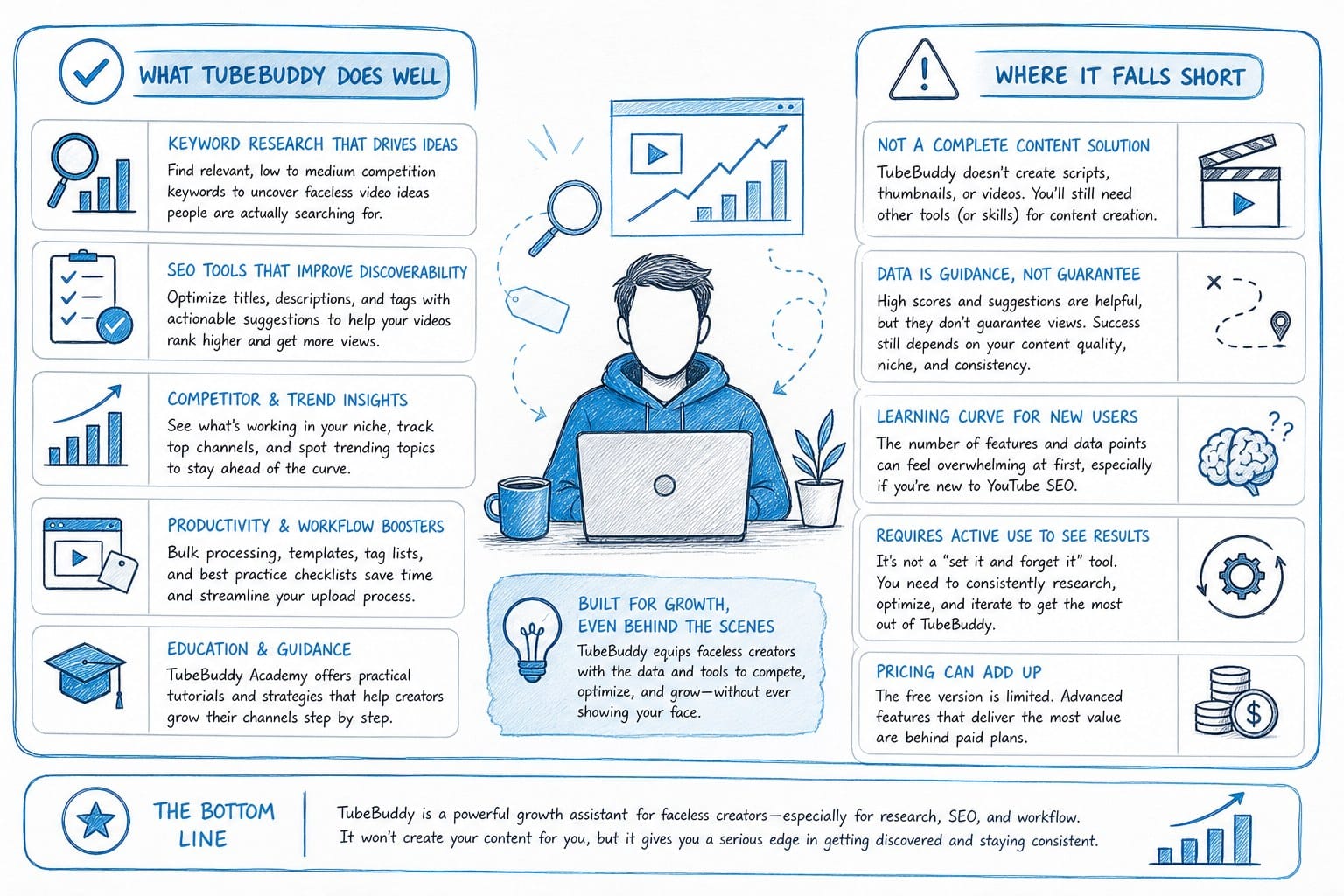
TubeBuddy is genuinely useful for certain things. It plugs directly into YouTube Studio and gives you data-driven suggestions right inside the interface you already use. You can see how competitive a keyword is before you commit to a topic. You can compare your video's tags against a top-ranking competitor and see what they are doing differently. You can run split tests on thumbnails to find out which one drives more clicks. You can track your channel's ranking over time for specific search terms and watch those rankings shift as you publish more content.
For a creator who already has a library of videos and wants to squeeze more organic traffic out of each one, those features matter. Knowing that a keyword has high search volume but low competition is genuinely useful information when you are deciding between two similar topics. Thumbnail A/B testing is one of the most direct levers a YouTube creator has for improving click-through rate, and TubeBuddy makes that test easy to set up and read.
But here is the structural problem: TubeBuddy is a post-production and post-upload tool. It assumes the video already exists. It does not help you write a script. It does not find you B-roll footage. It does not record or generate a voiceover. It does not add captions, build data visualizations, or help you edit a timeline. Every single one of those steps happens before TubeBuddy even enters the picture.
For a talking-head creator who films themselves on camera, that gap might not feel painful. They sit down, hit record, do a quick edit in their preferred software, and upload. TubeBuddy then helps them get found. The production side is already handled by the fact that they are the product.
For a faceless creator, the gap is enormous. Faceless channels depend entirely on production quality because there is no personality on screen to hold attention. A viewer watching a history channel, a geography explainer, or a finance documentary is not there because they like watching a specific person talk. They are there because the content itself is compelling, well-structured, visually interesting, and worth their time. If the script is loose, the voiceover sounds robotic, the B-roll is generic, or the pacing drags, viewers leave. And when viewers leave early, the algorithm stops recommending the video.
This means a faceless channel needs a tight script, professional voiceover, well-sourced and relevant B-roll, smooth transitions, lower thirds where appropriate, clean data visualizations when the topic calls for it, and accurate captions. Every single one of those elements has to be created, sourced, licensed, or assembled before the video is ready to upload. None of that is something TubeBuddy touches.
When faceless creators search for a TubeBuddy alternative, many of them are not actually looking for a different keyword tool. They are not sitting there wishing TubeBuddy had slightly better tag suggestions or a cleaner dashboard. They are looking for something that solves the production bottleneck, not the discoverability bottleneck. That is a fundamentally different problem, and it requires a fundamentally different kind of tool.
TubeBuddy's pricing tiers, its integration with YouTube Studio, and its bulk processing features are well-suited for channels that are already publishing consistently and want to compound their results. But if you are a solo creator or a small team struggling to publish even one video per week because production takes so long, no amount of keyword optimization will grow your channel. You cannot optimize a video you have not made yet. You cannot A/B test a thumbnail for content that does not exist.
This is the real gap that brings so many faceless creators to look beyond TubeBuddy. They want a tool that meets them earlier in the workflow, at the point where a topic idea needs to become a finished, publish-ready video. TubeBuddy was not built for that, and it does not claim to be. The problem is that creators searching for a better version of TubeBuddy often end up in a completely different product category once they realize what they actually need.
Some creators patch this together with a stack of separate tools: one for scripting, one for AI voiceover, one for sourcing stock footage, one for editing, one for captions. That approach can work, but it is slow, expensive, and requires managing multiple subscriptions and file transfers between platforms. Others hire freelancers for each step, which adds coordination time and budget requirements that do not scale well for a channel that is still building its audience and ad revenue.
The real alternative to TubeBuddy, for a faceless creator, is a production platform that automates the steps TubeBuddy skips entirely. That is what the next section covers in detail.
What faceless creators actually need from a production platform
Faceless YouTube channels span a wide range of niches. History, geography, finance, science, true crime, travel, technology, current events, nature, and space are all formats where creators have built large audiences without ever appearing on camera. The production challenges across these niches are remarkably consistent, even when the subject matter is completely different.
Scripting is where most creators feel the pain first. Writing a 2,000-word script for a 15-minute video essay is not a quick task. It requires research across multiple sources, a clear structural outline, pacing that keeps a viewer engaged without rushing them, and a voice that fits the channel's tone. A history channel needs a different register than a personal finance explainer. A true crime video needs careful sourcing and a different narrative rhythm than a geography comparison piece.
Some creators outsource scripting to freelance writers. That adds cost, typically anywhere from fifty to several hundred dollars per script depending on the writer and the length, plus the time it takes to brief the writer, review drafts, request revisions, and integrate the final script into the production process. Other creators write every script themselves, which can take a full day or more per video even for an experienced writer. At that pace, publishing two videos per week means writing is a full-time job before you even start on production.
Voiceover is the second recurring headache. Hiring a voice actor through a freelance marketplace costs money and takes time to brief, record, and revise. If the first take does not match the tone you wanted, you go back and forth with the voice actor until it does. Doing voiceover yourself requires a decent microphone, a quiet recording space with low background noise, and the skill to edit out mistakes, normalize levels, and match pacing to the script. AI voiceover tools have improved dramatically, but many still produce output that sounds flat or overly neutral, which does not hold up well for documentary-style content where the narration needs to feel authoritative.
B-roll sourcing is time-consuming and legally murky in ways that catch a lot of new creators off guard. Finding footage that actually matches what the script describes, making sure it is licensed for commercial use and not just free for personal projects, downloading it, organizing it by timestamp or segment, and syncing it to the voiceover is easily a half-day job on its own for a 15-minute video. Stock video platforms have large libraries, but finding the right clip for a specific historical event or geographic location often means sorting through dozens of irrelevant results. And using footage with the wrong license can result in a copyright strike that damages the channel.
Data visualization is a specialized skill that most content creators were not trained in. If your video talks about how global temperatures have changed over 50 years, which countries hold the most foreign currency reserves, how population growth differs between regions, or how a historical empire expanded over time, you need charts, maps, and timeline graphics that look clean and professional. Building those from scratch in a video editor requires design knowledge, access to the right data, and time that most solo creators do not have. Dropping a screenshot of a Wikipedia chart into a video looks cheap and erodes the credibility of the content.
Captions and accessibility add another layer of work that many creators underestimate. Auto-generated captions from YouTube are often inaccurate, especially for proper nouns, historical names, geographic terms, or technical vocabulary. A video about the Merovingian dynasty or the mechanics of quantitative easing will have auto-captions full of errors. Cleaning them up manually adds more time to an already long process. Skipping them entirely means leaving out a significant share of viewers who watch with sound off or rely on captions for comprehension.
When you add all of that up honestly, producing a single 20-minute faceless YouTube video can easily take 20 to 40 hours for a solo creator who is handling every step themselves. Scripting might take eight hours. Voiceover recording and editing might take four. B-roll sourcing and sync might take six. Timeline editing and transitions might take eight. Captions and final review might take another two to four. That is before you factor in any graphics, custom thumbnails, or video descriptions.
At that pace, publishing consistently enough to grow a channel is nearly impossible without a team. YouTube's algorithm rewards consistency. A channel that publishes twice a week grows faster than one that publishes twice a month, even if the twice-a-month videos are slightly higher quality. The compounding effect of consistent publishing, where each new video builds watch time, drives subscribers, and gives the algorithm more data to work with, is one of the most documented patterns in channel growth. But you cannot be consistent if each video takes you an entire week to produce on top of everything else in your life.
This is why tools built specifically for faceless YouTube production are growing in popularity. They are not trying to replace TubeBuddy's keyword features. They are trying to collapse a 40-hour workflow into something a single person can manage in a few hours without sacrificing the production quality that makes faceless content worth watching.
For creators who produce listicles, video essays, documentary-style content, or explainer videos, the ability to go from a topic idea to a finished, publish-ready video quickly is what actually unlocks channel growth. You can always add a keyword tool on top of a healthy publishing schedule. You cannot optimize your way to growth if you are barely publishing.
The scripting burden alone is significant enough that it deserves its own attention. A good starting point is understanding how much of the structural work of writing scripts for longer videos can actually be automated without losing quality. A free YouTube script generator for long-form video content gives a clear picture of what that automation looks like in practice and how it handles the pacing and structure that makes long-form documentary content work. Reading through that gives a useful baseline for what to expect from AI-assisted scripting before you commit to any platform.
The bottom line for faceless creators is this: the production bottleneck is the primary growth constraint for most channels in this format, especially in the first two years. Solving that bottleneck does not mean lowering quality standards. It means finding a workflow that gets high-quality videos produced fast enough that you can actually publish on a schedule that gives the algorithm something to work with. That is what the next section is about.
How Kliptory fits into the faceless creator workflow
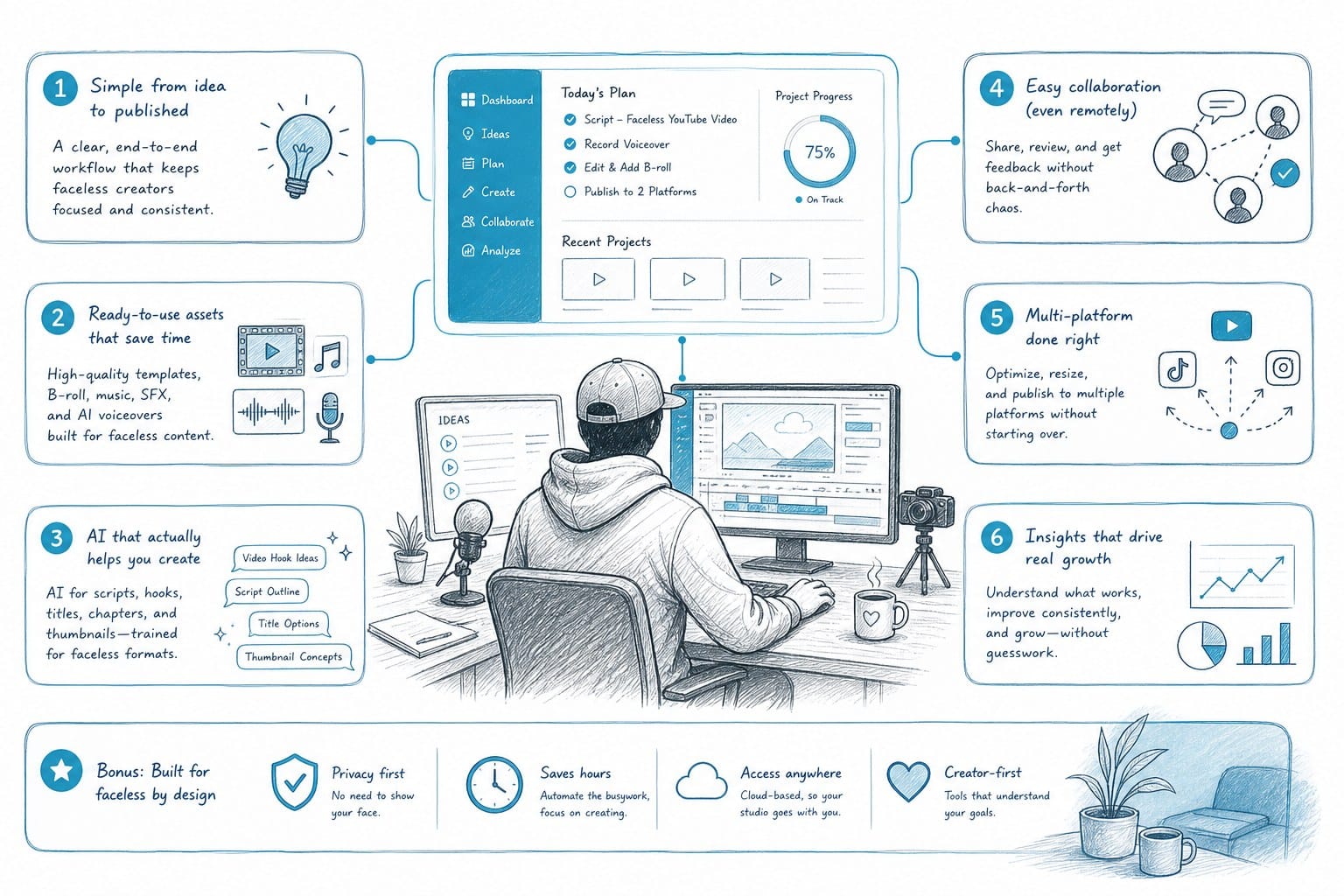
Kliptory is built specifically for faceless YouTube channels. It is not a keyword tool. It is not a browser extension. It is a full production platform that automates the steps that happen before you ever log into YouTube Studio, the steps that TubeBuddy assumes have already been completed.
Here is what that looks like in practice for a real content type.
Say you want to make a 25-minute documentary about the economic history of the Silk Road. Or a 10-minute listicle about the most geologically active volcanoes currently being monitored. Or a 15-minute explainer about how central banks use interest rates to manage inflation across different economic cycles. These are the kinds of videos that perform well on faceless channels because they serve viewers who want to learn something specific and are willing to watch for a long time if the content is good. But they are also the kinds of videos that take enormous time to produce manually because they require research, structure, data, and visual material that supports the narration.
Kliptory handles the scripting step automatically. It generates a full long-form script based on your topic, written in the structured, informational style that works for documentary and essay content. The scripts are built for the 5-to-40-minute range, which is where faceless channels tend to get the strongest average watch time and the highest ad revenue per view. A 20-minute video that holds viewer attention earns more than a 5-minute video with the same number of views, both because of higher ad impressions and because watch time is one of the signals YouTube uses to decide how aggressively to recommend a video.
From the script, Kliptory generates voiceover. This is not the flat, robotic output you might associate with early text-to-speech tools that read words in a monotone without any sense of sentence rhythm or emphasis. The voiceover is designed to match the tone of documentary and educational content, where the narration needs to feel authoritative and clear without being stiff. For creators who have tried other AI voiceover tools and found the output unsuitable for long-form content, the difference in natural pacing matters more than it might seem in a short demo clip. A viewer who is going to spend 20 minutes with your video will notice if the narration sounds robotic by the five-minute mark.
The platform then sources B-roll automatically, matching footage to the content of the script at the segment level. Instead of spending hours searching stock video platforms, previewing clips, downloading files, and then manually placing each one in a timeline, the system pulls relevant footage and places it against the voiceover. You get a rough cut with visual material already in place. The footage is commercially licensed, which removes the legal ambiguity that catches creators off guard when they source clips manually from free libraries without checking usage restrictions carefully.
For data-heavy content, Kliptory builds visualizations. If your video covers population growth over time, trade volumes between countries, a timeline of a historical conflict, or the geographic spread of a natural phenomenon, the platform can generate maps, charts, and timeline graphics that look professionally made. This is a significant advantage for creators in niches like history, economics, geography, and science, where the data visualization is not decoration. It is part of what makes the content credible and engaging. Viewers in these niches have been trained by high-production channels to expect visual support for claims. A video that only narrates statistics without showing them loses audience faster than one that puts the numbers on screen.
Captions are added automatically and synced to the voiceover. This matters for accessibility and also for viewer retention. A meaningful share of YouTube viewers watch with sound off in situations where audio is not practical, and captions allow those viewers to follow along without dropping out. For creators in niches with specialized vocabulary, historical names, or technical terms, having captions that are synced to the actual narration rather than auto-generated approximations also protects the professional appearance of the video.
The result is a finished video that is ready to review, make targeted adjustments to, and upload. For a 20-minute documentary-style video on a complex topic, this process takes hours rather than the weeks it would take to produce the same video manually by writing the script yourself, hiring a voice actor, sourcing footage, editing the timeline, and cleaning up captions separately.
For creators who want to reach audiences in multiple languages, Kliptory also supports multilingual production. This is worth paying attention to because the English-language YouTube audience is large but not the only opportunity. Spanish-speaking viewers, Portuguese-speaking viewers, and audiences in other languages represent substantial and in many cases less saturated markets for the same content formats. A documentary about ocean geography or the history of a major financial crisis translates well across language markets without requiring you to create entirely different content. You can read more about that capability in this piece on an AI video generator with multiple language support for YouTube creators. Reaching a second language market without hiring translators, additional voice actors, or a localization team is a real growth lever that most solo creators overlook because it previously required resources they did not have.
Kliptory is not trying to replace TubeBuddy. If you want to run thumbnail A/B tests, bulk-update tags across your existing video library, or track keyword rankings for videos you have already published, TubeBuddy is still a reasonable tool for that specific work. The two products operate at different points in the workflow and are not in direct competition in any meaningful sense. TubeBuddy works on videos that exist. Kliptory gets you to the point where videos exist fast enough to make TubeBuddy's optimization work worth doing.
For solo creators, digital entrepreneurs, and small teams trying to scale a faceless channel without building out a full post-production operation, the bottleneck is almost always production capacity rather than keyword knowledge. Most faceless creators who are stuck understand YouTube SEO reasonably well. They know about watch time, click-through rate, tags, and thumbnails. What they do not have is enough finished videos published consistently enough for the algorithm to build a pattern around their channel. Solving the production problem is what allows consistent publishing, and consistent publishing is what generates the watch time data and subscriber growth that keyword optimization can then amplify.
If you have been comparing production platforms and want to understand how Kliptory positions against other AI-powered options in this space, this article on a Produce.so alternative for AI-powered YouTube video creation breaks down what distinguishes Kliptory from other tools in the landscape of AI video platforms built specifically for YouTube. The differences in how platforms handle long-form scripting, footage sourcing, and data visualization matter a great deal for the types of content that perform best on faceless channels, and it is worth understanding those differences before committing to a workflow.
The faceless YouTube channel model works. Channels in history, science, finance, geography, nature, and current events regularly generate strong CPMs, loyal audiences, and meaningful ad revenue without a single frame of a human face. The model works because there is a large audience of viewers who want to learn, who are comfortable with narrated documentary formats, and who will watch long-form content if it is well-made and covers something they actually want to understand. That audience is not going anywhere.
But the model only works if you can produce content consistently enough for the algorithm to take the channel seriously. One video a month is not enough to build algorithmic momentum. Two videos a week at solid production quality is where channels start to compound, where each new video lifts the ones before it, where subscribers accumulate fast enough to matter, and where watch time data gives YouTube enough signal to put videos in front of new viewers through recommendations and suggested content.
For a single creator or a two-person team, hitting that publishing pace without an automation layer is close to impossible if you are producing long-form documentary content. The math does not work out. A 40-hour production timeline per video means two videos a week requires 80 hours of production time, which is more than two full-time jobs before you factor in strategy, community management, or anything else. The only way to close that gap without growing a large team is to automate the parts of the production process that do not require your specific judgment and taste.
Kliptory handles the parts that can be automated: the script structure, the voiceover generation, the B-roll sourcing and sync, the data visualizations, and the captions. What it leaves to you is the part that actually requires a creator: choosing topics that fit your audience, reviewing the output and adjusting what needs adjusting, making decisions about framing and emphasis, and building the strategic direction of the channel over time. That division of labor is what makes the publishing pace achievable without burning out or building a staff.
This is why the search for a TubeBuddy alternative among faceless creators so often leads to a completely different product category. They come in looking for better keyword data and leave with a production platform because they realize mid-search that keyword data was never their actual constraint. Getting videos made consistently at a pace that the algorithm can work with is the foundation. Everything else, including discoverability tools, thumbnail testing, and tag optimization, is built on top of that foundation. You cannot skip to the optimization layer if the production layer is still a bottleneck.
Ready to take the next step?
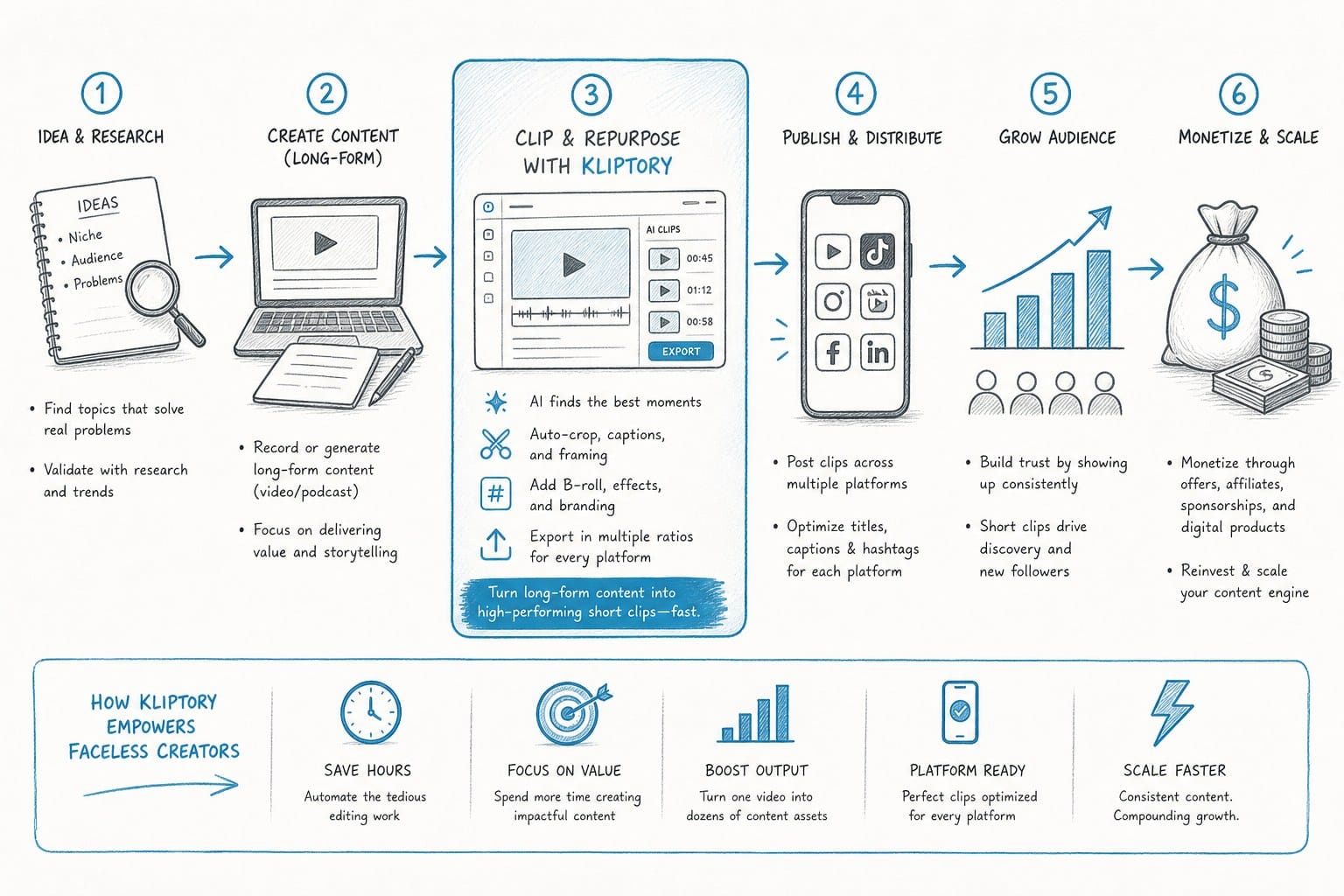
Ready to see how fast you can take a topic from idea to a finished documentary-style video without a production team behind you? Head over to Kliptory.com and start your first project. You pick the topic. Kliptory handles the script, voiceover, B-roll, data visualizations, captions, and editing. Your next video could be done in hours, not weeks.