AI video generator with multiple language support for YouTube creators

Table of contents
1. Why multilingual content is the fastest way to grow a faceless YouTube channel
2. What a real multilingual AI video production workflow looks like
3. Choosing the right AI video platform for global YouTube production
If you run a faceless YouTube channel and want to reach viewers beyond your home country, language is the biggest wall standing between you and that growth. Most creators know they should be publishing in Spanish, Portuguese, Hindi, or French, but they do not have the budget to hire translators, voice actors, and editors for every market. That is exactly where an ai video generator multiple languages workflow changes the game. This article walks through what multilingual AI video generation actually looks like in practice, why it matters specifically for long-form YouTube content, and how to build a global content operation without a full production team. We will cover the audience opportunity hiding in non-English markets, what a real production workflow looks like step by step, and what to look for when choosing a platform that can actually deliver on the multilingual promise.
Why multilingual content is the fastest way to grow a faceless YouTube channel
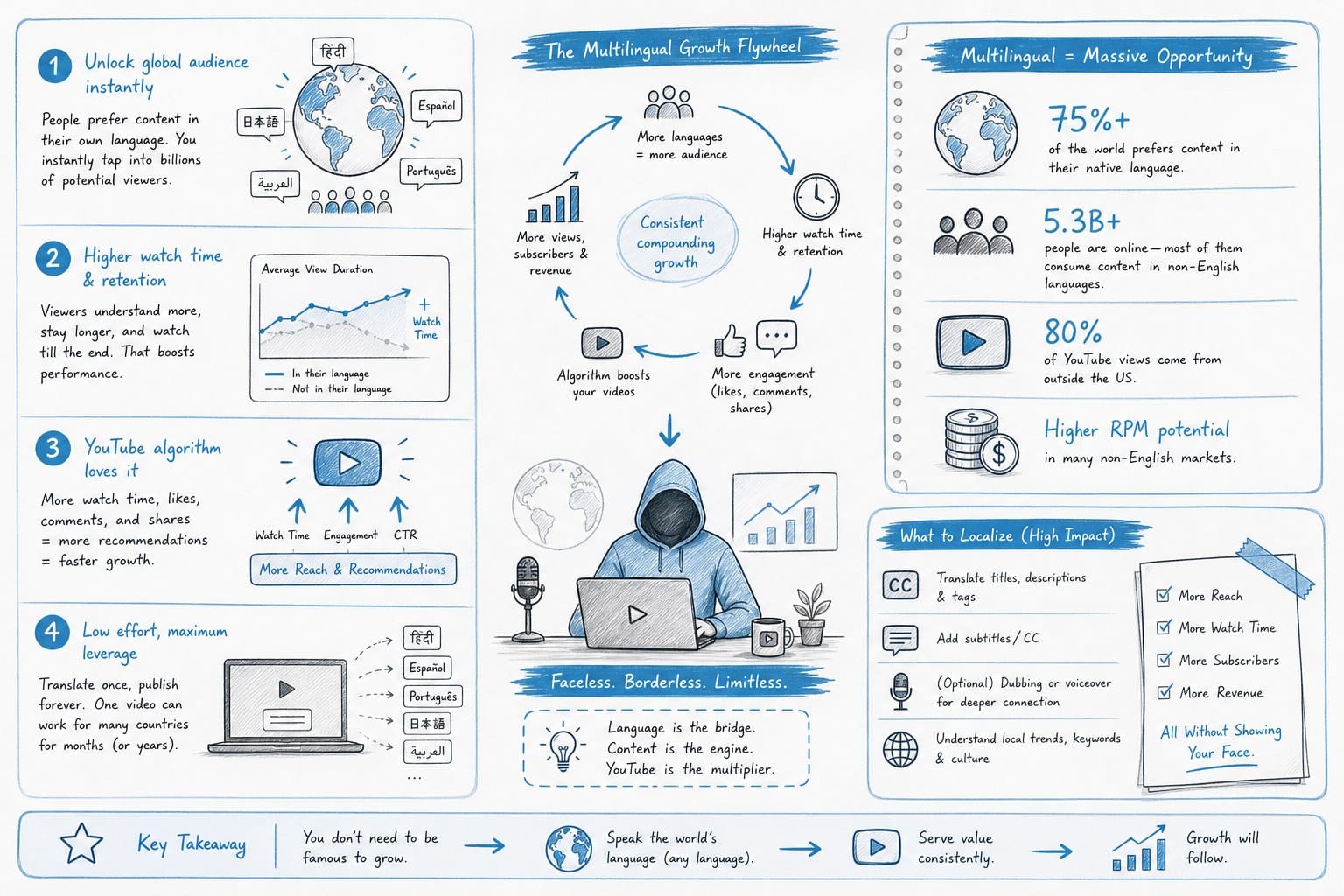
Most YouTube creators focus almost entirely on English-language content. That makes sense when you are just starting out, but it leaves a massive audience on the table. According to YouTube's own public statements, more than half of YouTube watch time comes from outside the United States. Brazil alone has over 100 million YouTube users. India, Indonesia, Mexico, Germany, and Japan each represent enormous viewer pools that are actively hungry for well-produced educational and documentary-style content. Spanish is the second most spoken language in the world by total speakers, and Portuguese-speaking Brazil is one of the fastest-growing YouTube markets on the planet. Yet the volume of high-quality long-form content in those languages still lags far behind what English creators produce every day.
The problem with going multilingual the traditional way is that it costs serious time and money. To properly translate and re-voice a single 20-minute video, you need a translator who understands the subject matter well enough to preserve tone and nuance, a voice actor who sounds natural and engaging in the target language, a video editor to sync the new audio with your existing cuts, and someone to redo the captions from scratch. For a solo creator or a small team, that pipeline can run several hundred dollars per video per language and take days or even weeks to complete. Multiply that by four or five languages and the math stops working almost immediately.
For faceless channels specifically, the economics of going multilingual are actually better than most creators realize. Because you are not on camera, there is no visual mismatch when you swap out the audio track. The B-roll footage, maps, charts, and text overlays can often stay exactly the same or require only minor adjustments. The voice is the primary element that changes, and AI voiceover technology has now reached a point where it produces natural-sounding narration in dozens of languages at a fraction of the old cost. A faceless documentary channel is, by its nature, already structured around audio-visual storytelling where the narrator is invisible. That structure translates almost perfectly into multilingual production.
Think about a channel that publishes history documentaries, geography explainers, or science breakdowns. Those topics are genuinely global. A video about the history of the Roman Empire is just as interesting to a viewer in São Paulo as it is to a viewer in Manchester. A deep dive on climate science resonates in Jakarta as much as it does in Toronto. The core content does not change. Only the language of delivery does. When you use an ai video generator multiple languages system, you can turn one well-researched script into five or six fully produced videos targeting completely different audiences, all from the same creative effort and the same production session.
The YouTube SEO benefit compounds over time in a way that most creators do not fully appreciate when they first think about multilingual content. When you publish the same core content in different languages, you are not just reaching new viewers passively. You are entering entirely separate search landscapes. A Spanish-language video essay about the Amazon rainforest competes against a completely different set of channels than its English counterpart. Search competition in many non-English language markets is significantly lower, which means your videos have a better statistical chance of ranking in search results and getting surfaced through YouTube's recommendation algorithm. A video that would struggle to rank on page one in English might easily land in the top three results for the equivalent Spanish-language query.
This creates a real compounding advantage for creators who move early. The channels building multilingual libraries right now are accumulating watch time, subscribers, and algorithmic trust in markets where the competition is still relatively thin. In two or three years, those markets will likely be as competitive as English. The window to establish early authority is open now, and AI production tools are what make it actually feasible for a solo creator or small team to move through that window.
I have seen creators running lean operations go from one active channel to three or four in under a year by using AI tools to localize their best-performing content. The key is having a production workflow that does not require rebuilding every video from scratch each time you switch languages. That distinction separates a scalable multilingual strategy from a one-off translation project. A one-off project is something you do once and hope it works. A scalable strategy is something you run every week because the process is fast enough and affordable enough to sustain.
For digital entrepreneurs treating YouTube as a monetization vehicle, the revenue picture becomes more compelling when you factor in multiple AdSense accounts, channel memberships, and affiliate deals targeted at specific regional markets. A channel serving Portuguese-speaking audiences in Brazil can run entirely different brand partnerships than your English channel, targeting products and services relevant to that market specifically. A channel serving Spanish-speaking audiences in Latin America opens doors to regional advertisers who cannot access your English audience at all. The same core content library effectively generates parallel revenue streams in separate markets, which changes the return on investment calculation for every video you produce.
AdSense CPM rates vary significantly by region, and English markets do tend to pay higher rates per thousand views. But the volume potential in large non-English markets can more than compensate for that difference, especially in categories like finance, education, and technology where advertisers in those regions compete aggressively for viewer attention. A faceless channel with 500,000 subscribers in Brazil and 500,000 subscribers in the United States is not generating the same AdSense revenue from both, but the Brazilian channel may have been far cheaper and faster to build because competition for that audience was lower when you entered the market.
The practical starting point for most creators is not to launch in five languages simultaneously. That is overwhelming and leads to half-finished projects. Pick one additional language market where your topic category has real search demand and where competition is measurably lower than it is in English. For most history, geography, science, and explainer channels, Brazilian Portuguese or Spanish for Latin America are excellent first choices. The audience sizes are enormous, the hunger for quality long-form content is real, and you can validate whether your topic translates well into those markets before investing in additional languages. Get your workflow dialed in for one additional language, watch how the content performs, learn what that audience responds to, and then expand from there with confidence rather than guesswork.
What a real multilingual AI video production workflow looks like
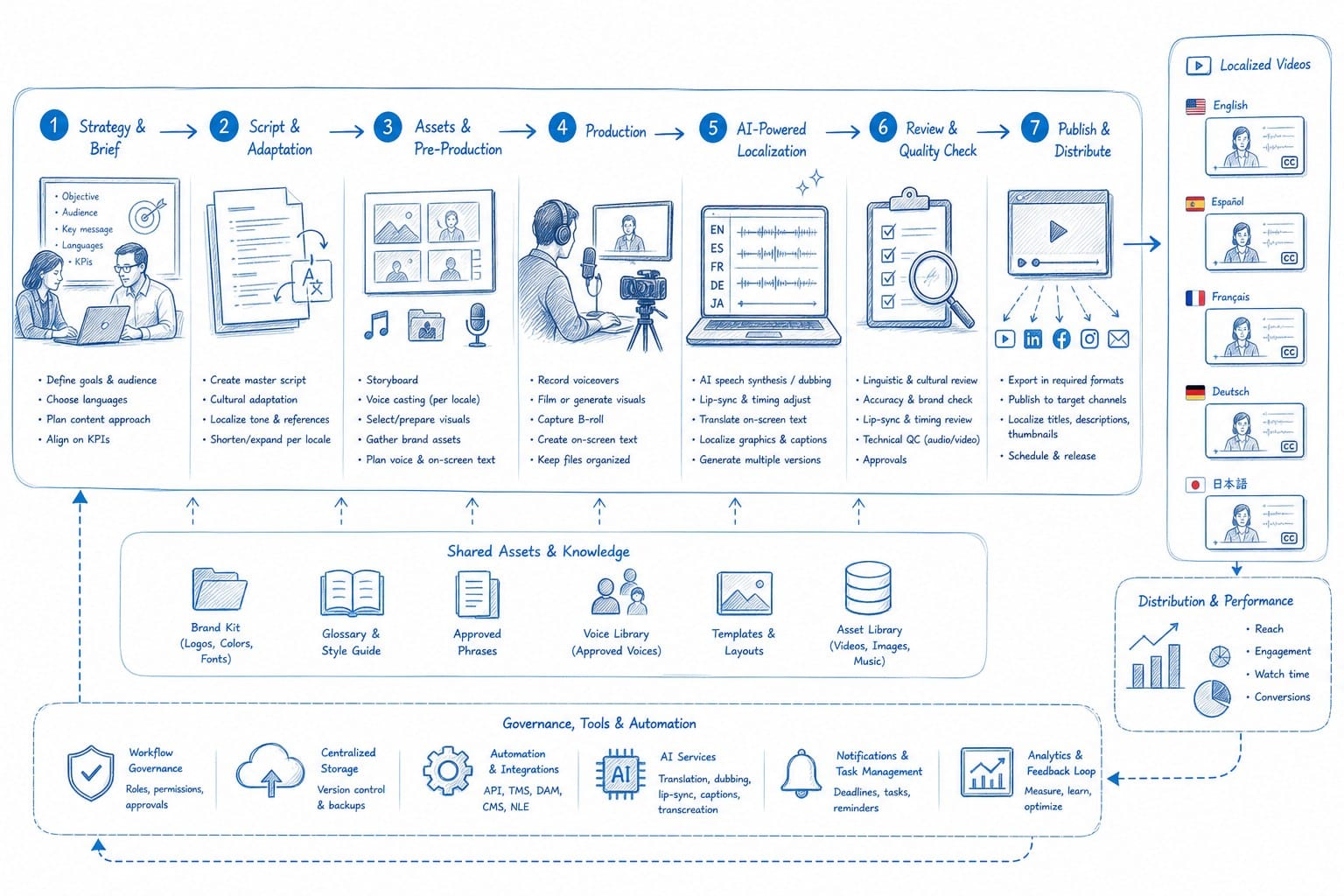
A lot of creators have a fuzzy idea that AI tools can somehow magically produce a finished video in ten languages with one click. The reality is more nuanced than that, but it is still dramatically faster than any traditional production workflow. Understanding exactly what happens at each step helps you plan your time, set realistic expectations, and avoid the mistakes that slow creators down when they first try to scale into multiple languages.
The starting point is always the script. For a documentary-style video, the script is the foundation everything else gets built on. It determines the narrative arc, the pacing of the visuals, the emotional beats of the narration, and the overall running time. AI scripting tools can generate a research-backed, structured script on virtually any topic, but the quality of what comes out depends heavily on the specificity of what goes in. A vague prompt produces a generic script. A detailed prompt that specifies the target audience, the angle you want to take, the length you are aiming for, and the key points you want to cover produces something much closer to a finished draft.
For multilingual production, you have two main approaches to the scripting stage. The first is to write the script in your strongest language, produce the English version first, and then use AI translation to generate versions in your target languages. This is faster upfront and works well for straightforward informational content where the topic is genuinely universal. The second approach is to generate separate scripts tailored to each target market from the beginning, adjusting not just the language but the cultural references, examples, and framing. This takes more time but tends to produce more naturally resonant content, especially for markets where idioms, humor, and local references matter a great deal to how viewers receive the material.
For most faceless documentary and explainer channels, the first approach is the practical starting point. You write a strong English script, refine it until you are happy with the narrative, and then generate translated versions that preserve the structure and pacing of the original. The risk to watch for is that direct translation occasionally produces awkward phrasing or loses the rhythm that makes narration pleasant to listen to. Reviewing the translated script before generating voiceover, even if you are not fluent in the language, can catch obvious structural problems like sentences that run too long or transitions that feel abrupt.
Once the script exists in your target languages, AI voiceover generation handles narration. Modern AI voice engines support a wide range of languages including Spanish, French, German, Portuguese, Hindi, Japanese, Korean, Mandarin, Arabic, Italian, Dutch, and Indonesian, among others. The quality has improved dramatically over the past two years. Natural pacing, appropriate emphasis, and even regional accents within a language are now achievable without hiring a human voice actor. Brazilian Portuguese and European Portuguese sound different to native speakers, and modern voice engines can distinguish between them. Mexican Spanish and Castilian Spanish have different phonetic profiles that matter to regional audiences, and better platforms handle that distinction rather than producing a generic accent that sounds foreign to both groups.
For faceless YouTube content where the narrator never appears on screen, AI voiceover is genuinely viable as a production-quality solution. The standard that matters is not whether a trained linguist can tell the difference between AI and human narration in a controlled listening test. The standard that matters is whether a typical viewer watching your video on their phone while commuting finds the narration engaging and easy to follow. By that standard, current AI voice quality passes in most languages when the voice model is selected carefully and the script is written with natural spoken rhythm rather than formal written syntax.
B-roll is often the piece of the puzzle that creators worry about most when localizing content. The good news is that for most documentary and explainer topics, the visual footage is universal. Aerial mountain footage, city traffic clips, archival historical images, nature footage, and abstract motion graphics work regardless of what language the narration is in. The visuals tell a parallel story to the audio, and that visual story does not have a language. Where you do need to localize visuals is in text overlays, lower-thirds, on-screen labels, and data visualizations. If your video includes a map with labeled regions, a timeline with dated events, or a chart comparing statistics with text descriptions, those elements need the text updated to match the target language. This is where the difference between an integrated platform and a patchwork of separate tools becomes most visible. An integrated platform handles text localization in graphics as part of the generation process. A patchwork workflow requires you to open each graphic in a design tool, retype the text, export, re-import, and sync everything manually.
Captions are a critical piece that creators sometimes treat as optional or address only after the video is already published. YouTube's auto-generated captions are unreliable in non-English languages, and they perform even worse on AI-generated narration because the audio profile is slightly different from human speech. Burned-in captions that are accurate and properly timed signal quality to viewers, improve accessibility for deaf and hard-of-hearing audiences, and help non-native speakers follow along more easily. In many non-English markets, a meaningful percentage of viewers watch videos with captions on even when they are fluent in the language, either because they are in a noisy environment or because they find following along visually helpful. Generating captions as part of the production pipeline rather than as an afterthought saves the tedious correction work that comes from trying to fix auto-captions after the fact.
Kliptory is built specifically for this kind of long-form faceless YouTube production. It automates scripting, voiceover generation, B-roll sourcing, data visualizations including maps and timelines and charts, captions, and final editing inside a single platform. For creators producing content in multiple languages, this matters because every element of the video is generated together rather than assembled from five different tools that do not communicate with each other. You are not exporting a script from one tool, uploading it to a voice generator, downloading the audio file, dropping it into a video editor, manually syncing cuts, and then going back to a separate caption tool to redo the subtitles. The entire workflow runs in one place, which means the handoffs that introduce errors and consume time in traditional workflows simply do not exist.
This integrated approach is what makes the ai video generator multiple languages promise actually deliverable in practice. When each step of production feeds automatically into the next, you can realistically produce a finished 15-minute or 20-minute documentary-style video in a few hours rather than a few days. When you need to produce that same video in three languages, you are multiplying hours of effort rather than multiplying weeks. The compounding time savings over a month of consistent production is what makes a multilingual channel strategy genuinely viable for a solo creator who also has other responsibilities.
For creators who have been exploring AI production tools already, you may have come across platforms that focus primarily on short-form or social content. Long-form YouTube videos have fundamentally different requirements. A 25-minute video essay needs coherent narrative structure that holds together across a long runtime, smooth B-roll pacing across dozens or even hundreds of individual cuts, synchronized data visualizations that appear at the right moment in the narration, and consistent audio quality that does not fatigue the listener. Shorter-form tools often struggle with these requirements because they were engineered for a different output. If you have been evaluating options, it is worth reading about what makes a platform genuinely suited to long-form YouTube video production with AI before committing to a workflow you will be living with for the next year.
One more practical note on workflow sequencing: thumbnail and title localization is easy to overlook but matters for click-through rate in non-English markets. A thumbnail that uses English text will underperform in a Spanish-language search result. The investment in generating language-specific thumbnails for each market version of your video is small relative to the production work you have already done, and it pays off in higher click-through rates from the moment the video goes live. Build this step into your standard multilingual checklist rather than treating it as optional, and you will see meaningfully better early performance from each new language version you publish.
Choosing the right AI video platform for global YouTube production
Not every AI video tool is built for what we are describing here. There are dozens of platforms that will let you create short clips, turn a blog post into a 90-second social video, or add captions to a recording. Those tools have their place, but they are not designed for the creator who wants to build a serious long-form YouTube channel that generates real AdSense revenue, accumulates a library of hundreds of videos across multiple languages, and grows a loyal audience over time. Using a short-form tool to produce long-form content is like using a pasta maker to bake bread. The machine works, but it was not designed for the job you are asking it to do.
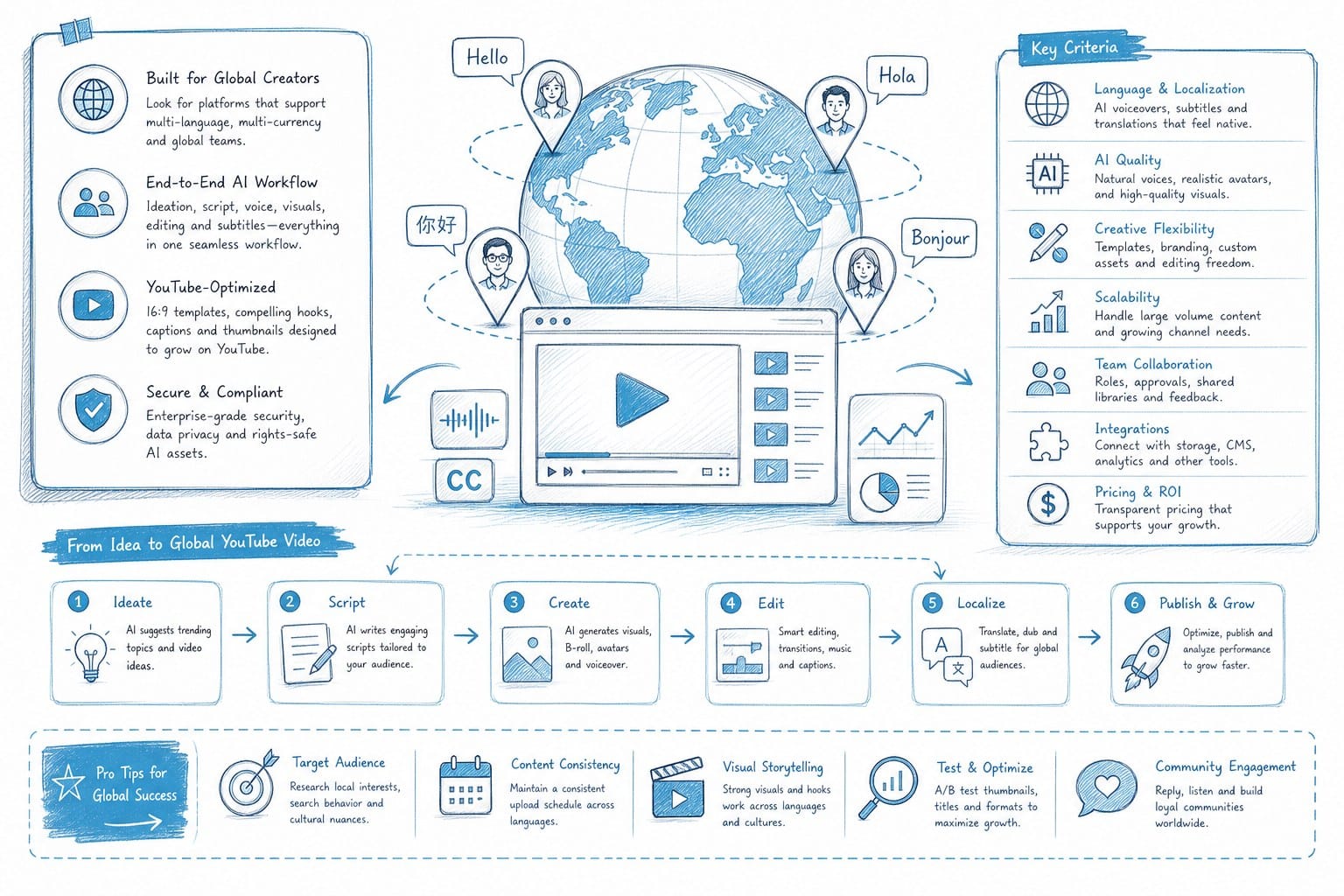
When evaluating a platform for a multilingual long-form YouTube workflow, there are specific capabilities that either exist or do not. Understanding what to look for in each area prevents you from choosing a tool that handles nine out of ten requirements well but breaks down on the one that matters most for your specific situation.
The first thing to evaluate is whether the platform handles the full production stack without forcing constant file transfers between services. Every handoff between separate tools is a point where quality can degrade, where time gets wasted on format conversions and re-imports, and where small errors accumulate into large problems. A script that looks correct in a text editor sometimes breaks when pasted into a voice generator because of special characters or formatting. An audio file that sounds clean in isolation sometimes creates sync drift when dropped into a video editor alongside B-roll at a different frame rate. The more integrated the platform, the less of your creative energy gets consumed by these kinds of technical friction points rather than by actually making good content.
The second capability to evaluate is whether the platform genuinely supports long-form video at the quality level that YouTube rewards with recommendations and search placement. This is harder to assess from a feature list because most platforms will claim to support long-form video. What you actually need to test is whether a 20-minute or 30-minute video comes out with coherent narrative pacing, smooth transitions between B-roll segments, synchronized data visualizations, and consistent audio quality throughout the entire runtime. Ask for example outputs in your topic category at the length you actually plan to produce. If the platform's examples are all under five minutes, that tells you something important about where the engineering investment has gone.
The third capability is language support that is genuinely integrated rather than bolted on as an afterthought. Some tools offer translation as an export feature that happens after the main production is complete. This means the translation happens outside the platform, and you then have to re-import the translated script, regenerate the voiceover, manually retime cuts that have shifted because the translated narration runs longer or shorter than the original, and redo any text overlays that referenced the original language. That is not a multilingual production workflow. That is doing the job twice with a translation step in the middle. Genuine multilingual support means language is a parameter you set at the beginning of the production process, and the platform handles all the downstream adjustments that follow from that choice.
The fourth thing to evaluate is pricing relative to the per-video economics you need in order for the math to work at your production volume. If the platform costs as much per video as it would cost to hire a freelance editor, the AI tool is not solving your core problem. The whole point of an ai video generator multiple languages approach is that you can produce more content for less money, which is what makes running four channels across four language markets viable for a team of one or two people. Look at what the platform charges per video or per minute of finished content, calculate your realistic monthly production volume, and make sure the total cost leaves enough margin to justify the investment.
Kliptory is designed with these requirements in mind. It is built specifically for faceless YouTube channels producing long-form content, which means the feature set reflects what actually matters for that use case rather than being a general-purpose video tool trying to serve every type of creator simultaneously. Scripting, voiceover, B-roll sourcing, custom data visualizations including maps and timelines and charts, captions, and final editing all work together inside one integrated workflow. You are not managing a stack of five subscriptions and manually bridging the gaps between them every time you start a new video.
For creators currently evaluating other tools or considering alternatives, two comparisons worth reading are the ones we have put together for AI-powered YouTube video creation alternatives and tools built specifically for long-form YouTube creators. These walk through specific feature comparisons that are relevant when you are trying to decide where to build a production workflow you plan to run at scale for years.
There is a concern I hear consistently from creators who are new to AI production tools, and it is worth addressing directly. The question is whether viewers will be able to tell the difference between AI-produced content and human-produced content, and whether that difference will hurt channel performance. The honest answer has two parts. First, AI voiceover quality varies significantly between platforms. A cheap or outdated voice engine produces narration that sounds robotic, reads punctuation incorrectly, and exhausts listeners within minutes. A modern, well-trained voice engine with good pacing and natural emphasis is genuinely engaging to listen to for extended periods. The gap between these two experiences is large, and it is worth spending time evaluating voice quality specifically before committing to a platform.
Second, visual production quality in AI-assembled videos varies enormously based on how the platform sources and sequences B-roll. A video built from generic stock footage selected without attention to relevance, with abrupt cuts and no visual coherence, will perform poorly regardless of how strong the script is. A video with well-sourced B-roll that visually supports the narration, smooth pacing, and accurate captions can genuinely compete with human-produced content in most documentary and explainer categories. The creators who succeed with AI production treat it as an acceleration tool rather than a replacement for editorial judgment. They still develop interesting angles on their topics, review the output before publishing, and make adjustments when something does not meet their quality standard. What they are not doing is spending 40 hours per video on editing, caption correction, and manual B-roll hunting. That time savings is what makes a multilingual channel strategy sustainable rather than a short-term experiment.
For small media teams and agencies producing content at volume, the multilingual capability adds a meaningful business dimension beyond just growing your own channels. A client who wants YouTube content produced in English, Spanish, and Portuguese is a significantly larger contract than a client who only needs English. If you can deliver that scope without tripling your production costs, the margin on that work becomes genuinely attractive as a service offering. AI production tools that support multiple languages let small teams compete for enterprise-level content contracts that would have been impossible to staff and deliver profitably even three years ago.
There is also a strategic advantage for agencies in the quality floor that AI tools create. When every video in a client's multilingual library is produced through the same integrated workflow, quality is consistent across languages and across months of production. The Brazilian Portuguese version of a video looks and sounds like it was produced with the same care as the English version because it was produced through the same process. That consistency builds the kind of audience trust that translates into subscriber loyalty and long-term channel growth, which is ultimately what clients are paying for.
To pull together what to look for before building a multilingual YouTube production workflow: you want an integrated full-stack platform that handles everything from script to final export without requiring constant file management between separate tools. You want genuine support for long-form video at the quality level that earns YouTube recommendations. You want language support that is built into the production pipeline from the beginning rather than added as an afterthought. And you want pricing that makes the per-video economics work at the production volume you are actually targeting. Kliptory fits that profile because it was purpose-built for exactly this use case. It is not a short-form tool adapted for longer content or a general-purpose video platform trying to serve every creator category. It is a tool designed specifically for the kind of work we have been describing throughout this article, and that specificity shows in the output quality and in how the workflow actually feels to use at scale.
Ready to take the next step?
If you are ready to start building a multilingual faceless YouTube channel without hiring a full production team, Kliptory gives you everything you need to go from idea to finished long-form video in hours. Visit Kliptory to see how it works and start producing content that reaches global audiences.