AI video essay maker for faceless YouTube channels

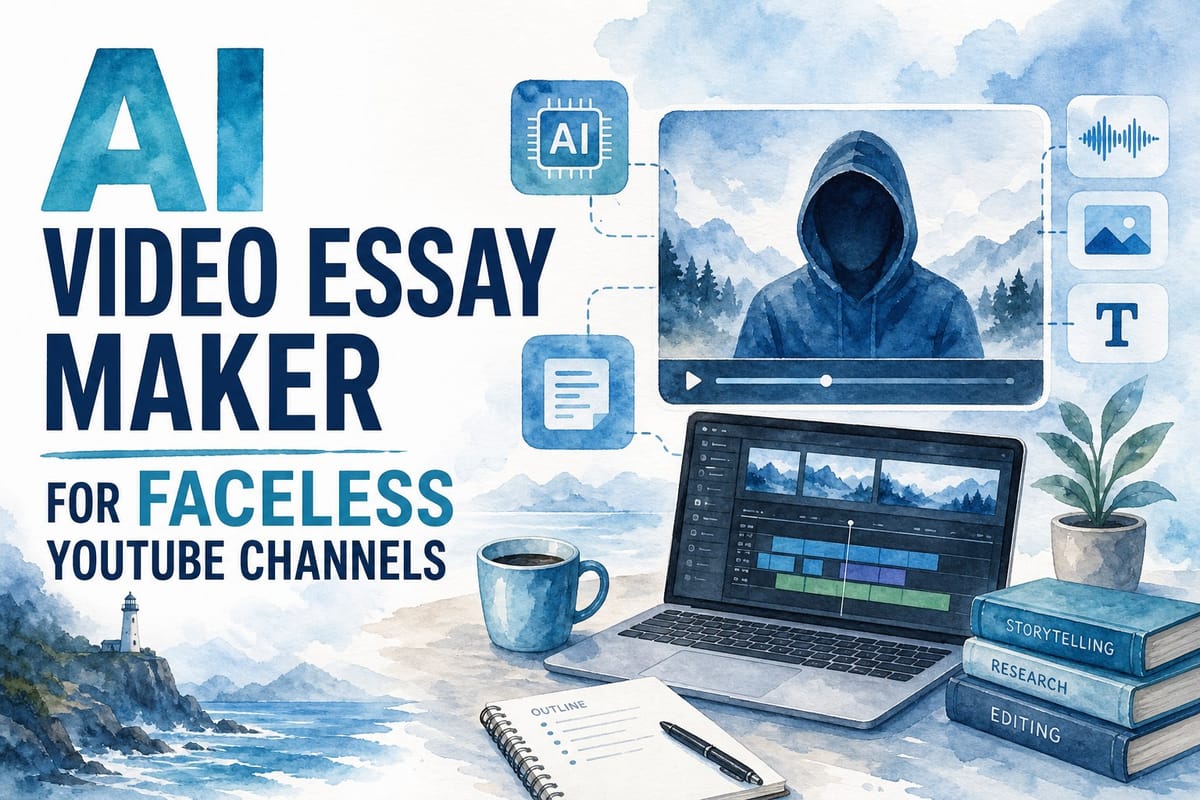
Table of contents
1. What an AI video essay maker actually does
2. Why faceless YouTube channels need this type of tool more than anyone
3. How Kliptory works as an AI video essay maker for long-form content
Running a faceless YouTube channel is one of the most practical ways to build an audience and earn money online without ever appearing on camera. But producing a quality video essay is not simple. You need a script, a voice, footage, data visuals, captions, and an edit that holds a viewer's attention for ten, twenty, or even thirty minutes. Doing all of that manually can take weeks. That is where an ai video essay maker changes the game. Instead of hiring a team of editors, researchers, and voice actors, you can use an AI-powered platform to handle most of the heavy lifting. In this article, I will walk through what these tools actually do, why they matter for faceless channels specifically, and how a platform like Kliptory helps creators produce documentary-quality video essays faster than ever before.
What an AI video essay maker actually does
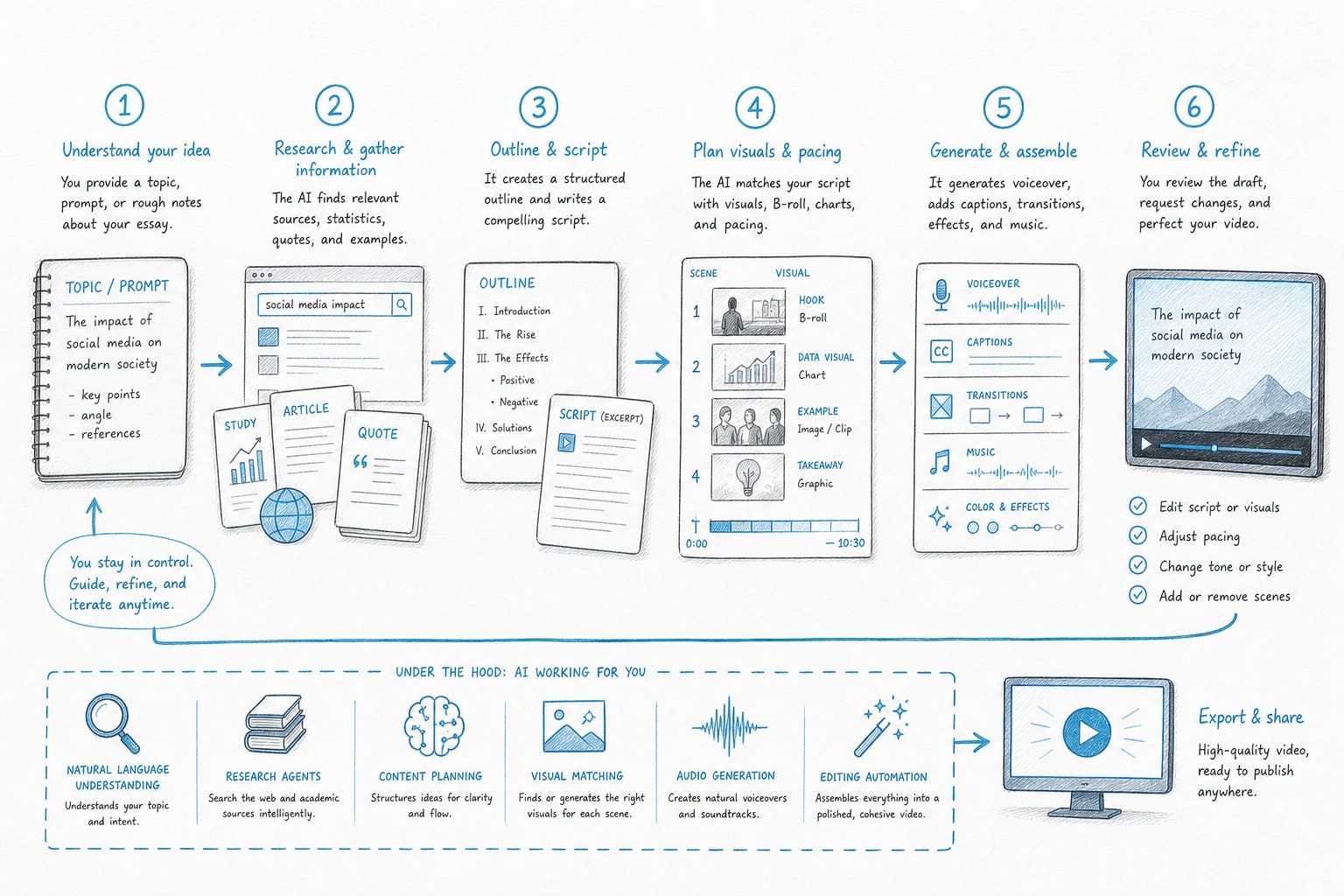
Let me be direct about what we are talking about here. An ai video essay maker is a software tool that takes your topic or script and automates the production steps that would otherwise require a full post-production team. It is not just a text-to-video novelty. The best tools handle the entire pipeline from idea to a finished, publishable video.
Here is what that pipeline typically looks like when done manually.
First, you write a script. For a fifteen-minute video essay, that is roughly 2,000 to 2,500 words. Writing a well-researched, well-structured script can take anywhere from three hours to an entire day depending on the topic.
Next, you record or source a voiceover. If you do not want to record yourself, you need to find a convincing AI voice, adjust pacing, and sync it to your content.
After that, you need B-roll footage. Video essays typically need a constant stream of supporting visuals. That means searching stock libraries, downloading clips, and manually placing them on a timeline.
Then come the data visuals. If your essay covers history, economics, geography, or any topic with statistics, you often need maps, timelines, charts, or graphs. Building those from scratch in a graphics program takes real skill and time.
Finally, you add captions, handle color grading, and export the file.
A skilled solo creator who is fast at all of this might produce one video every two to three weeks. That pace is hard to scale.
An ai video essay maker compresses that entire workflow. Instead of spending three weeks on one video, creators using AI tools can produce multiple polished videos in the same timeframe. The automation handles the repetitive and technical steps so that the creator can focus on the creative direction and strategy behind the content.
This matters because YouTube rewards consistency. Channels that publish regularly tend to grow faster. If you can only produce one video a month because of production time, your channel is always going to be slower to gain traction than a channel that publishes every week.
I want to be clear about something, though. The best ai video essay maker tools are not magic buttons. You still need to have a solid topic, understand your audience, and make sure the content is accurate and interesting. The AI handles production; you still need to handle creative judgment. The combination of human direction and AI automation is what actually produces great results.
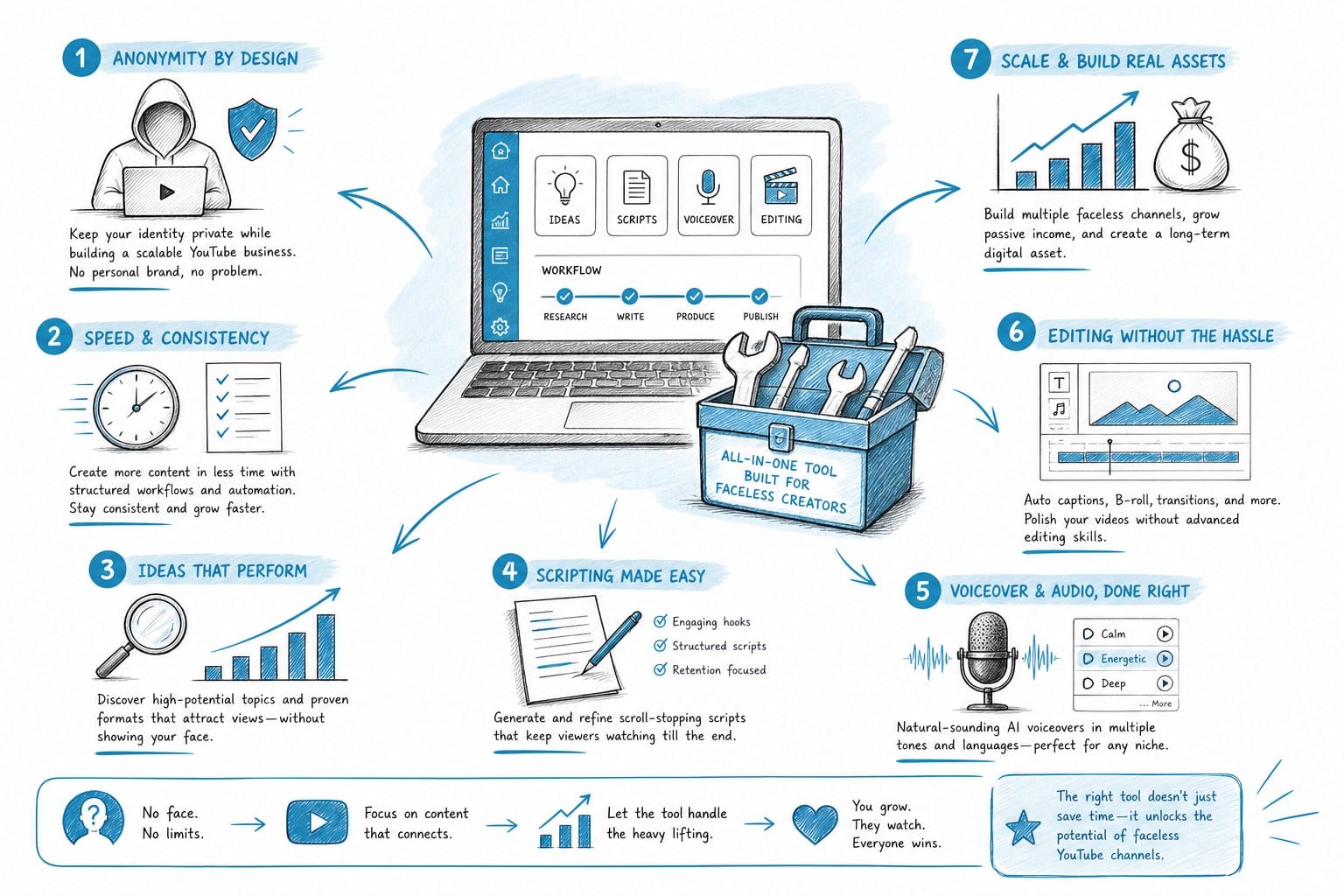
For faceless channels specifically, this kind of tool is especially useful. You never need to film yourself. You never need to appear on screen. The whole production can happen entirely on your computer. If you want to understand the broader workflow for this type of content, check out how to make a YouTube documentary without filming anything for a detailed breakdown of the process.
The most important thing to look for in an ai video essay maker is whether it covers the full pipeline or just one part of it. Some tools only generate scripts. Others only convert text to video. A platform that handles scripting, voiceover, B-roll, data visuals, captions, and editing together is far more valuable than a collection of separate tools you have to stitch together yourself. That integration is what saves the most time and produces the most consistent results.
Why faceless YouTube channels need this type of tool more than anyone
Faceless YouTube channels have a unique set of production demands. Because the creator never appears on screen, every second of video has to be filled with something visually interesting. You cannot cut to a talking head for relief. You cannot rely on personality and body language to keep people watching. The visuals have to do that work on their own.
This is why video essays are such a popular format for faceless channels. When done well, they combine strong narration, relevant footage, and supporting graphics to create something that feels more like a documentary than a standard YouTube video. But that production quality is exactly what makes them so time-consuming to produce without automation.
Let me break down the specific challenges faceless channel operators face.
The first challenge is volume. Many successful faceless channels publish two to four videos per month to stay competitive in the YouTube algorithm. At fifteen to twenty minutes per video, that is a massive amount of content to produce consistently. Without automation, this usually means hiring editors, researchers, and voice actors, which adds significant cost.
The second challenge is visual variety. A ten-minute video with a single stock clip playing on repeat will not hold viewers. You need constant visual changes, relevant footage, graphics, and text overlays. Sourcing and placing all of that manually is one of the most time-intensive parts of production.
The third challenge is data-heavy topics. Many of the most popular faceless channel niches, such as history, geopolitics, finance, science, and crime, involve data that is best communicated through visuals. Maps showing territorial changes, timelines of events, charts comparing statistics. Building those graphics without a dedicated motion designer is either very slow or very expensive.
The fourth challenge is consistency. When you are producing a lot of content, maintaining a consistent style and quality across videos is difficult. If each video looks and feels slightly different, it is harder to build a recognizable brand.
An ai video essay maker addresses all four of these challenges at once. The automation handles volume by dramatically reducing production time. Built-in B-roll sourcing handles visual variety. Integrated data visualization tools handle maps, timelines, and charts without requiring a motion designer. And because everything is produced through the same platform with the same settings, the style stays consistent across every video.
For digital entrepreneurs and side-hustlers running faceless channels, this is particularly significant. If you are building a YouTube channel as a side income stream, you probably do not have the budget to hire a post-production team. You also probably do not have forty hours a week to spend on video production. An AI tool that handles the bulk of the technical work lets you run a channel that looks professionally produced without the cost of a production company.
Small agencies managing multiple YouTube channels face similar pressure. If an agency is running five or six different faceless channels across different niches, producing content for all of them with a small team requires serious automation. An ai video essay maker lets a small team output what would previously have required a much larger operation.
I also want to address something that comes up a lot in creator communities, which is the question of quality. Some people assume that AI-produced content is going to look cheap or generic. That assumption is becoming less accurate as these tools improve. Platforms that combine AI scripting with real stock footage libraries, professional AI voices, and proper data visualization tools can produce videos that look and feel like genuine documentary content. The key is choosing a platform that is built specifically for long-form video essays rather than short social media clips.
If you are evaluating your options in this space, it is worth doing a proper comparison of what different tools offer. The article on best AI video generator alternatives for faceless YouTube creators covers the landscape in detail and can help you figure out what actually fits your workflow.
One more thing worth mentioning here is the role of hooks. Even the most beautifully produced video essay fails if the first thirty seconds do not grab the viewer. This is a creative challenge that AI tools can assist with but cannot fully replace human judgment on. Getting your opening right is critical. If you want to strengthen that part of your videos, the guide on YouTube hook generator: write video intros that stop the scroll is worth reading alongside any production tool you choose to use.
How Kliptory works as an AI video essay maker for long-form content
Kliptory is built specifically for the type of content we have been talking about. It is an AI-powered production platform designed for creators running faceless YouTube channels who want to produce long-form, documentary-style video essays without needing a post-production team. I want to walk through what it actually does at each stage of production so you can understand how it fits into a real workflow.
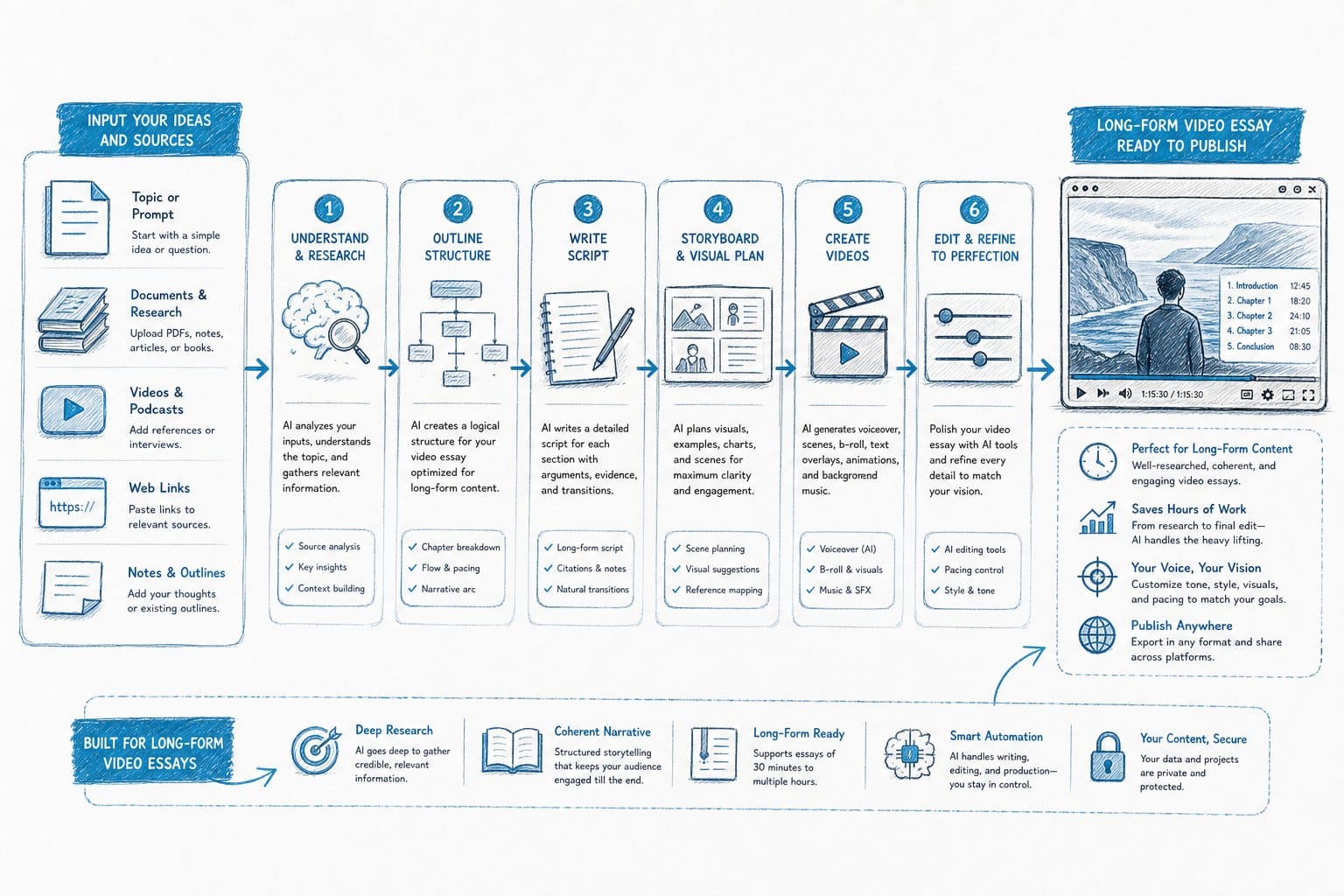
The starting point is scripting. You give Kliptory a topic, and it generates a full script structured for long-form video. This is not just a paragraph summary. It is a proper narrative script designed to hold attention across five to forty minutes of content. The scripting is built around the kind of information-dense, story-driven format that works well for video essays on history, geography, science, finance, crime, and other popular faceless channel niches.
Once the script is ready, Kliptory handles voiceover. It uses AI voices that are realistic enough for long-form documentary content. You are not getting a robotic monotone. The voices have pacing variation and natural-sounding inflection, which matters a lot when someone is going to listen to your content for twenty minutes straight.
After voiceover comes one of the most valuable parts of the platform, which is automated B-roll sourcing. Kliptory pulls relevant footage to match your script. Instead of spending hours searching stock libraries and downloading clips, the platform handles that process and places the footage on the timeline to align with the narration. This single feature saves a significant amount of time for anyone who has ever tried to produce a video essay manually.
Then there are the data visuals. This is where Kliptory stands out from more generic video tools. It can generate maps, timelines, and charts directly inside the platform. If you are making a video about World War II, you need maps showing troop movements. If you are covering the history of global oil prices, you need charts. If you are explaining the timeline of a major legal case, you need a visual timeline. Kliptory builds those visuals as part of the production process rather than requiring you to create them separately in another program.
Captions are also handled automatically. This matters for reach, since many viewers watch YouTube with sound off, and captions also improve accessibility. Having them generated and synced automatically removes another manual step from the workflow.
The final output is an edited video ready for upload. You are not receiving raw footage and a script and then having to put everything together yourself. The platform produces a complete video that you can review, make adjustments to if needed, and then upload directly to YouTube.
For a solo creator, this workflow is transformative. Someone who was previously spending three weeks on a single fifteen-minute video can now produce that same video in a matter of hours. That frees up time to research better topics, optimize thumbnails and titles, engage with the audience, and plan channel strategy, all the things that actually grow a channel over time.
For small teams and agencies, the math is even more compelling. If a small team of two or three people is managing multiple faceless channels, Kliptory lets them output a volume of content that would otherwise require a much larger team. The cost savings compared to hiring editors, researchers, and voice actors are substantial.
I also want to address the learning curve question. Some AI tools require a lot of technical knowledge to use effectively. Kliptory is designed for people who want professional results without needing professional post-production skills. You do not need to know video editing software. You do not need to understand audio mixing or color grading. The platform handles those technical elements so that the creator can focus on the content itself.
This is especially important for people who are earlier in their YouTube journey. If you are just starting a faceless channel and have not yet built up revenue to justify hiring editors, Kliptory gives you a way to produce videos that look competitive with established channels right from the beginning. You are not starting with rough, poorly produced content while you save up enough to hire help. You can publish something genuinely polished from your first video.
For people who are already running established channels, the benefit is scale. If you are currently producing one video per month because that is all your production capacity allows, Kliptory can increase that output significantly. More videos means more chances to rank, more ad revenue potential, and faster channel growth.
The niches that tend to work best with this kind of tool are the ones where video essays already perform strongly on YouTube. History and historical events, geopolitics and international relations, true crime and major legal cases, science and technology, personal finance and economics, pop culture analysis, and explainer content on complex topics all fit well with the documentary-style format Kliptory is built to produce.
If your channel operates in any of those spaces, or if you are planning to start one, an ai video essay maker like Kliptory is worth understanding as a core part of your production workflow. The channels that will dominate these niches in the next few years are going to be the ones that figured out how to produce high-quality content at scale. AI production tools are how that happens.
One practical note on getting started. The most effective way to use any AI production tool is to stay involved in the creative decisions even as you automate the technical ones. Choose your topics carefully. Review the script the AI generates and adjust anything that does not match your channel's voice or accuracy standards. Make sure the finished video reflects the standard you want your channel to be known for. The AI handles the heavy lifting, but the creative direction still comes from you. That combination of human judgment and AI automation is what produces video essays that actually build an audience.
Ready to take the next step?
If you are ready to stop spending weeks on single videos and start producing documentary-quality video essays consistently, Kliptory is built for exactly that. Visit kliptory.com to see how the platform works and start producing the kind of long-form content that grows faceless YouTube channels.