
How to Make Ultra Long YouTube Videos People Actually Finish

Long YouTube videos are having a moment. Creators are dropping two-hour documentaries, four-hour gaming sessions, and ninety-minute deep dives on everything from true crime to cooking techniques. And somehow, people are watching. Not just clicking and bouncing, but actually sitting through the whole thing. So what's the secret? Why do some long videos feel like they fly by while others lose half their audience in the first ten minutes? The answer isn't as complicated as most creators make it, but it does require you to think differently about what a long video actually is and what it asks of your audience.
The honest answer is that length itself isn't the problem. Pacing is. Structure is. The way you talk to your audience is. A bad twenty-minute video can feel like a punishment. A great three-hour video can feel like hanging out with a friend on a rainy afternoon. The difference comes down to a handful of things that most creators either don't know about or just skip because they seem like extra work. And here's the thing about skipping that work: your audience always notices, even when they can't name what they're noticing. They just feel a vague sense that the video is dragging, and then they're gone.
This post is going to walk you through exactly how to build ultra long videos that hold attention from the first frame to the last. A lot of you have asked about this in the comments and through DMs, especially after noticing that longer videos are getting pushed harder by the algorithm lately. The questions keep coming in about watch time, retention curves, structure, and editing habits for long form content. So let's get into all of it, starting with the place where most long videos actually fall apart.
Why most long videos fall apart (and what to do instead)
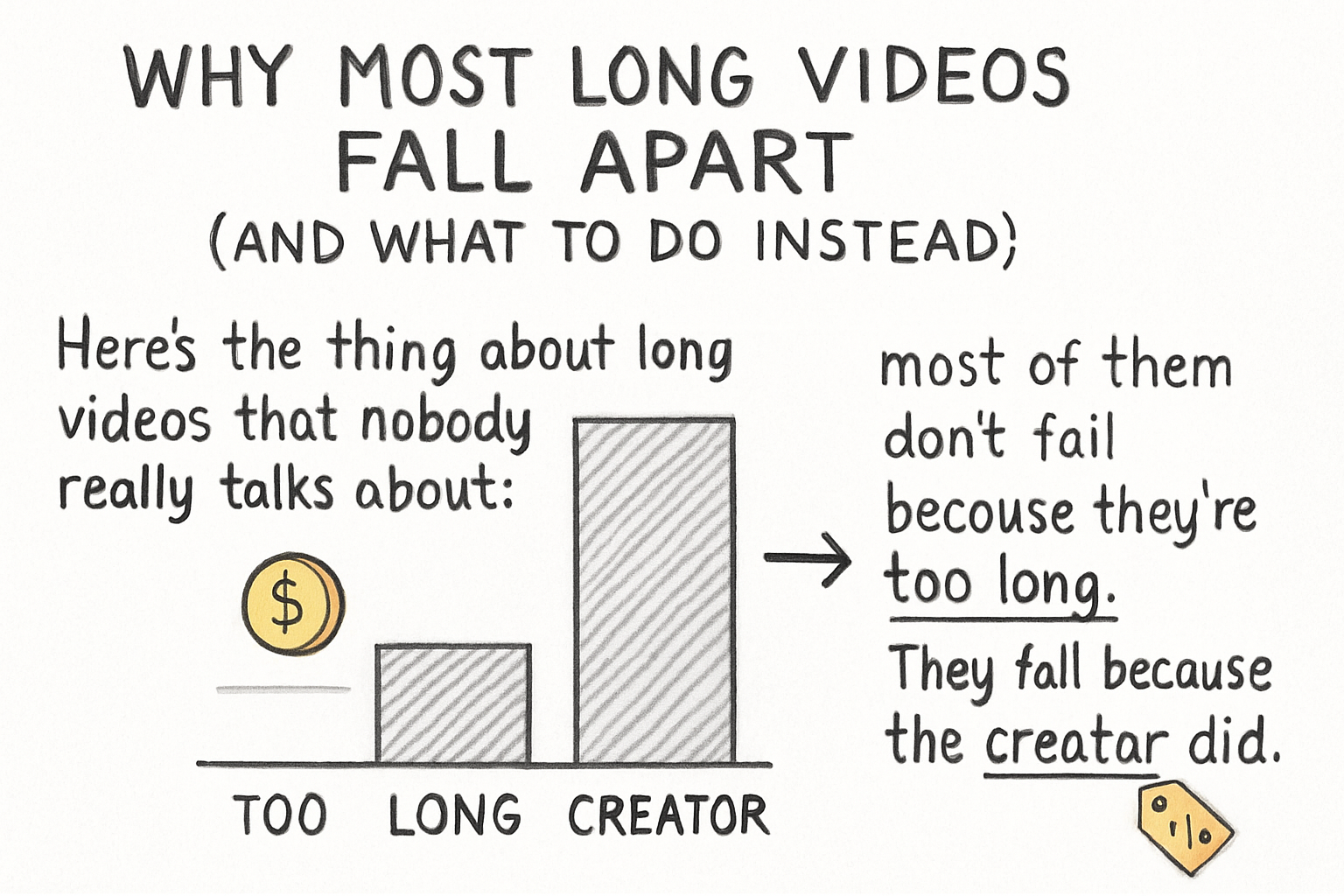
Here's the thing about long videos that nobody really talks about: most of them don't fail because they're too long. They fail because the creator didn't plan for length. They just kept filming until they ran out of things to say, slapped it together in an edit, and uploaded it hoping people would stick around. That approach almost never works, and the retention graph on those videos tends to look like a ski slope. Steady drop from the first minute, all the way to the end.
The number one killer of watch time in a long video is the feeling that nothing is happening. Viewers are smart. They can feel when a creator is stalling, repeating themselves, or just filling time. The moment that feeling sets in, they're gone. Not because they don't like you, but because their attention has a cost and they're not getting enough back for what they're spending. Think about the last time you closed out of a video mid-watch. What triggered it? Usually it was a moment where you realized you'd been watching for three minutes and nothing had changed, nothing had moved forward, nothing had surprised you. That's the feeling you're trying to prevent.
The fix starts before you ever hit record. You need a real structure, something that works almost like a TV series episode. Think of your long video as a collection of connected mini-segments, each one with its own beginning, middle, and end. When one segment wraps up cleanly and the next one starts with a little burst of energy, the viewer's brain gets a small reset. It feels fresh again. That's what keeps people watching for ninety minutes or two hours. Each mini-segment acts like a new reason to stay. You're not just making one long promise to your audience and asking them to wait for the payoff. You're making a series of smaller promises and keeping them regularly along the way. That rhythm is what builds the kind of trust that turns a first-time viewer into someone who watches until the end.
Let's say you're making a ninety-minute cooking video where you attempt a complicated multi-course dinner. Instead of just filming yourself cooking from start to finish, you'd break it into clear segments: the prep disaster, the sauce that almost ruined everything, the plating panic, the final reveal. Each one of those is its own little story arc with tension and resolution. The viewer finishing one segment feels a sense of completion, and then the next segment opens with a new question. That structure alone can dramatically change your retention numbers because it never lets the video feel like it's standing still.
I personally think the biggest mistake new creators make is treating a long video like a long short video. It's not. It's a completely different format that needs its own rules. Back when I first started experimenting with longer content, I tried to apply the same fast-paced editing style I used for ten-minute videos, and it backfired badly. The pacing felt frantic, the structure was a mess, and my analytics looked like a cliff. Every segment ended abruptly and started without any kind of transition or re-engagement moment. Viewers had no idea where they were in the video or why they should care about what was coming next. It took a few tries to realize that long videos need room to breathe, but only in the right places, and they need clear signposts so the viewer never feels lost. You also want to check out our guide on hooking viewers in the first five seconds because even a long video lives or dies based on what happens right at the start. If you lose someone in the first thirty seconds, all the great structure in the middle doesn't matter.
Building a structure that keeps people locked in
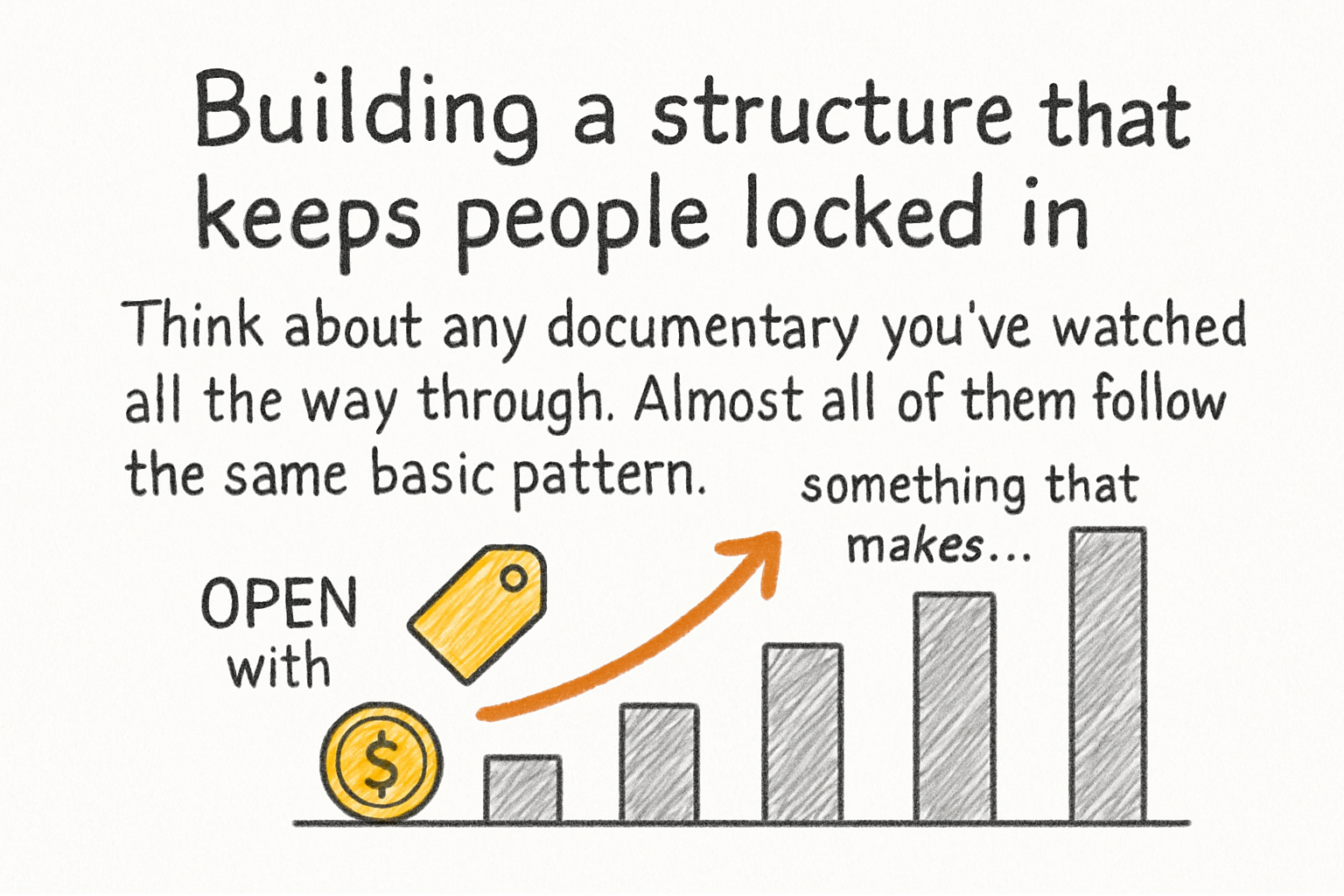
Think about any documentary you've watched all the way through. Almost all of them follow the same basic pattern. They open with something that makes you ask a question. Then they spend the middle answering that question while raising new ones. Then they close with a payoff that feels earned. Your long YouTube video needs to do the same thing, even if it's about something as casual as a day in your life or a game playthrough. The format is flexible. The principle isn't. Every long video that holds attention is organized around questions that need answering and payoffs that feel worth waiting for.
One technique that works incredibly well is what some creators call the chapter promise approach. Early in the video, you tell viewers exactly what's coming. Not in a boring list format, but conversationally and with some personality built in. Something like, "By the end of this, you're going to see me completely fail at this three times before it finally works, and I promise the third failure is genuinely embarrassing." Now the viewer has a reason to stay. They're waiting for that payoff. You've made a promise and they want to see you keep it. This works because the human brain is wired to stick around when it knows a resolution is coming. You're essentially using the same trick a mystery novel uses on page one when it shows you the dead body before it explains who did it. You've created a question the viewer needs answered.
You can layer multiple promises on top of each other for really long videos. Open with a big promise that won't pay off until near the end. Then inside each segment, make smaller promises that pay off within ten or fifteen minutes. The big promise keeps people from leaving. The small ones keep rewarding them along the way so they don't feel like they're just waiting around. A gaming creator doing a four-hour playthrough might open with, "I'm going to beat this level without taking a single hit, but it's going to take me a while to get there." Then inside each attempt, there are smaller moments of tension and release. The structure works at multiple levels at once.
Chapters are also a huge deal for long-form content and they're criminally underused. YouTube's built-in chapter feature lets viewers jump around, but here's the counterintuitive part: giving people the option to skip actually makes them less likely to leave. It sounds backwards, but it's true. When someone feels trapped in a video with no landmarks, they bail. When they can see the map, they're more willing to keep driving. Think about it from your own experience as a viewer. If you're twenty minutes into a long video and you have no idea how much is left or what's coming, the uncertainty alone can make you close the tab. But if you can see "Chapter 4 of 8: The Final Test" in the progress bar, you know where you are. That context makes continuing feel manageable. Name your chapters something interesting, not just "Part 1" or "Introduction." Make the chapter titles feel like reasons to keep going. "The moment everything went wrong" is a better chapter title than "Part 3" in every possible way.
You also need to think hard about your pacing between segments. A long video that never changes its energy level gets exhausting, the same way a conversation with someone who talks at the exact same volume and speed for two hours gets exhausting. Mix slow, detailed explanations with faster, more exciting moments. Drop a funny clip or a surprising fact right when things start to feel heavy. Think of it like a heart rate monitor. You don't want it flat. You want it moving, rising, falling, rising again. A true crime creator might spend five minutes doing slow, careful explanation of the timeline, then cut to a fast-paced recap of the key contradictions, then slow down again for a thoughtful analysis section. The rhythm itself keeps the brain engaged because it never knows quite what speed to expect next. If you're curious about how playlist structure can also play into keeping people watching across multiple videos, our article on YouTube playlist strategies to skyrocket your watch time goes deep on that. The same brain science that makes playlists work applies inside a single long video too, because in both cases you're managing the viewer's sense of progress and payoff over an extended period of time.
The editing and production habits that actually move the needle
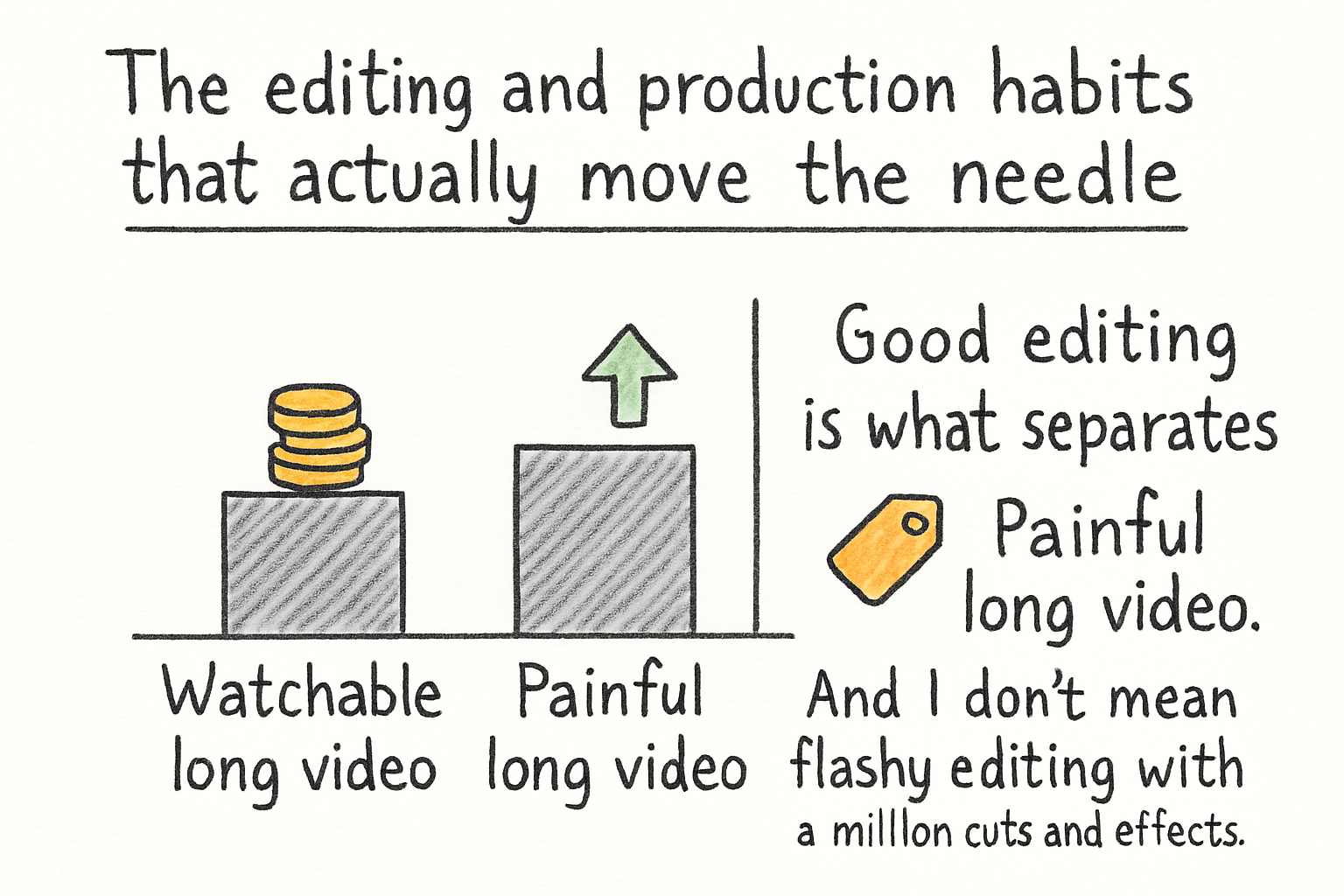
Good editing is what separates a watchable long video from a painful one. And I don't mean flashy editing with a million cuts and sound effects. I mean clean, intentional editing that serves the story and respects the viewer's time. Every scene that doesn't add something should be cut. Every pause that goes a second too long should be trimmed. Every moment where you said "um" five times in a row should be cleaned up. It sounds obvious, but most creators leave way too much fat in their long videos because cutting feels like losing work you did. That's the wrong way to think about it. Cutting is not losing work. Cutting is finishing the work. The raw footage is the rough draft. The edit is the actual video.
Let's get specific about what "fat" looks like in a long video, because it takes a few different forms. The most obvious one is dead air, those moments where nothing is happening and you're not saying anything meaningful. But there's a subtler version that's just as damaging: over-explanation. This is when you've already made a point clearly and then spend two more minutes re-explaining it because you're not sure the viewer got it. Trust your audience. If you explained it well once, move on. Repeating yourself in a long video doesn't reinforce your point, it tells the viewer their time isn't being respected, and that's when they start wondering if they should just go watch something else. Every minute of a long video needs to justify itself by either advancing the story, deepening the understanding, or giving the viewer a reason to feel good about still being there.
One of the most effective editing habits for long videos is what editors call re-hooking. Every ten to fifteen minutes, you do something that reminds the viewer why they're still watching. It could be a quick recap of what just happened, a tease for what's coming next, or just a shift in energy that makes the video feel alive again. Think of it like a TV show that cuts to a commercial break right before something exciting happens. You're doing the same thing, just without the commercial. A re-hook might sound like, "Okay so now that we've seen why the first attempt failed, here's where it gets actually interesting," followed by a short preview clip of something dramatic coming up. You're giving the viewer a little burst of dopamine and a new reason to keep going. The re-hook is your way of saying, hey, you've made it this far, here's why the next part is worth sticking around for. Creators who do this consistently see their retention curves flatten out instead of steadily dropping, which is exactly what you want.
On the production side, audio quality matters more in long videos than short ones. Bad audio is annoying for three minutes. It's genuinely unbearable for ninety. If a viewer has to strain to understand what you're saying, they'll tolerate it for a little while, but that discomfort compounds over time. By the forty-minute mark, a slightly bad audio mix feels like a dealbreaker. Getting your audio right isn't about having the most expensive gear. It's about using what you have correctly: recording in a quiet space, getting the mic close to your mouth, monitoring your levels so you're not peaking or too quiet, and doing a basic noise reduction pass in your editing software before you export. If you're still figuring out what gear makes sense for your setup, our rundown of the best equipment for starting a YouTube channel on a budget has solid options that won't break the bank. Also, using text overlays and lower thirds to label segments, reinforce key points, or add a bit of humor can keep visual interest high during longer stretches of talking-head content. When you're watching someone talk at a camera for twenty minutes straight, the visual experience gets monotonous fast. Lower thirds that appear at the right moments give the viewer's eyes something to track and help reinforce what they're hearing. Our complete breakdown of lower thirds, chyrons, and title cards covers exactly how to use those tools without overdoing it, because heavy-handed text overlays can be just as distracting as no visual variety at all.
Finally, don't sleep on your analytics after you upload. YouTube's audience retention graph will tell you exactly where people are dropping off, and for a long video, that information is gold. You can go back, figure out what happened at the thirty-two-minute mark that caused a dip, and then ask yourself what you were doing at that moment. Was there a long-winded explanation that went on too long? Did the pacing slow to a crawl? Did you repeat something you'd already said ten minutes earlier? Once you know what caused the drop, you can avoid that same mistake in the next video. Over time, you build a detailed picture of how your specific audience responds to different pacing choices, segment lengths, and energy levels, and that picture is worth more than any generic advice about long-form content. Our guide on using YouTube Analytics to grow your channel walks through how to read those graphs and actually act on what they're telling you. Most creators look at their analytics for five seconds, feel vaguely bad about the numbers, and close the tab. Don't be that creator. The data is telling you a story about your audience if you're willing to read it.
Ready to take the next step?
Making long videos that people actually finish isn't some mystery formula. It's about planning your structure before you film, building in energy shifts so the pacing never goes flat, re-hooking your audience every ten to fifteen minutes, editing with real intention, and then paying attention to the data so you keep getting better. None of these steps are complicated on their own. The challenge is doing all of them consistently and treating every long video as its own complete experience that needs to earn every minute the viewer gives it. If you start applying even two or three of the things in this post, you're going to see a real difference in your retention numbers. And if you want a tool that helps you manage, clip, and repurpose your long-form content without a ton of extra work, check out Kliptory. It's built for creators who are serious about long-form video and want smarter ways to get more out of every hour they put on screen. Drop a comment below and let me know what your biggest struggle with long videos has been. I read every single one.