Why avatars video may not be what faceless creators actually need

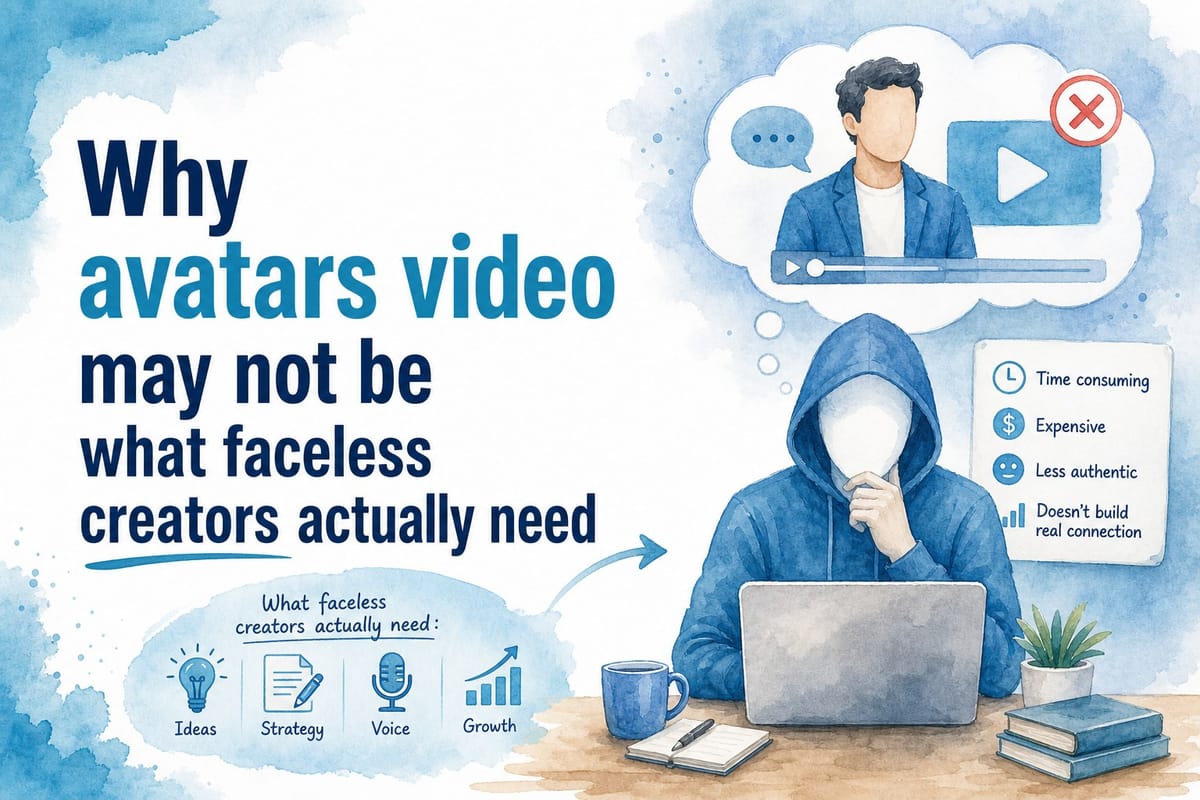
Table of contents
1. What avatars video actually gives you and what it leaves out
2. The real production problem faceless creators are trying to solve
3. What a production-first approach actually looks like in practice
If you run a faceless YouTube channel, you have probably spent time looking at avatars video tools as a way to put a "face" on your content without ever stepping in front of a camera. The pitch is appealing. Pick a digital human, type a script, and watch your presenter deliver it on screen. No camera. No lighting setup. No nerves. It sounds like the perfect shortcut for creators who want to stay anonymous while still building an audience.
But after spending real time inside the faceless creator space, I want to make the case that avatars video is solving the wrong problem for most of us. The real bottleneck is not whether your video has a face. It is whether you can produce high-quality, long-form content fast enough to build a channel that actually grows.
That is a very different problem, and it requires a very different solution. This post breaks down what avatar tools actually deliver, what faceless creators actually need, and what a smarter production approach looks like when you map it against a real workflow.
What avatars video actually gives you and what it leaves out
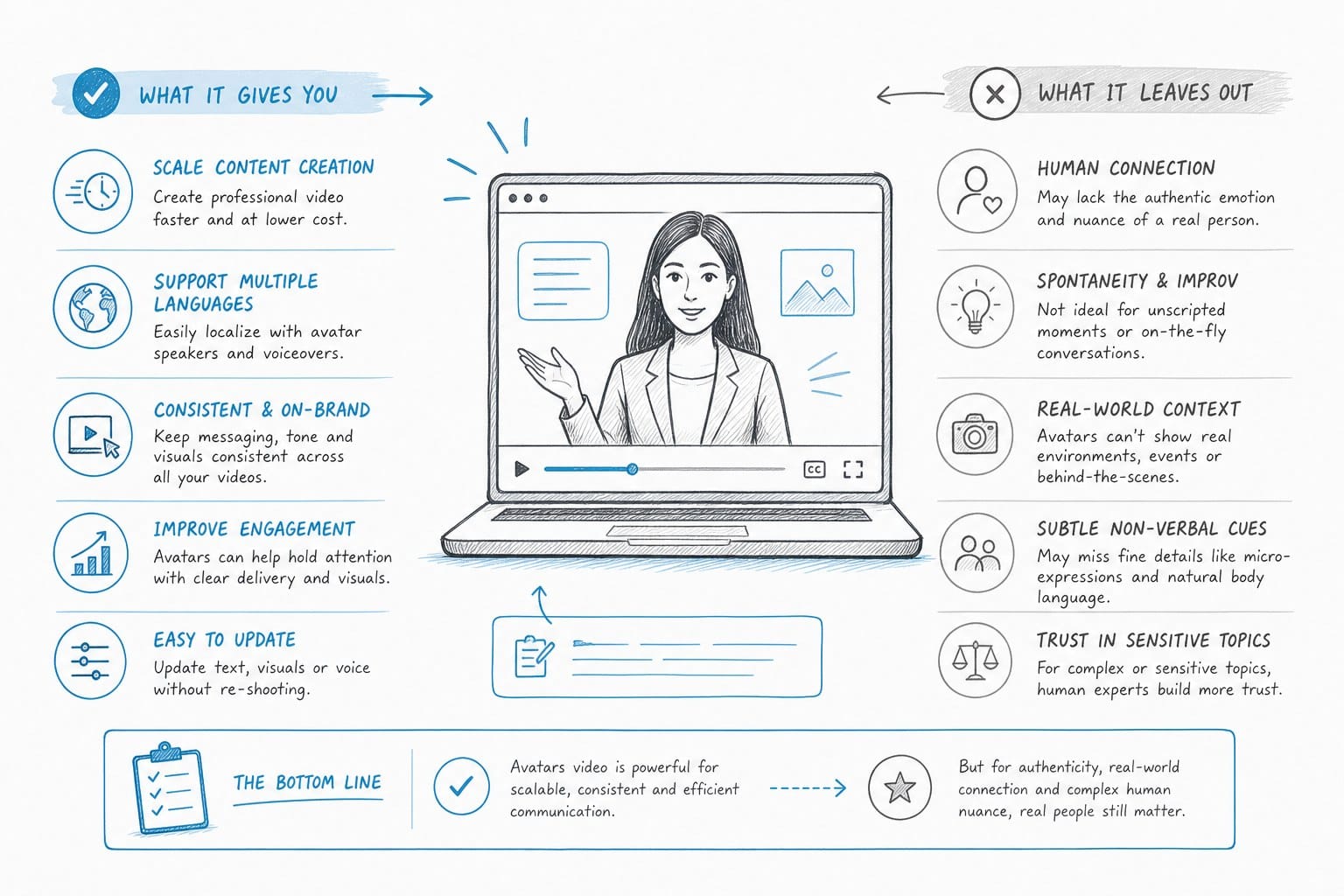
An avatars video tool gives you a digital presenter. That is genuinely useful in some contexts. Corporate training videos, internal communications, and product demos for software companies all benefit from a human presence on screen when a real person is not available. The avatar fills that gap cleanly and at a reasonable cost.
For faceless YouTube channels, though, a digital presenter is rarely the missing piece. Think carefully about what goes into a successful documentary-style video essay or a well-researched listicle. You need a script that is structured like a story, with a clear arc that keeps people watching from the opening line to the final frame. You need a voiceover that sounds natural, not robotic, and that carries enough energy to hold a viewer's attention across 15 or 20 minutes. You need b-roll footage that matches what is being said at every single moment, not just footage that is loosely related to the topic. You need maps, timelines, and charts to support data-heavy claims in a way that makes the information stick. You need captions that are accurate, properly timed, and readable on a phone screen. You need all of those elements edited together into a final cut that flows.
An avatars video tool handles one small slice of that list. It gives you a talking head. But most faceless channel creators are not failing because their videos lack a talking head. They are failing to scale because every other part of production is slow, manual, and expensive.
Here is a concrete example. Say you run a history channel and you want to publish a 20-minute documentary about the fall of the Byzantine Empire. You spend three days researching and writing the script. You spend a full day sourcing b-roll clips and map assets that actually match the timeline you are describing. You spend two days editing the raw footage, adjusting the pacing, and layering in music at the right volume. You spend another day adding captions, checking them for accuracy, and doing a final quality pass before export. That is roughly a week of work for one video. Dropping an avatar presenter into that workflow saves you maybe an hour on voiceover recording. Everything else is still on your plate, untouched.
The creators I have seen grow fastest are not the ones who found a better digital presenter. They are the ones who figured out how to compress that entire one-week production cycle into a matter of hours. The competitive advantage on YouTube is not visual novelty. It is output velocity combined with consistent quality.
There is also a deeper strategic issue worth naming directly. A digital avatar adds a visual element to your video, but it does not add the thing that YouTube's algorithm and your audience actually reward, which is consistent, high-volume output of well-researched, well-produced content. You can have the most realistic avatar on the market and still publish once a month because everything else in your pipeline is a bottleneck. Publishing once a month is not a winning YouTube strategy in any niche I have seen succeed.
I also want to address the quality perception question honestly. Many viewers have grown skeptical of avatar-driven content, and that skepticism is not irrational. The uncanny valley effect is real. When a digital face does not quite sync with the audio, or when the expressions do not match the emotional weight of what is being said, viewers notice. They may not be able to articulate exactly what feels off, but the result is a subtle sense of disconnection that shows up in your watch time data. Faceless channels that rely on stock footage, text overlays, motion graphics, and strong narration do not have this problem. The audience focuses entirely on the content rather than evaluating whether the presenter looks and sounds like a real human being.
For more on this point, it is worth reading about why faceless channels win without an AI video avatar. The argument there reinforces something that plays out consistently in practice: the absence of a human or avatar face is not a liability for these channels. In many cases it is a genuine advantage, because it removes a layer of potential distraction and puts the full weight of the viewing experience on the research, the narration, and the visuals.
There is one more angle worth covering here, which is the question of differentiation. Many successful faceless channels have built strong brand identities around their visual style. The way they use b-roll, the color grading choices, the music selection, the pacing of the narration between sentences. That accumulated style is what makes a viewer recognize a video in their feed before they even read the title. Avatars video tools do not help you build that kind of visual identity. They give you a generic presenter that looks similar to the presenters used by every other channel running the same tool. That is not differentiation. That is the opposite of it.
The tool that solves your real problem is not the one that adds a face to your content. It is the one that helps you produce more content, at higher quality, without requiring a full production team to do it.
The real production problem faceless creators are trying to solve
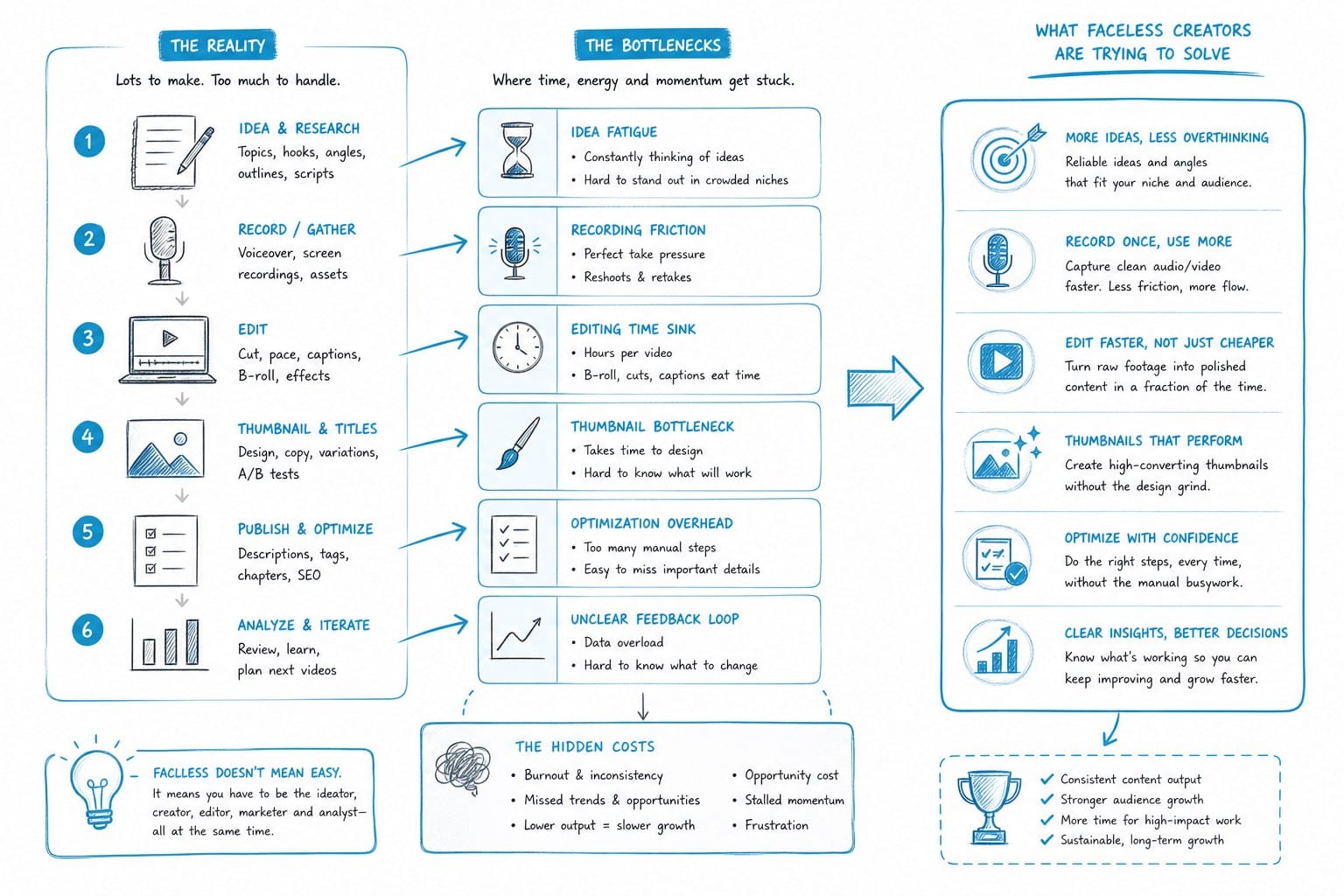
When I talk to faceless channel operators about their biggest challenges, the conversation almost never starts with "I need a better presenter." It starts with one of three things: time, cost, or consistency. Those three problems are deeply connected, and none of them are solved by an avatar.
Time is the most common complaint. Long-form YouTube content takes a long time to produce at every stage of the process. A 15-minute video essay involves hours of research to get the facts right, then more hours of scriptwriting to turn those facts into something a person would actually want to watch. After that comes voiceover recording, which requires multiple takes and audio cleanup. Then b-roll sourcing, which means searching through stock libraries to find footage that is both accurate and visually compelling. Then editing, which involves cutting, pacing, layering music, timing captions, and checking everything before export. If you are doing all of that yourself, you might get two or three videos out per month. Two or three videos per month is rarely enough velocity to build real momentum on YouTube, especially in competitive niches where other creators are publishing more frequently.
Cost is the second issue. The obvious solution to a time problem is to hire help. You could bring on a scriptwriter, a voiceover artist, a video editor, and a researcher. But those costs add up quickly. A capable video editor working on long-form content can cost $500 to $1,500 per video depending on complexity and length. A good scriptwriter charges similarly. A voiceover artist with the right style and tone might charge by the word or by the finished minute. If you are not yet monetized or your channel is still in early growth stages, that investment is very hard to justify against uncertain returns.
Consistency is the third challenge and arguably the most underrated one. YouTube rewards channels that publish on a regular schedule. The algorithm favors content that arrives predictably, because predictability signals to YouTube that a channel is worth surfacing to subscribers and new viewers alike. But when production is slow and expensive, consistency is the first thing that suffers. You push a publish date back by a few days. Then you push it again. Then two weeks pass without an upload and your subscriber notification rate drops. The channel loses momentum that is genuinely hard to rebuild.
None of these three problems are solved by an avatars video tool. An avatar does not research your topic. It does not write your script. It does not find the right b-roll clip to illustrate a point about trade routes in medieval Europe or population growth in sub-Saharan Africa in the twentieth century. It does not generate a timeline graphic or animate a map showing territorial changes over decades. It does not edit your audio so that the pacing feels natural between sentences. It does not add captions or sync them frame-accurately to the spoken word. It does not compress your production timeline from a week to a day.
What these problems actually require is a different category of tool entirely. Instead of a synthetic presenter to record your script, you need something that can automate the production pipeline at a structural level, handling multiple stages of the process rather than substituting one component with a shinier version of itself.
This is where AI-powered video production platforms designed specifically for long-form content become relevant. Instead of giving you an avatar to read your script, these tools help you generate the script, produce the voiceover, source and time the b-roll to match the narration, create data visualizations where the content calls for them, add captions automatically, and export a finished edit. The output is not a short clip with a talking head. It is a full-length documentary-style video that is ready to upload to YouTube.
For faceless creators specifically, that distinction matters enormously. The goal is not to put a face on the content. The goal is to publish more content, at higher quality, with less time and money invested per video. A platform that automates the full production pipeline gets you there. An avatar tool does not, because it addresses none of the steps that are actually consuming your time.
I also want to talk about niche fit, because context matters. Avatars video tools tend to work best for short-form or mid-length content where a presenter is genuinely central to the format. Explainer videos in the two-to-five-minute range, product walkthroughs, training modules for onboarding employees. For those use cases, the avatar format makes sense. The presenter is an integral part of the viewing experience and the avatar fills the role adequately.
But the most successful faceless YouTube channels are built almost entirely around long-form content. Video essays. Deep-dive documentaries. Ranked listicles with detailed, well-sourced entries. Country and region comparison videos. History retrospectives that cover decades or centuries in a single upload. These formats are built on the quality of the research, the depth of the narration, and the visual production that brings the information to life. They are not built on who or what is delivering the words. An avatar adds visual noise without adding value in that context. A well-timed animated map or a data chart that appears exactly when the narrator references a statistic does far more for viewer retention than a digital face in the corner of the frame.
There is also a practical reality about how viewers engage with long-form documentary content. They are not watching because of the presenter. They are watching because the topic is interesting and the production makes it easy to follow. When you add an avatar to that equation, you are not adding value to the viewer's experience. You are adding a visual element that draws attention away from the content itself and toward the question of whether the presenter looks and sounds real. That is not a trade worth making.
For a more detailed breakdown of why this matters strategically, why AI avatar videos may not be what faceless creators actually need covers the reasoning thoroughly and is worth reading before you make a decision about where to put your production budget.
What a production-first approach actually looks like in practice
Let me walk through what a production-first approach to faceless YouTube looks like in practice, because the contrast becomes much clearer when you map it against a real workflow rather than talking about it in the abstract.
Start with the topic and the title. This is where a lot of creators waste more time than they realize. They have a rough idea but spend hours trying to figure out how to frame it for maximum click-through rate. A good title is not just something catchy. It is optimized for the kind of search intent that brings viewers who will actually watch the video, engage with it, and come back for more. If you are building a faceless channel around geography, history, politics, or any other research-heavy topic, understanding how to craft a title that performs is a real skill with a real learning curve. Getting it right at the beginning of your process saves you from producing a strong video that never finds its audience.
Tools that help with this step are genuinely valuable. If you want to go deeper on the title side of things, this piece on how to use a YouTube video title generator to grow your channel is a useful place to start. The principles it covers apply whether you are optimizing for search, for browse, or for the suggested video placement that drives a lot of views on longer content.
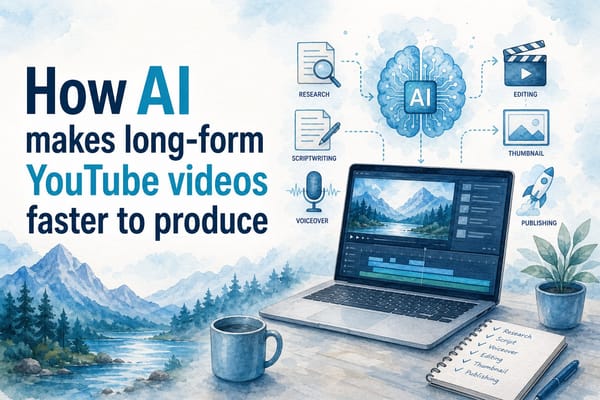
Next comes research and scripting, which is the most intellectually demanding part of the process and the one that takes the longest when done manually without any assistance. A 20-minute YouTube documentary typically requires somewhere between 4,000 and 6,000 words of well-structured, factually accurate script. That script needs to open with something that hooks a viewer before they click away. It needs to move through information in a logical sequence that feels like a story rather than a lecture. It needs to land on a conclusion that makes the viewer feel the time was well spent. Writing that from scratch, with proper sourcing and attention to flow, can take a full day for an experienced writer working on a topic they know well. For a creator who is also doing their own research, it can take longer.
AI-assisted scripting tools can compress that timeline significantly, but only if they are built to handle long-form, factual content rather than short marketing copy or generic blog posts. The difference matters. A tool trained on marketing content will produce scripts that sound promotional and shallow. A tool built for documentary-style narration will produce scripts that match the tone and structure that long-form YouTube audiences actually respond to.
Voiceover comes next, and this is one area where AI technology has genuinely gotten very good very quickly. Neural text-to-speech voices have reached a level of quality where many of them are difficult to distinguish from a human narrator, particularly in calm, measured narration styles that work well for documentary and educational content. The key qualities to evaluate are naturalness, pacing between sentences, and the ability to handle complex proper nouns like historical figures, geographic locations, and technical terminology without stumbling. A production platform that includes a quality voiceover engine removes the need to record your own audio or pay a voice actor for every video you produce.
Then comes the visual layer, and this is where faceless channels live or die. Stock footage needs to match the narration not just loosely but moment by moment. If your narrator is describing the population density of a specific region in a specific decade, you need visuals that support that statement accurately. Generic footage of a modern city is not adequate. It creates a mismatch that viewers pick up on even if they cannot name exactly what feels wrong.
Beyond b-roll, long-form documentary content frequently needs custom visual elements to be effective. Animated maps showing geographic boundaries changing over time make territorial history understandable in a way that static images simply cannot. Timelines that place events in sequence give viewers a framework for absorbing a lot of information without losing track of when things happened. Charts and graphs that make data comparisons clear and immediate are often the difference between a viewer understanding a point and a viewer scrolling away because the information felt abstract.
These visual elements are not decorative. They are functional. They are the tools that turn a narrated script into something that feels like a real documentary rather than a PowerPoint presentation with someone talking over it. And they are also the elements that take the longest to produce manually, because each one requires sourcing or creating the asset, timing it to the narration, and integrating it into the edit cleanly.
Editing ties everything together and is where the cumulative weight of the production pipeline becomes most apparent. Every cut needs to be timed to the narration so that the visual and the spoken word land together. Music needs to sit at the right volume under the voice, close enough to add atmosphere without competing with the words. Captions need to be accurate, properly timed, and positioned so they are readable without covering important parts of the frame. Graphics need to enter and exit smoothly without feeling jarring. For a video in the 20-to-30-minute range, this is several hours of work even for an experienced editor who is moving efficiently.
When you look at that full pipeline laid out in sequence, the question becomes straightforward: which part of this process does an avatars video tool actually accelerate? The honest answer is very little. It might handle one narrow component of the visual presentation, and only by adding a presenter element that the format does not require and that many viewers actively find distracting.
A platform built specifically for faceless long-form content, on the other hand, can meaningfully accelerate every stage of that pipeline. That means moving from a topic idea to a finished, edited, captioned, export-ready video in hours rather than a week. It means being able to publish twice a week instead of twice a month. It means building the kind of content volume and publishing consistency that actually moves the needle on a YouTube channel over the course of months.
I want to be direct about one thing: I am not dismissing avatar technology across the board. In the right context, with the right format, for the right audience, it is a useful tool. But the faceless creator community has spent a lot of time and real money chasing solutions that do not match the actual problem. Avatars video tools get marketed aggressively to this audience because the audience is large, motivated, and actively looking for shortcuts. The pitch lines up with a genuine desire. But the thing being sold rarely lines up with what faceless channels actually need to grow.
Before you spend money on an avatars video subscription, do one useful exercise. Map out your current production pipeline and track where the hours are actually going. Write down how long research takes. How long scripting takes. How long sourcing b-roll takes. How long editing takes. For most faceless creators, the total will be dominated by scripting, b-roll sourcing, and editing. The voiceover component, which is the only thing an avatar meaningfully replaces in this workflow, will be a small fraction of the total.
Solving the big parts of the pipeline is what will grow your channel. Solving the small part is what will leave you frustrated six months from now with a tool you are still paying for and a publishing schedule that has not improved.
Kliptory is built around that specific problem. The platform automates long-form video production for faceless channels from scripting through final export, including b-roll sourcing and timing, data visualizations, captions, and editing. The goal is to let a solo creator or a small team produce documentary-quality content at a volume and pace that would otherwise require a full post-production staff. That is the kind of leverage that moves a channel from stagnant to scaling, and it has nothing to do with whether your video has a face on it.
Ready to take the next step?
If you are running a faceless YouTube channel and your production timeline is the thing holding you back, Kliptory is worth a close look. The platform is built to handle the full production pipeline for long-form documentary-style content, so you can go from a topic idea to a finished, export-ready video without a production team behind you. Visit kliptory.com to see how it works and whether it fits the kind of content you are building.