How to Write a Script for a Long-Form YouTube Video

Writing a script for a long-form YouTube video sounds like a lot of work, and honestly, it is. But here's the thing: it's the kind of work that pays off every single time you hit upload. A solid script is what separates a video that holds people for 40 minutes from one that bleeds views after the first two. Most creators skip this step or treat it like an afterthought, and their watch time shows it. The difference between a video that earns loyal subscribers and one that gets clicked away from in the first three minutes often comes down to whether someone sat down and did the hard thinking before the camera ever turned on.
A lot of you have asked about this exact topic, especially those of you who are building channels around longer content like tutorials, documentaries, or deep-dive essays. Maybe you've tried scripting before and felt like it made your delivery sound stiff and robotic. Maybe you tried winging it and ended up with two hours of footage you had to hack apart in the edit. Both of those problems are real, and both of them are solvable. The good news is that scripting for long-form video isn't some mysterious art form reserved for professional writers. It follows a process, and once you understand that process, writing gets faster and way less stressful. You'll stop staring at a blank page and start actually producing content that works.
This guide walks you through the whole thing from picking your angle to writing your final line. We'll cover how to plan your structure before you type a single word of actual script, how to write dialogue that keeps people watching even when your video is an hour long, and how to make sure what you write on the page actually sounds like a real human being when it comes out of your mouth on camera. Whether you're making your first long-form video or your fiftieth, there's something here that'll make your next script better than your last one. Let's get into it.
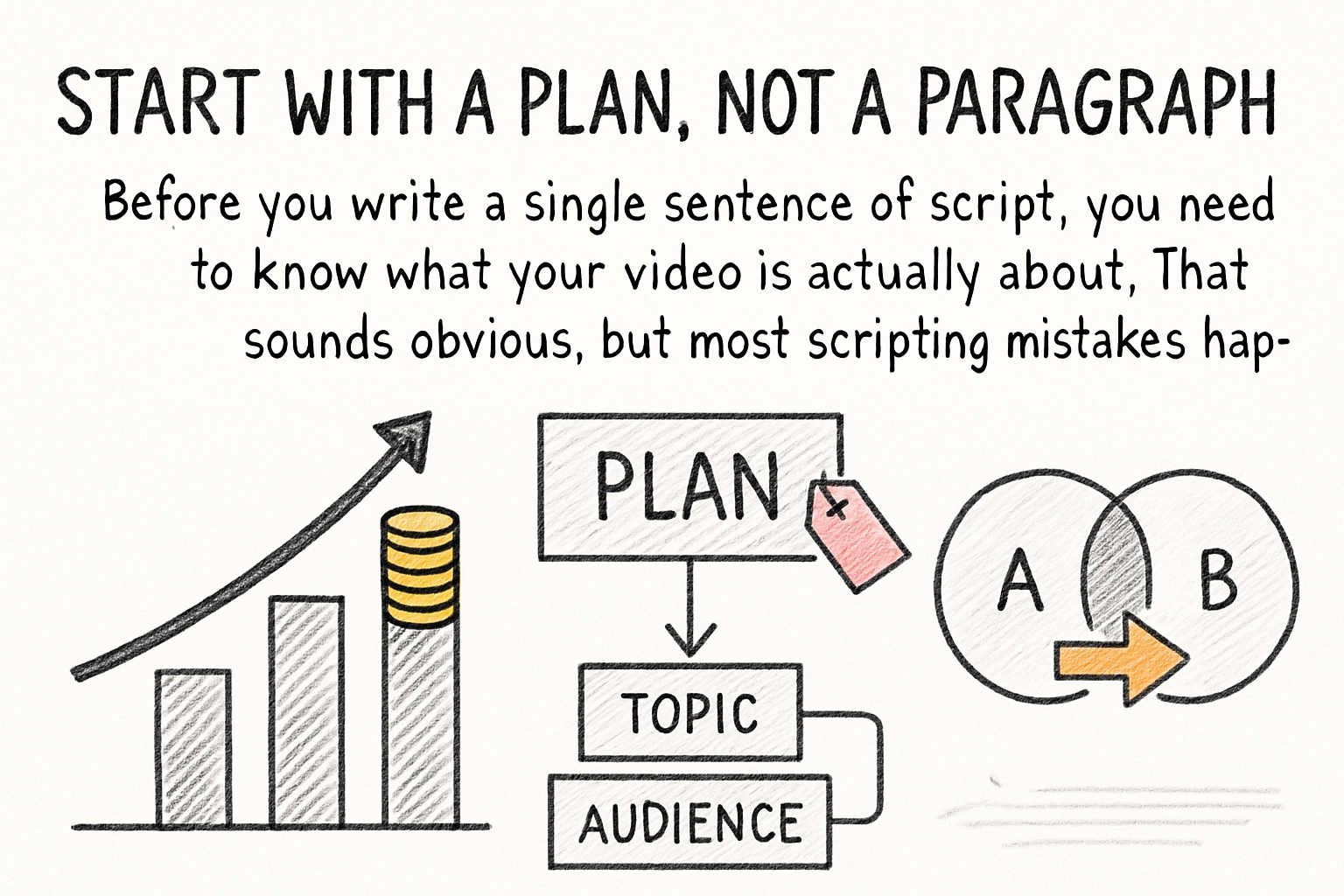
Start with a plan, not a paragraph
Before you write a single sentence of script, you need to know what your video is actually about. That sounds obvious, but most scripting mistakes happen right here. Creators pick a topic and then just start writing, and what comes out is a messy blob of ideas that wanders in seventeen different directions. Planning first saves you from rewriting later, and it saves you from recording something you'll realize halfway through the edit was never going to work.
Start by writing out your core promise in one sentence. Ask yourself this: what will someone know, feel, or be able to do after watching this video that they didn't before they clicked play? That answer becomes your north star for the entire project. Every section, every story, every example you write should connect back to it. If a chunk of content doesn't serve that promise in some clear way, cut it before you even flesh it out. This sounds harsh, but it's actually freeing. You stop second-guessing every paragraph and start asking one simple question instead: does this serve the promise? Yes or no. That filter speeds up every decision you make from here on out.
Once you've got your promise locked, build out a rough outline. Think of your video like a series of chapters in a short book. Each chapter should cover exactly one main idea and then hand off to the next in a way that feels natural, not forced. For a 30-minute video, you might have five or six of these chapters. For a 60-minute video, you might have eight to ten. Either way, each chapter needs to stay tight and focused. Cramming two or three big ideas into one section confuses viewers and muddles your pacing. Keep it to one idea per chapter, give it enough room to breathe, and then move on. If you want more help thinking through structure at this level, our piece on how to structure a 30-minute YouTube video for retention goes deep on exactly this kind of chapter-by-chapter planning.
Here's where a lot of people get the outline wrong: they treat it like a to-do list instead of a story map. They write down topics in order and call it done. But a good outline tells you not just what you'll cover, but why you're covering it in that specific order. The sequence of your chapters is an argument. You're building something. Each chapter should make the next one feel necessary, like you couldn't understand chapter four without having gone through chapters two and three first. That sense of progression is what keeps a long-form viewer committed to watching all the way through. They feel like they're moving somewhere, not just sitting through a lecture.
I personally think the outline stage is where most of your actual creative work happens. The writing part later is really just filling in the bones you've already built. When I've got an outline that feels genuinely solid, where I know exactly what each chapter is doing and why it comes when it does, I can write a full script in a fraction of the time it would take me otherwise. When the outline is shaky or half-formed, I end up rewriting the same three paragraphs over and over because they don't have a clear job to do. A weak outline creates a weak script no matter how good your sentences are. Get this step right and everything that comes after it gets easier in ways you won't fully appreciate until you're in the middle of your next edit and nothing needs to be cut.
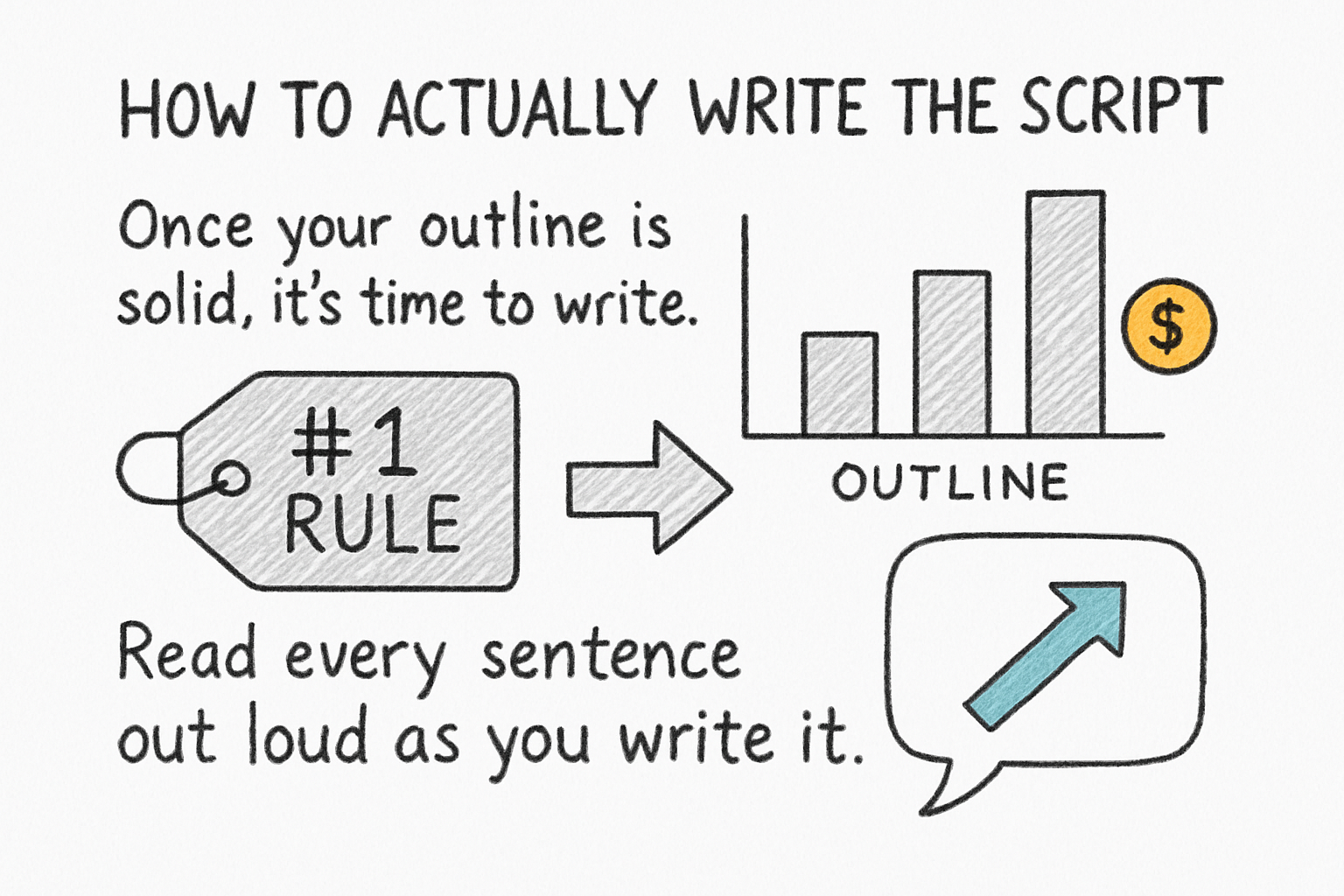
How to actually write the script
Once your outline is solid, it's time to write. And the number one rule here is to write like you talk. Read every sentence out loud as you write it. If something sounds weird coming out of your mouth, rewrite it right there before you move on. Long-form YouTube videos work because they feel like a conversation, not a lecture. The moment your script starts sounding formal or stiff, like something you'd turn in for a class assignment, you've lost the viewer. They didn't click on your video to read a textbook with their ears. They clicked because they want to spend time with someone who knows what they're talking about and can explain it in plain language.
Start with your hook, and don't treat it casually. The first 30 to 60 seconds of your video decide whether someone stays or leaves, and that's not an exaggeration. Most viewers make that decision before your intro music even finishes. You don't need to do something crazy or over-the-top to hold them. You don't need a jump cut every two seconds or a thumbnail face plastered across the frame. You just need to make the viewer feel like they showed up to exactly the right place for whatever they came to learn or understand. There are a few ways to do this well. You can state the problem you're solving in a way that makes viewers feel like you read their mind. You can tease the most surprising or counterintuitive thing you're going to reveal later in the video. You can open with a specific story or scenario that puts the viewer inside the problem immediately. Check out the full breakdown on YouTube intro strategies and how to hook viewers in the first 5 seconds if you want to go really deep on this piece alone, because it's worth treating the hook as its own separate craft.
From there, move through your chapters. Each one should open with a clear signal of what you're about to cover so viewers always know where they are in the video. Then deliver on what you promised for that chapter, with examples, specifics, and enough detail to actually be useful. Then close that chapter with a small payoff, a moment of resolution or insight, and a bridge that pulls people naturally into the next section. Those bridges are critical in long-form content and a lot of creators completely ignore them. Things like "but here's where it gets interesting" or "that brings us to the part most people get completely wrong" work because they create tiny moments of curiosity that push people forward. They're mini cliffhangers scattered throughout the video. Without them, each chapter just ends and viewers have a split second to decide whether to keep going or click away. The bridge removes that decision point by giving them a reason to stay before they even think to leave.
Let's talk about examples, because this is where a lot of long-form scripts fall apart. Abstract explanations without concrete examples feel academic and distant. Viewers can follow you for a minute or two, but then they lose the thread and start half-watching. Examples anchor ideas to reality. Say you're making a video about how to price a freelance project. You could write two paragraphs explaining the general theory of value-based pricing. Or you could write one paragraph explaining the concept and then walk through what it looks like when a specific freelance designer sits down with a specific client, runs through the numbers, and arrives at a specific rate. The second version is longer but it's also the version people actually remember. Use real scenarios, real numbers, real decisions. Make your viewer feel like they're watching something happen rather than listening to someone explain a concept.
Don't be afraid to write a lot in your first draft and then cut it down later. Overfilling your first draft is completely fine. You can always trim. What's genuinely harder is trying to stretch thin material into a long video, because viewers can feel it the way you can feel when someone is stalling. They sense when a creator is padding out content to hit a runtime, and they click away. The goal is to write from a place of having more good material than you can use, then tighten until only the best stuff survives. That discipline is what produces long-form content that people actually finish. The guide on how to make ultra long YouTube videos people actually finish is worth reading alongside this one, because it covers the retention side of this challenge in a lot more depth.
One more thing worth saying about the actual writing process: give yourself permission to write badly in the first pass. Some creators freeze up because they're trying to write perfect sentences on the first try. That's not how good writing works. Get the ideas down in whatever rough shape they come out in. Ugly sentences, half-finished thoughts, placeholder phrases like "explain this better later," all of that is fine. The first draft is supposed to be messy. The second draft is where you shape it. The third draft is where you make it sound like you. Most people never get to the third draft because they quit after the first one felt bad. Push through.
Making your script work on camera
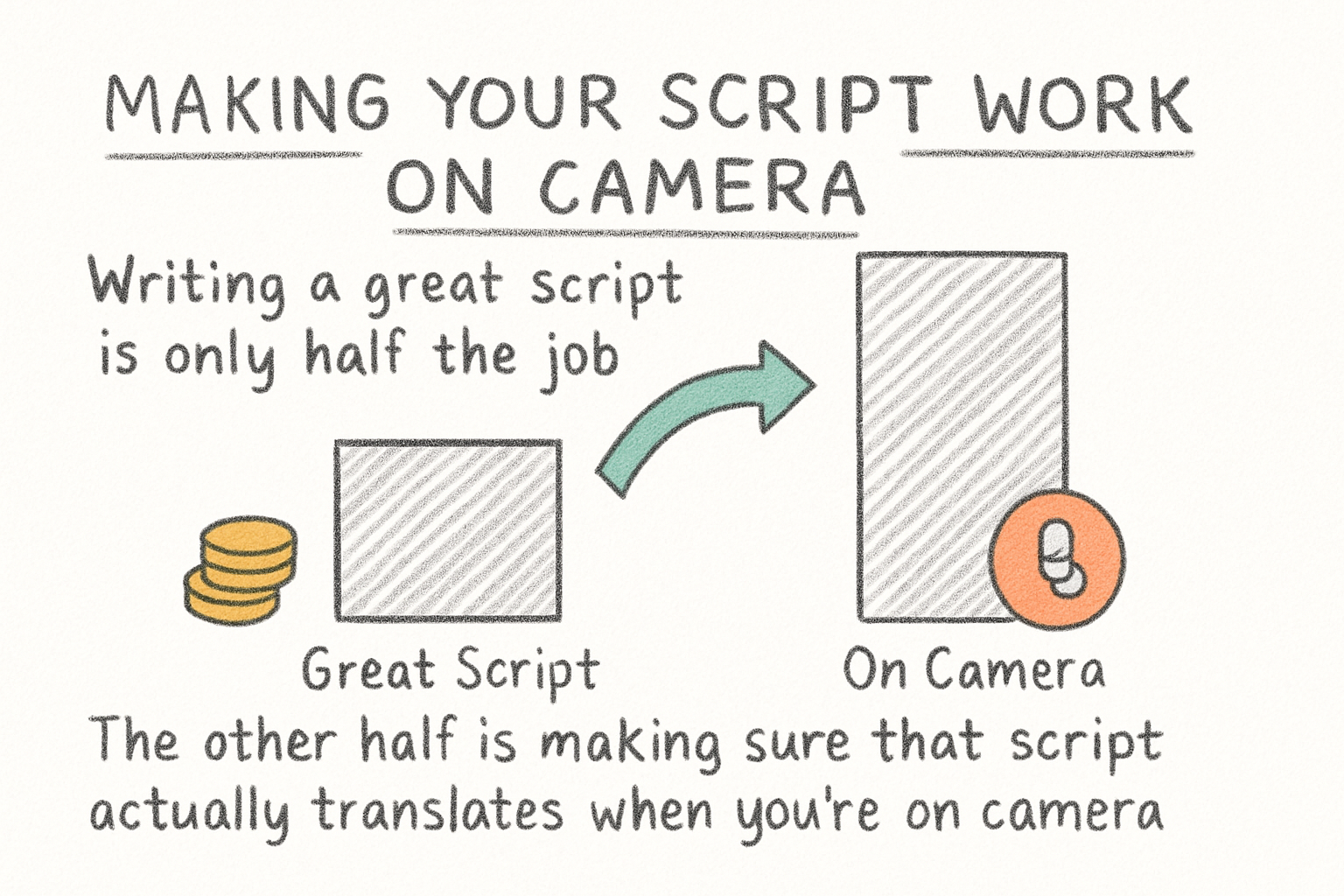
Writing a great script is only half the job. The other half is making sure that script actually translates when you're on camera with a mic clipped to your shirt and the record light blinking. A script that reads well on the page doesn't always work when it's coming out of a real human mouth. There are things you can do during the writing process itself to set yourself up for a much smoother recording session, and skipping this part is why a lot of creators end up with dozens of takes they can't use.
First, keep your sentences short. This isn't just a readability tip for viewers, it's a practical breathing tip for you as the person delivering the content. Long, winding sentences that connect three or four ideas with a string of conjunctions are hard to deliver naturally on camera. They force you to rush, swallow your words, run out of air, or pause awkwardly in the middle of a thought. Short sentences give you natural pause points that actually come across as confident and deliberate on screen. They also make editing easier, because each sentence becomes its own clean, self-contained unit that you can cut and rearrange without losing the meaning of the surrounding material. When you're in the edit and you need to tighten a section, short sentences are your best friend. Long sentences that can't be split are the ones that force you to cut entire paragraphs when all you wanted to do was trim a few words.
Second, build in variety. Long-form videos live or die by their pacing, and pacing is something you control at the script level, not just in the edit. If your script is one long, unbroken stretch of explanation with no shift in tone, energy, or format, viewers will drift. Their attention isn't gone because they don't care about your topic. It's gone because their brain needs something to react to, and a flat wall of information doesn't give it anything. Write in stories. Add a moment where you ask a rhetorical question and then answer it a beat later. Include a personal take that surprises people. Throw in an unexpected comparison that makes an abstract concept suddenly click. I once sat through a 45-minute deep-dive video about the history of a trading card game and stayed completely locked in for the whole thing, not because the topic was inherently thrilling to me, but because the creator kept shifting gears every four or five minutes. One section was almost journalistic. The next had a personal story in it. The one after that used a specific, funny example that broke the tension. Variety doesn't mean chaos. It means you're respecting the fact that human attention isn't a constant thing, it's a wave, and your script should work with that rhythm instead of against it.
Third, decide how you're going to use your script when you actually record, and make that decision before you start writing. This matters more than most creators realize. If you're planning to read from a teleprompter, you need to write every word, every transition, every aside, because there's no room to improvise when the text is scrolling past your eyes. If you're going to memorize sections and deliver them from memory, you might want to write in shorter, chunkier paragraphs that are easier to hold in your head. If you're going to use a detailed outline and speak freely within each chapter, then your script doesn't need to be word-for-word at all. It just needs to be detailed enough that you know exactly what you're trying to say in each section and roughly how you want to say it. Each approach produces a different kind of energy on camera. Teleprompter delivery can look smooth but sometimes feels a little flat. Free-form delivery feels alive but can meander. Memorized delivery often lands in the middle and works well for creators who want the warmth of speaking naturally without losing the precision of a full script.
The other thing worth thinking about is energy. When you write your script, it's easy to write at whatever energy level you happen to be at that day. But when you record, you'll probably need to perform the material at a higher energy level than feels natural in order for it to translate through a camera lens without feeling flat. The camera compresses energy. What feels enthusiastic in your living room often looks calm on screen. So read your script and ask yourself where the moments of genuine enthusiasm are. If you can't find any, you might need to rewrite some sections until you feel something when you read them. An engaged creator is the single biggest factor in whether a long-form video holds attention. You can have a flawless structure and perfect pacing, but if you sound like you're bored by your own material, no edit in the world will save you.
Finally, do a full read-through of your completed script out loud, from the first word to the last, before you record a single frame. Time it. See where you stumble. Notice where it gets slow or where your voice goes flat because the writing is pulling you down. Mark those spots and fix them. This step feels tedious, and honestly, the first time I did it I kept stopping every few paragraphs because I was so used to treating writing as a reading experience rather than a speaking experience. But the read-through is where you find all the problems that the page was hiding. It's the closest thing to a dress rehearsal you can give yourself before the real performance, and it almost always makes your final recording go faster because you've already worked through the rough patches.
Ready to take the next step?
Scripting a long-form video takes real effort, but it's the kind of effort that builds into something solid over time. Every hour you spend planning your structure and working through your script is an hour you're not spending re-recording shaky sections or trying to rescue a rambling edit at two in the morning. The skills you build with your first long-form script carry forward into every video you make after it. You get faster. Your outlines get sharper. Your hooks get stronger. And your viewers start to feel it, even if they can't name exactly why your videos hold their attention better than others. Start simple, build the habit, and give yourself room to improve rather than demanding perfection on the first try. If you're serious about growing a long-form channel and want tools that actually support the planning and production process, check out Kliptory and see how it helps creators stay organized, build better scripts, and scale their content without things falling apart. Drop a comment below and let us know where you usually get stuck when you're scripting. Do you stall out in the outline phase? Do you lose steam halfway through the first draft? Do you write something you love on paper but can't deliver on camera? We read everything, and your question might end up as the next guide.