How to create multilingual faceless YouTube videos with AI

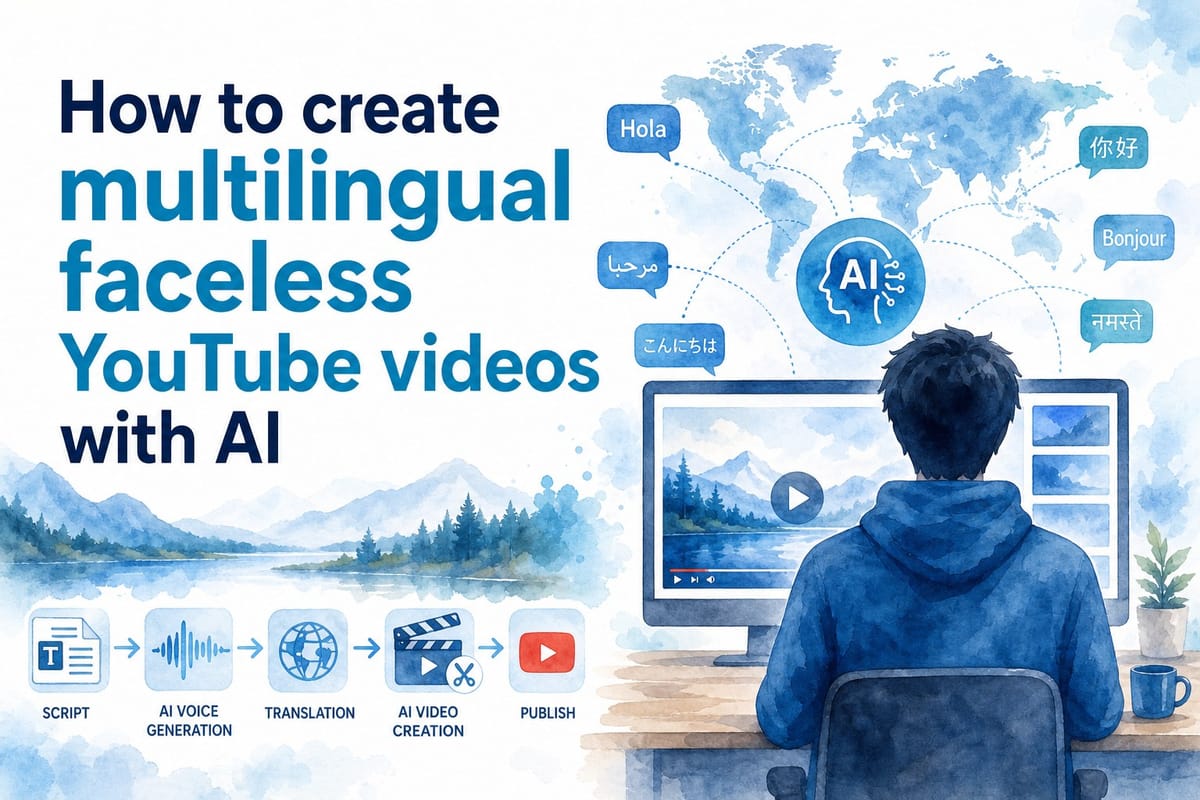
Table of contents
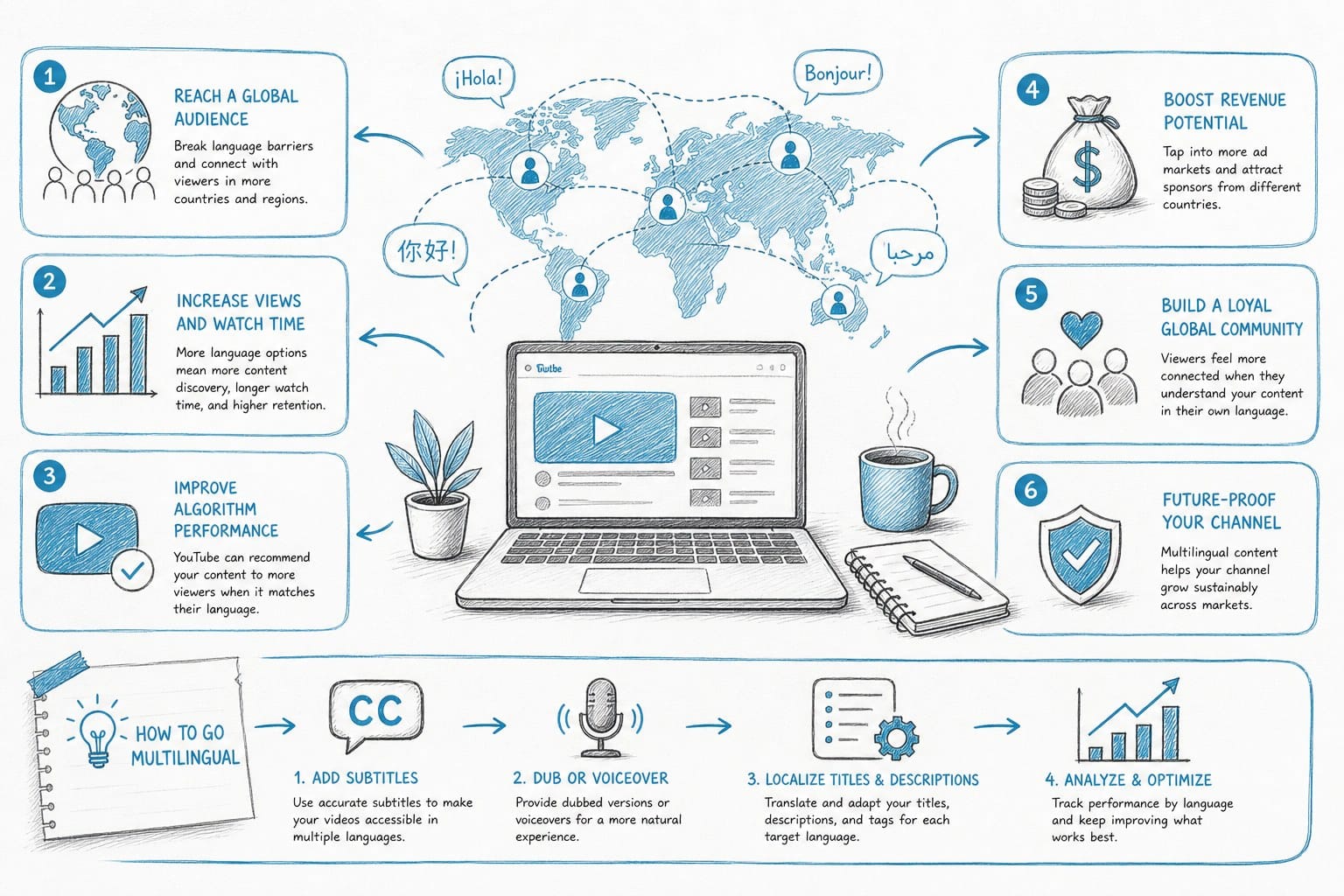
1. Why multilingual content matters for faceless YouTube channels
2. Building a multilingual AI video workflow step by step
3. Scaling a multilingual faceless channel operation with AI automation
YouTube has more than 2.5 billion logged-in users every month, and a large portion of them do not speak English as their first language. If I run a faceless YouTube channel and only publish in English, I am leaving a significant portion of that audience on the table. The good news is that AI tools have made it practical to produce videos in multiple languages without hiring a translation team, recording studio, or army of editors. In this article, I walk through exactly how to build a multilingual faceless YouTube video workflow using AI, what to think about before you start, and how a platform like Kliptory fits into the process.
Why multilingual content matters for faceless YouTube channels
There are somewhere between 5,000 and 7,000 living languages in the world, depending on how researchers draw the line between a language and a dialect. YouTube operates in over 100 countries and supports dozens of interface languages. That gap between the number of languages humans actually speak and the number of languages most YouTube creators publish in represents a real opportunity.
Faceless channels have a structural advantage here. A channel that shows a host on camera has to re-record or dub every single video if it wants to reach speakers of another language. A faceless channel built around narration, stock footage, data visualizations, and captions can swap out the audio layer and update the text overlays without rebuilding the entire video from scratch. The core visual production stays intact. Only the language-specific elements need to change.
Let me put this in concrete terms. Imagine I run a faceless documentary channel about world history. I produce a 20-minute video in English about the fall of the Roman Empire. That same video, adapted into Spanish, Portuguese, French, German, or Hindi, could realistically reach 10 times the audience with a fraction of the original production effort. Each adapted version targets a different YouTube market, gets indexed by different search queries, and accumulates watch hours independently. From a monetization standpoint, some of those markets -- like Germany or France -- have advertiser CPM rates that rival or exceed English-language CPMs.
The challenge used to be execution. Translation costs money. Professional voiceover artists in multiple languages cost more money. Syncing new audio to existing footage, re-timing captions, and re-rendering the final video requires a post-production team. Most solo creators and small channel operators simply could not afford to run a multilingual operation.
AI has changed this equation. Scriptwriting, voiceover generation, caption creation, and even B-roll sourcing can now be automated at a fraction of the traditional cost. A creator who knows how to string these tools together can produce documentary-style videos in multiple languages without any of the legacy production overhead.
Before diving into the workflow itself, it is worth thinking about which languages to target first. I would not recommend trying to publish in 15 languages on day one. A smarter approach is to look at YouTube Analytics for any existing channel and check the geographic breakdown of viewers. If a channel already gets meaningful watch time from Spanish-speaking countries, that is a clear signal to prioritize Spanish. If there is no existing data to work from, I would look at YouTube search volume tools to identify which language markets have strong demand for the topic and relatively weak competition. Spanish, Portuguese, Hindi, and German are generally strong starting points for English-language creators expanding into new markets because of their large YouTube user bases and growing advertiser ecosystems.
One more thing to keep in mind: adapting content across languages is not just a mechanical translation exercise. Language carries cultural context. A joke that lands in English might not translate well into Japanese. A historical reference that feels familiar to an American audience might need more explanation for a Brazilian one. The best multilingual content is not a literal word-for-word translation. It is a thoughtful adaptation that respects the audience's cultural frame of reference. AI tools can handle the heavy lifting of translation and voiceover generation, but a human review step -- even a quick one -- adds real value, especially for channels trying to build loyal audiences in specific markets.
Building a multilingual AI video workflow step by step
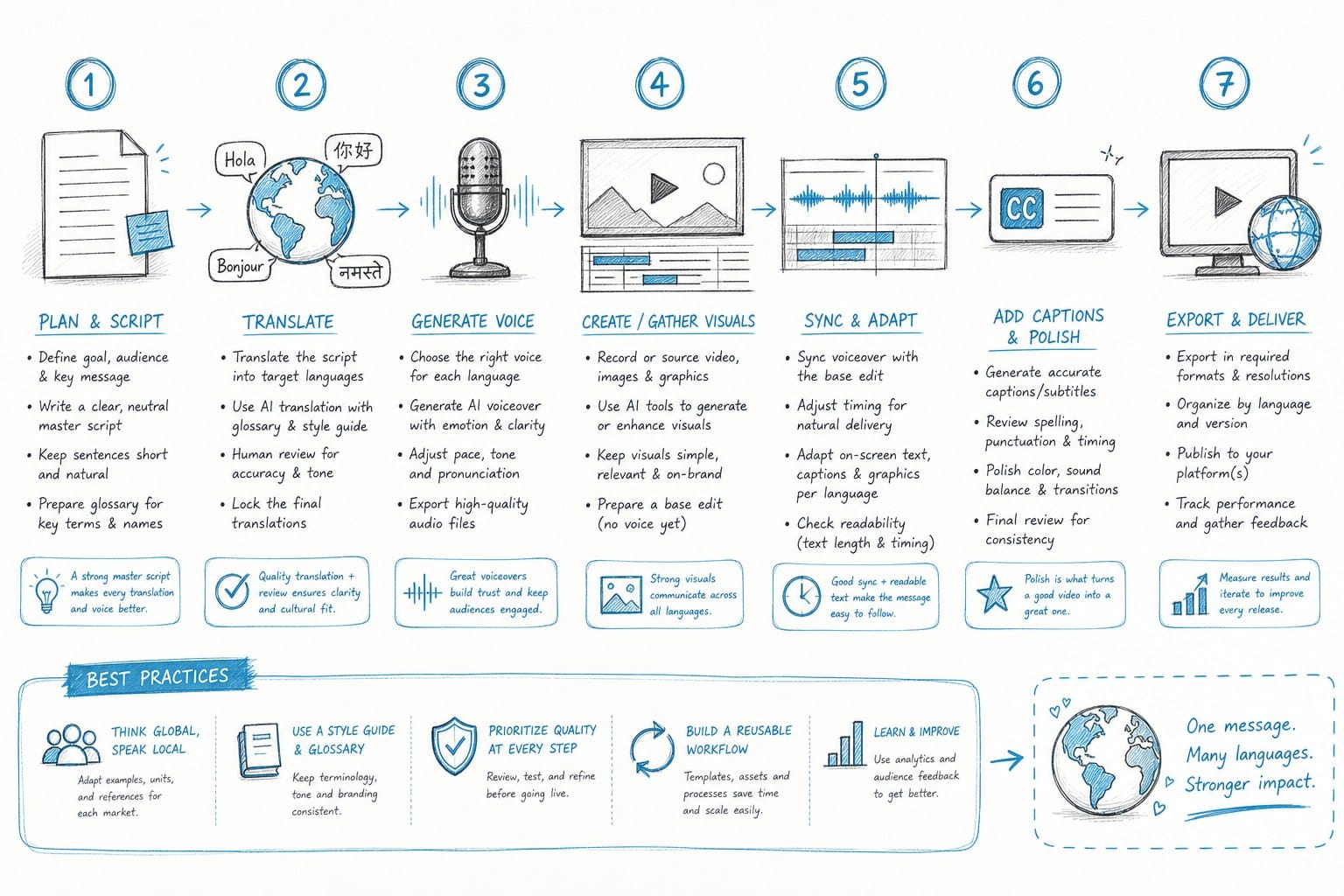
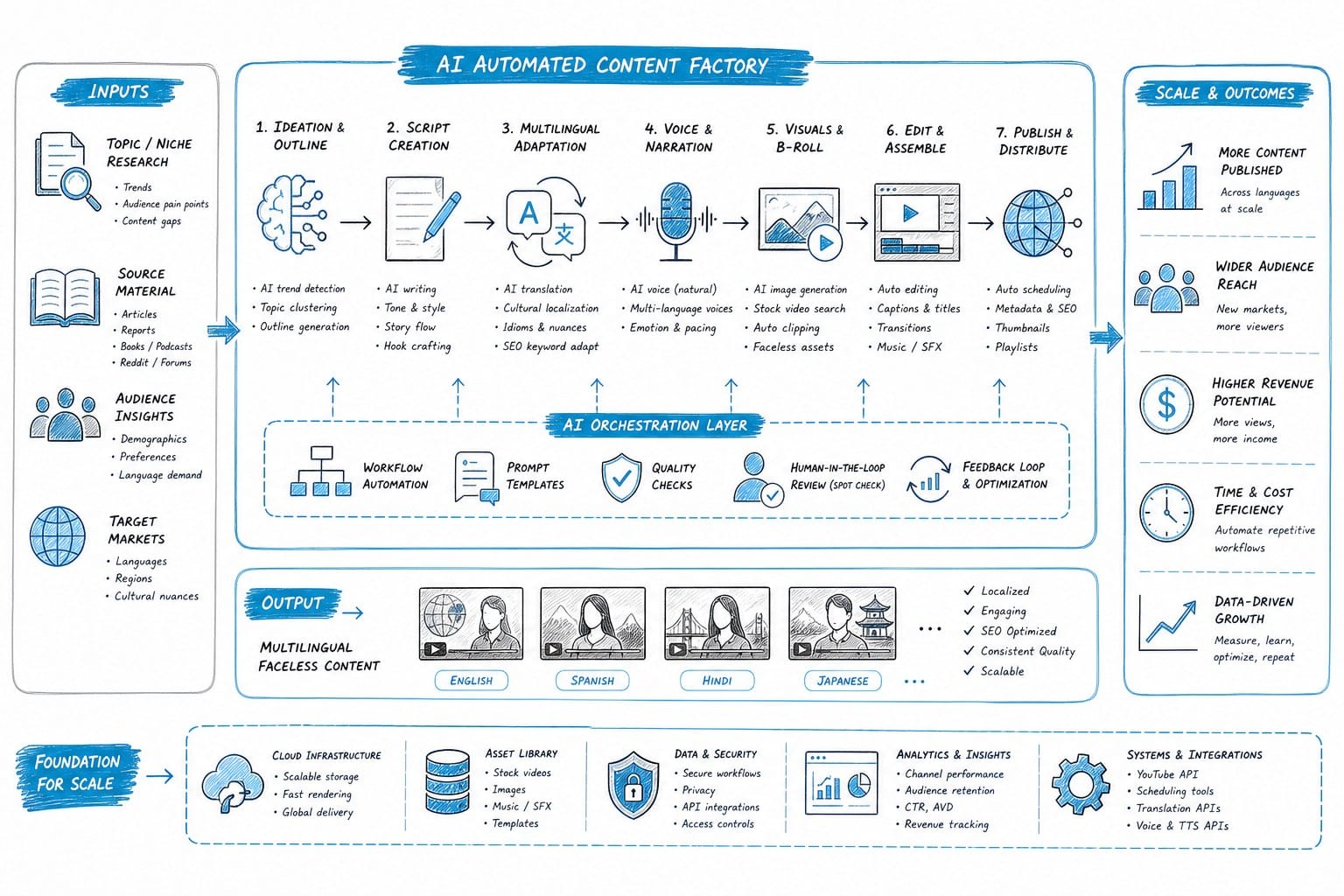
A functional multilingual faceless YouTube workflow has several distinct stages: scripting, translation and cultural adaptation, voiceover generation, visual assembly, caption creation, and final export. AI can assist at every single one of these stages. Here is how I think about each one.
Scripting in the source language
Every multilingual video starts with a solid script in one primary language. For most creators, that is English, because it is the language they write and think in most fluently. The script is the backbone of the entire video. Everything else -- the voiceover, the B-roll choices, the data visualizations -- flows from it.
For long-form faceless content, a script for a 20-minute video might run 3,000 to 4,500 words. That is a substantial document, and writing it well takes time. AI scripting tools can generate a structured first draft based on a topic prompt, which I can then edit, fact-check, and refine. The goal is a script that reads naturally when spoken aloud, is logically structured, and fits the documentary or explainer format the channel uses.
If you want to go deeper on what the long-form scripting process looks like, I wrote about it in detail in this post about how to produce long-form YouTube videos with AI.
Translating and adapting the script
Once the source script is finalized, the next step is translation. AI translation has improved dramatically. Tools built on large language models can produce translations that read naturally in the target language rather than sounding like a literal word swap. That said, I always recommend treating the AI translation as a strong first draft rather than a finished product.
For the adaptation step, I think about a few specific things. First, are there any idioms or culture-specific references in the source script that will not make sense to a speaker of the target language? Second, are there any names, dates, or units of measurement that need to be reformatted for the target market? Third, does the tone match what feels natural in that language? A conversational tone that works in English might feel too informal in German, or the reverse.
If I am serious about a particular language market, I will run the AI translation past a native speaker -- even just a friend or a freelancer on a platform like Upwork -- to catch anything the AI missed. This is a one-time cost per script, and it is worth it for channels trying to build real audiences rather than just chasing algorithmic reach.
Generating voiceover in multiple languages
This is where AI has made the biggest leap forward for multilingual content. Text-to-speech tools have improved to the point where they can generate natural-sounding narration in dozens of languages with minimal robotic artifacts. Some tools allow creators to clone a specific voice and generate speech in multiple languages using that same voice profile, which creates continuity across a channel's library.
When selecting a voice for a specific language, I think about a few things. Does the voice sound like a native speaker, or does it have a noticeable accent that might feel off to the target audience? Does the pacing feel natural for that language? Some languages are spoken faster or slower on average than English, and a good text-to-speech system will account for this. Does the voice match the tone of the content -- authoritative for a documentary, conversational for an explainer?
For faceless channels, the voiceover is the primary human element in the video. It is the thing that builds trust with the audience. Spending time selecting the right AI voice for each language is not a detail to rush through.
Assembling visuals and data elements
Faceless documentary-style videos rely heavily on B-roll footage, maps, timelines, charts, and other visual elements to support the narration. The good news is that most of these visuals are language-agnostic. A map of ancient Rome is equally useful whether the narration is in English or French. A bar chart comparing economic data communicates the same information regardless of the voiceover language.
The main visual elements that do need language-specific adjustments are text overlays, lower thirds, and any on-screen labels or annotations. If a chart has axis labels in English, those labels need to be updated for the Spanish or German version. If there are title cards with text, those need translation too.
A platform like Kliptory handles this kind of automated visual assembly for long-form content, including maps, timelines, and data visualizations, which makes the multilingual adaptation process significantly faster because the core visual structure is already built programmatically rather than hand-edited in a timeline.
Generating and syncing captions
Captions serve two purposes: accessibility and discoverability. For multilingual content, they also serve as another layer of language adaptation. AI captioning tools can generate captions directly from the translated voiceover audio, which means captions are often produced automatically as a byproduct of the voiceover step.
I always review auto-generated captions before publishing. Even a small error in a caption can look unprofessional to native speakers of the target language. For channels investing in specific language markets, accurate captions are a basic quality signal.
YouTube also allows creators to upload translated metadata -- titles, descriptions, and tags -- for each language a video is published in. This is often overlooked, but it matters for search. A video titled in Spanish will appear in Spanish search results. A video with only an English title will struggle to surface for Spanish-language queries even if the audio and captions are in Spanish.
Final export and channel strategy
Once the language-specific version of a video is fully assembled -- translated script, localized voiceover, updated text overlays, accurate captions, and translated metadata -- it is ready to export. I think of each language version as a separate asset that lives on a separate channel.
Running separate YouTube channels for each language is generally the right approach for serious multilingual operations. YouTube's algorithm is better at recommending content to users who watch in a specific language if that content lives on a channel where all the content is in that language. A single channel that mixes English and Spanish videos tends to confuse the recommendation engine and produces weaker organic reach in both markets.
This does mean managing multiple channels, which adds operational complexity. But for a faceless channel operator using AI automation, the marginal effort of managing a second or third channel is much lower than it would be for a traditional video creator who produces everything manually. The Kliptory platform is designed specifically for this kind of scaled faceless channel operation, automating the heavy production work so that managing multiple channels becomes a realistic proposition for a solo creator or small team.
Scaling a multilingual faceless channel operation with AI automation
Once the basic workflow is in place, the next challenge is scale. Producing one video in three languages is manageable. Producing 10 videos a month in five languages is a different problem. This is where automation becomes the difference between a sustainable operation and an overwhelming one.
Let me walk through what a scaled multilingual operation actually looks like in practice, and where AI automation makes the biggest difference.
Systematizing content selection across languages
Not every topic translates well across all language markets. A video about American tax policy might perform well for English-speaking audiences but have limited appeal in Germany or Brazil. A video about the history of the Amazon rainforest might do extremely well in Portuguese but generate less interest in Hindi-speaking markets.
The most efficient multilingual operations start with topic selection that considers cross-market appeal from the beginning. Topics that tend to travel well across languages include world history, geography, science, technology, global economics, and nature. Topics that are tightly tied to one country's culture, politics, or legal system are harder to adapt and often not worth the effort.
I build a content calendar that flags each planned video with its target language markets. Some videos get produced in all five languages I operate in. Others only make sense for two or three specific markets. This kind of intentional topic selection prevents me from wasting production resources on adaptations that are unlikely to perform.
Automating the production pipeline
For long-form faceless content, the production pipeline has several stages that can each be partially or fully automated. Scripting can be AI-assisted. Translation can be AI-generated. Voiceover can be AI-synthesized. B-roll sourcing can be automated based on script keywords. Data visualizations can be generated programmatically. Captions can be auto-generated from audio. Final export can be automated.
The more of these stages that run automatically, the more videos I can realistically produce per month without adding headcount. A creator using a full-stack production platform like Kliptory can produce documentary-style videos in hours rather than the weeks it would take with a traditional post-production workflow. When that efficiency applies to multiple language versions of the same video, the math becomes compelling.
If I can produce the English master version of a 20-minute video in a few hours, and each language adaptation takes another hour or two of AI-assisted work, I can realistically ship five language versions of a video in a single working day. That is a level of output that was simply not possible for solo creators before AI automation.
For more on what this kind of accelerated production looks like at the long-form end of the spectrum, I cover it in this post about how to create ultra long form YouTube videos with AI.
Quality control at scale
The risk with heavy automation is quality degradation. AI translation is good but not perfect. AI voiceover is natural-sounding but can stumble on proper nouns, regional names, or technical terminology. Auto-generated captions have error rates that vary by language.
I recommend building a lightweight quality control step into the workflow for each language version. This does not need to be a full editorial review. It can be a 15-minute listen-through of the finished audio to catch any obvious errors, a scan of the captions for formatting issues, and a check of the translated metadata before publishing. For channels in the early stages of building an audience in a new language market, this quality control investment pays off in audience retention and trust.
For channels operating at very high volume, it can make sense to hire a part-time language reviewer for each target market. A freelancer who speaks native Spanish and knows the YouTube content space can review three or four videos a week in a few hours, which is affordable even for small channel operations. Their job is not to rewrite the AI translation but to catch anything that sounds unnatural or culturally off before it reaches the audience.
Building channel authority in each language market
Running a multilingual faceless operation is not just about translating existing content. Over time, the strongest language-specific channels develop a content identity that fits that market. A Portuguese-language channel might lean into topics that resonate specifically with Brazilian or Portuguese audiences. A Hindi-language channel might cover topics that connect with South Asian history, culture, or current events more often than a pure translation of the English channel would.
This market-specific content identity builds faster audience loyalty than a channel that feels like a generic translation of something made for a different audience. I think of each language channel as its own brand that happens to share a production infrastructure with the other channels.
For faceless channels specifically, the visual and audio production quality serves as the brand anchor. Consistent use of the same documentary style, the same visual language, and a consistent AI voice personality across episodes creates the kind of recognizable experience that keeps subscribers coming back. When I maintain that consistency across multiple language versions, each channel builds its own loyal audience independently.
Monetization across language markets
One of the strongest arguments for running multilingual faceless channels is the monetization math. YouTube ad revenue varies significantly by geography. English-language content targeting North American or UK audiences typically earns higher CPM rates than content targeting audiences in lower-income markets. But several non-English markets -- Germany, France, the Netherlands, Scandinavia, Japan -- have advertiser CPM rates that are competitive with or higher than English-language rates.
A faceless channel operator running German and French language versions of a successful English channel is not just doubling or tripling potential revenue. In some cases, the German or French channel might generate more ad revenue per 1,000 views than the original English channel, depending on the topic and the audience demographics.
Beyond AdSense, multilingual channels also open doors to sponsorship deals with brands that are trying to reach specific regional audiences. A Spanish-language YouTube channel with 50,000 subscribers in Latin America is an attractive partner for brands targeting that market, regardless of what language the original English channel is in.
For creators thinking about YouTube channel monetization broadly, it is also worth reading about the full ecosystem of tools available for faceless channel operators. This post covers some useful context on TubeMagic alternatives for faceless YouTube creators, which touches on the broader toolkit side of running a scaled channel operation.
Common mistakes to avoid
Before I close out this section, let me flag a few mistakes I see multilingual faceless channel operators make.
The first mistake is using machine translation without any human review and publishing directly. AI translation is impressive but it produces unnatural phrasing in every language often enough that native speakers notice. Even one pass of light editing from a native speaker catches the most obvious issues.
The second mistake is using the same YouTube channel for multiple languages. As I mentioned earlier, YouTube's recommendation algorithm works better when a channel is clearly identified with one language. Mixing languages on one channel tends to hurt both audiences.
The third mistake is translating everything including content that does not have cross-market appeal. Topic selection for multilingual expansion should be intentional. Not every video is worth adapting into every language.
The fourth mistake is neglecting translated metadata. The title, description, and tags for a video are just as important for search discoverability as the audio language. A Spanish voiceover with English metadata is a missed opportunity.
The fifth mistake is launching too many language channels at once before the production workflow is running smoothly. Starting with one additional language, building the workflow until it runs reliably, and then expanding to a second language is a much more sustainable approach than trying to spin up five language channels simultaneously.
A multilingual faceless YouTube operation built on AI automation is one of the most scalable content businesses available to individual creators today. The combination of low marginal production cost per language, broad audience reach across markets, and strong monetization potential makes it worth the upfront investment in workflow design and quality control systems.
Ready to take the next step?
If you are ready to start building a faceless YouTube channel that produces long-form documentary-style videos at scale, Kliptory is designed for exactly this kind of operation. It automates scripting, voiceover, B-roll sourcing, data visualizations, captions, and editing in one platform, which gives you the production capacity to run multilingual channels without a post-production team. Check out what Kliptory can do and see how fast you can go from topic idea to finished video.