How to create ultra long form YouTube videos with AI


Table of contents
1. Why ultra long form videos are worth the effort
2. The step-by-step process for building ultra long form videos with AI
3. Choosing the right AI platform for ultra long form production
Ultra long form YouTube videos are taking over the platform. Channels publishing videos between 20 minutes and several hours are pulling in more watch time, stronger ad revenue, and deeper audience loyalty than shorter clips ever could. The problem is that making these videos the traditional way is brutal. Writing a script alone can take days. Sourcing footage, recording voiceover, editing, adding captions, and syncing everything together can stretch a single video into weeks of work. That is where AI production tools change the game. This guide walks you through exactly how to create ultra long form YouTube videos with AI, from the initial concept all the way to a finished, publish-ready file, without hiring a full production team or spending weeks on a single upload.
Why ultra long form videos are worth the effort
Before getting into the how, it helps to understand why creators are pushing video length further than ever before. The economics and algorithm behavior behind ultra long form content make a compelling case on their own.
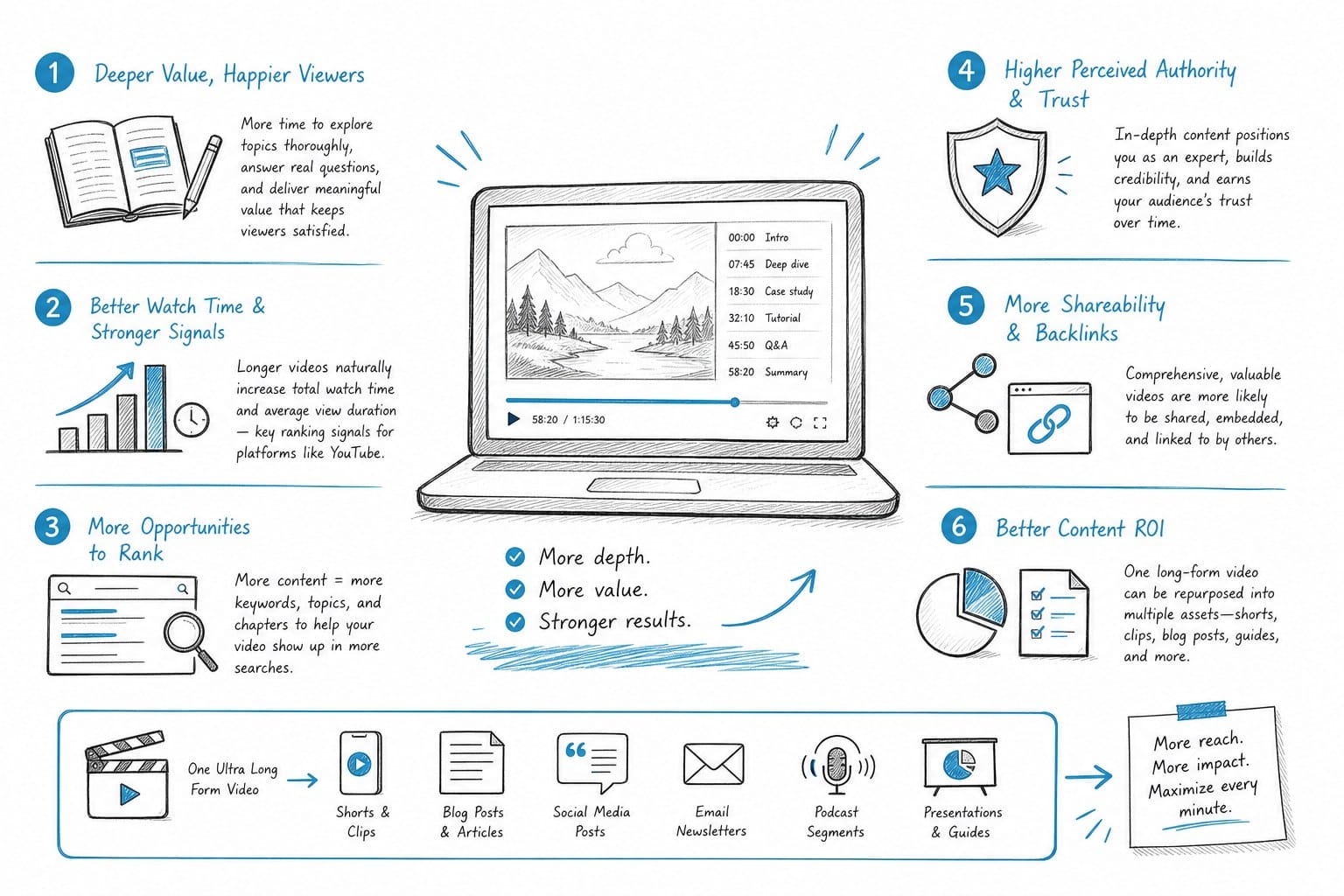
Watch time is what actually moves the needle
YouTube's algorithm rewards watch time, not just views. Actual minutes watched matter more than click counts. When someone sits through a 30-minute documentary-style video on your channel, that signals to YouTube that your content is valuable. That single long video can generate more total watch time than ten shorter videos combined, even if fewer people click on it. The algorithm notices that gap and responds by recommending the longer video more aggressively over time.
This is not a theory. It is a pattern that shows up consistently in creator analytics across niches. Channels that pivot from 8-minute videos to 25-minute videos in the same niche often see total watch time jump substantially within the first few months, even before their subscriber count grows. The longer format earns more time per viewer, and YouTube rewards that efficiency.
Ad revenue multiplies with length
Once a video crosses the eight-minute mark, creators can place mid-roll ads. In ultra long form content running 20 to 40 minutes or longer, you can place multiple mid-rolls. That multiplies your ad revenue per view without needing more viewers to show up. A channel earning $4 CPM on five-minute videos can realistically earn $10 to $15 per thousand views on a 30-minute video in the same niche, simply because more ad slots are available and advertisers pay higher rates for longer, more engaged viewing sessions.
For faceless channels that rely entirely on ad revenue rather than sponsorships or merchandise, this math matters a lot. Publishing fewer, longer videos can generate more total revenue than publishing more short videos on the same schedule, while also demanding less constant output from the creator.
Subscriber trust compounds with longer content
Viewers who finish a long video tend to trust the channel more. They feel like they learned something substantial. That trust converts into subscriptions at a higher rate than short clips typically do, and those subscribers tend to return for future videos at a higher rate as well.
This is especially relevant for faceless channels. Without a personal brand or on-camera personality to connect with, the content itself has to do all the trust-building work. A 35-minute deep dive into a topic gives the video far more room to demonstrate expertise, add useful context, and deliver on the promise of the thumbnail and title than a 6-minute summary ever could. Viewers who finish that 35 minutes feel like they got something real, and they remember the channel for it.
The formats that fit this length naturally
Not every topic works at 30 minutes. The ones that do tend to share specific structural traits. Ranking videos that cover 20 or 50 items, historical narratives with a clear arc, comparative analyses across many subjects, investigative explainers, and geography or economics deep dives all fit the ultra long form format naturally.
Think about a video titled 'The complete rise and fall of Blockbuster' or 'Every US state ranked by economic output' or 'How 10 of history's biggest empires collapsed.' Each of those topics has enough genuine substance to fill 25 to 40 minutes without padding. The viewer comes in wanting to understand all of it, not just get a quick answer. That intent is what separates ultra long form topics from short-answer topics that get padded artificially.
History, geography, finance, true crime, science, and technology are the niches where this format performs most consistently. These are subjects people actively want to go deep on. They open a video expecting a substantial commitment and they feel satisfied when they get one.
The production problem that used to make this format impractical
The challenge has always been production cost, in both time and money. A 30-minute video needs roughly 4,000 to 5,000 words of scripted narration, dozens of B-roll clips, data visualizations if the topic calls for them, captions, and a polished edit. Doing that manually, even with some freelance help, could cost several hundred dollars and take one to three weeks per video.
At that pace, publishing two to four ultra long form videos per month is essentially a full-time job even with a small team. For solo creators or small operations, it is simply not sustainable. Most creators who attempt it burn out after a few videos and either slow down dramatically or abandon the format entirely.
AI changes that math in a fundamental way. Channels that build an AI-assisted production workflow can put out two to four videos per month without burning out. That is enough to build a serious YouTube business over 12 to 18 months. To understand how AI fits into long-form production more broadly, the guide on how to produce long-form YouTube videos with AI is a solid starting point before diving deeper into the ultra long approach.
The step-by-step process for building ultra long form videos with AI
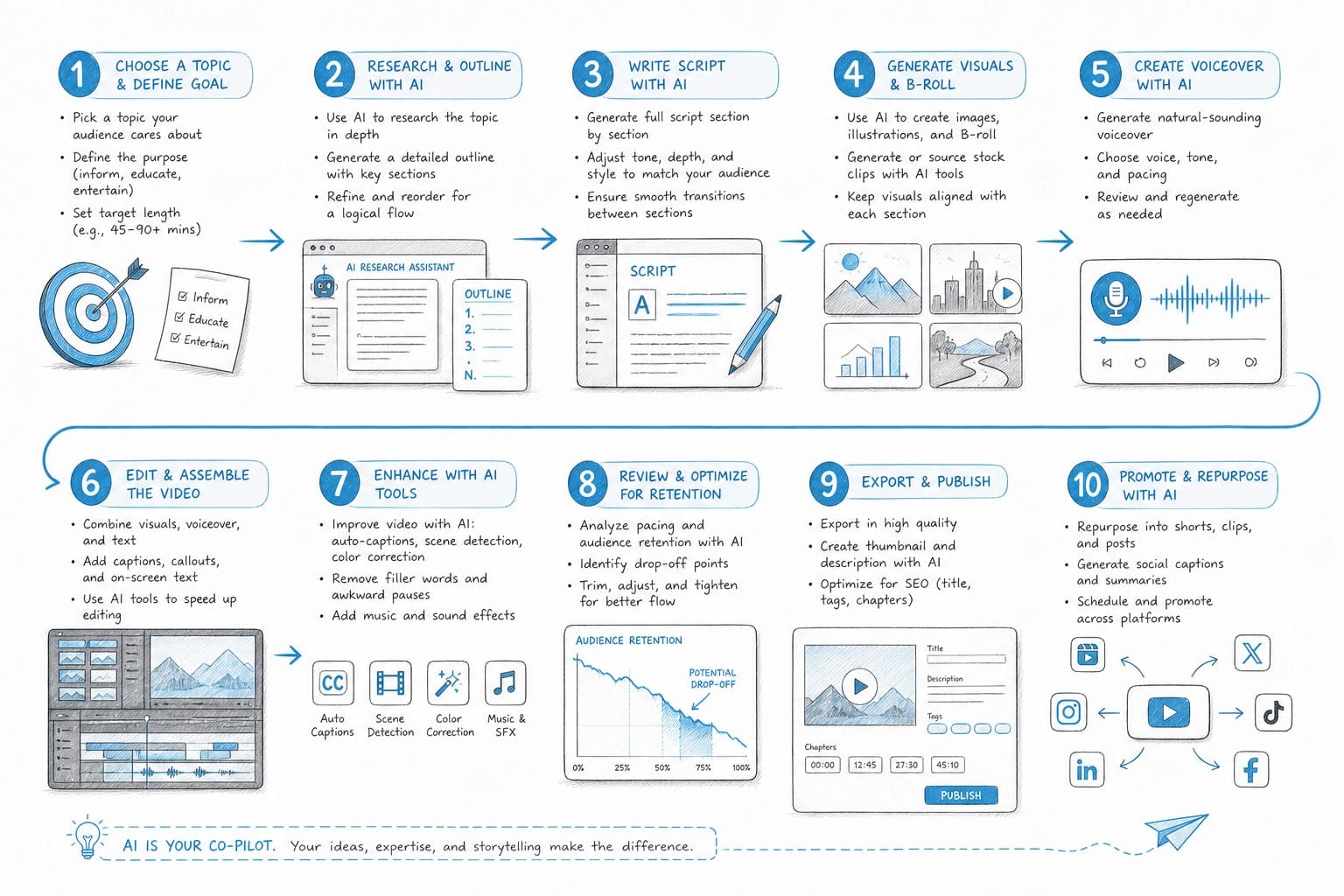
Creating ultra long form content with AI is not about pressing one button and getting a finished video. It is a structured workflow where AI handles the heavy lifting at each stage and you provide direction, review, and judgment. Here is how that process breaks down in practice.
Start with a strong topic and outline
Everything starts with topic selection. Ultra long form videos earn their length by covering a subject with real depth. Thin topics padded out to 25 minutes feel like a waste of the viewer's time, and your retention metrics will reflect it within the first few days of publishing.
Good ultra long form topics have multiple natural sub-sections that build on each other. Rankings that cover 20 or 50 items, historical narratives with a clear arc from beginning to end, comparative analyses across many subjects, and deep investigative explainers all work because the length serves the content rather than fighting against it. The viewer should feel, at the start, that there is a lot they want to understand about this topic, not that they just need one quick answer.
With AI, you can generate a structured outline in minutes. Feed your topic into an AI scripting tool and ask for a detailed chapter-by-chapter breakdown. A well-built platform produces an outline with clear sections, each with its own narrative purpose and natural connection to the sections around it. You can edit that outline before scripting begins, which is much faster than building the structure from scratch. Getting the outline right before you write a single word of narration is the most important step in the entire process, because a weak structure creates problems at every stage that follows.
Spend time here. Add sections the AI missed. Remove sections that feel redundant. Reorder the flow if a different sequence tells the story better. This is where your judgment as a creator matters most, and it takes 20 to 30 minutes rather than days.
Script the full narration
This is where most creators hit a wall with ultra long form content. A 30-minute video at a natural narration pace of around 130 words per minute needs roughly 3,900 words of script. At 40 minutes, you are looking at over 5,000 words. Writing that entirely by hand is a significant time investment even for experienced writers, and maintaining consistent tone and narrative flow across that many words is genuinely difficult.
AI scripting tools can generate the full narration text based on your outline. The key is making sure the output flows like a story rather than reading like a collection of Wikipedia summaries. Good AI platforms trained on documentary-style writing patterns produce text that has natural pacing, smooth transitions between sections, and a consistent narrative voice throughout. The best output reads like something a human researcher and writer spent a week on, not like a list of facts arranged in order.
You should still review and adjust the script before moving forward. Read through it with the outline in front of you and check that each section connects logically to the next. Verify that any facts or statistics align with sources you trust. Add specific examples, data points, or anecdotes that give the video more credibility and specificity than a generalist AI output will typically include on its own. This review pass usually takes one to two hours for a 30-minute script, compared to the four or five days it would take to write the whole thing from scratch.
Pay particular attention to the opening two to three minutes and the transitions between major sections. Those are the moments where viewers decide whether to keep watching or click away. If the AI draft feels weak in those spots, rewrite them directly.
Generate the voiceover
Faceless channels do not show the creator on camera, so voiceover quality determines more of the viewer experience than almost anything else. A robotic or monotone AI voice kills retention fast, regardless of how good the script is. Viewers will tolerate minor imperfections in a three-minute video. They will not sit through 30 minutes of a voice that sounds unnatural.
Modern AI text-to-speech has improved dramatically over the past two years. The best voices now handle pacing, emphasis, and natural pauses in a way that sounds close to a professional human narrator. In ultra long form content, small imperfections in the voice are actually less noticeable than in short clips, because the viewer is focused on the information being delivered rather than scrutinizing every word. What matters most is that the voice stays consistent, clear, and appropriately paced for the full duration.
When choosing a voice, pick one that matches the tone of your niche. A calm, measured voice works well for history, geography, and finance content. A slightly more energetic voice works better for true crime or technology. Listen to a full two to three minute sample of any voice before committing to it for a 30-minute production, because qualities that seem fine in a short preview can become grating at length.
Platforms like Kliptory include AI voiceover generation as part of an integrated production pipeline, so you are not exporting a script to one tool, generating audio, downloading it, importing it to another tool, and repeating that cycle across every stage of production.
Source and sync B-roll footage
B-roll is the visual layer that keeps viewers engaged during narration. In ultra long form content, you need a substantial amount of it. A 30-minute video has roughly 1,800 seconds of screen time. Even alternating between graphics and footage clips, you might need 60 to 100 individual video clips or images to fill the visual track without repeating yourself in ways that viewers notice.
Manually searching stock libraries for each clip, downloading, renaming, and placing them in a timeline is time-consuming work at any video length. For ultra long form content, doing it manually is genuinely prohibitive. A single 30-minute video might require four to six hours of stock footage work alone, before you touch the edit.
AI tools that automatically match B-roll to script content cut that time down to a fraction. The system reads the script, identifies the key subjects, locations, and scenes described or implied in the narration, and pulls relevant footage from licensed libraries. You review the selections and swap out anything that does not fit, but the initial matching is done for you. What used to take an afternoon takes an hour.
For ultra long form content covering topics like geography, economics, or history, data visualizations add significant production value. Maps that highlight specific regions, timelines that show the sequence of historical events, and charts that illustrate economic trends make abstract information concrete and easier to follow. These visual elements separate a professional-looking video essay from a basic slideshow. AI platforms that generate maps, charts, and timelines automatically from your script data save multiple hours of work in design tools and make it possible for a solo creator to produce content that looks like it came from a team.
Add captions and finalize the edit
Captions are not optional for serious YouTube channels. A significant share of viewers watch with sound off, particularly in the first few seconds when they are deciding whether to commit. Captions also improve accessibility and help viewers follow along more easily during complex sections of a long video, which supports retention throughout.
AI caption generation from voiceover audio is accurate enough now that manual cleanup is minimal. The captions sync automatically to the audio, and you review for errors rather than transcribing from scratch. The more important task is making sure captions are styled consistently and positioned so they do not obscure other visual elements in the frame.
The final edit pass is about pacing. Ultra long form videos need breathing room between sections. A section that feels rushed loses viewers because they cannot process what they just heard before the next point arrives. A section that drags loses viewers because they sense filler and skip forward or click away. Reviewing the assembled video and adjusting timing where the pacing feels off is still a human judgment call, but AI handles all the mechanical assembly that used to account for the majority of editing time.
Realistic time expectations with an AI workflow
With a fully AI-assisted workflow, a 20 to 30 minute documentary-style video can go from concept to finished file in several hours of active work rather than several weeks. That still requires your input and review at multiple stages. You are the creative director throughout. AI handles the production labor. The combination is what makes ultra long form content sustainable for a solo creator or a small team publishing consistently over months.
Choosing the right AI platform for ultra long form production
Not every AI video tool is built for ultra long form content. Most are designed for short clips, social media snippets, or explainer videos that run two to five minutes. When you are building a video that runs 20, 30, or 40 minutes, the platform you use needs to handle a fundamentally different set of requirements. A tool that works well for a four-minute video may break down completely at the scale of a 35-minute documentary-style production.
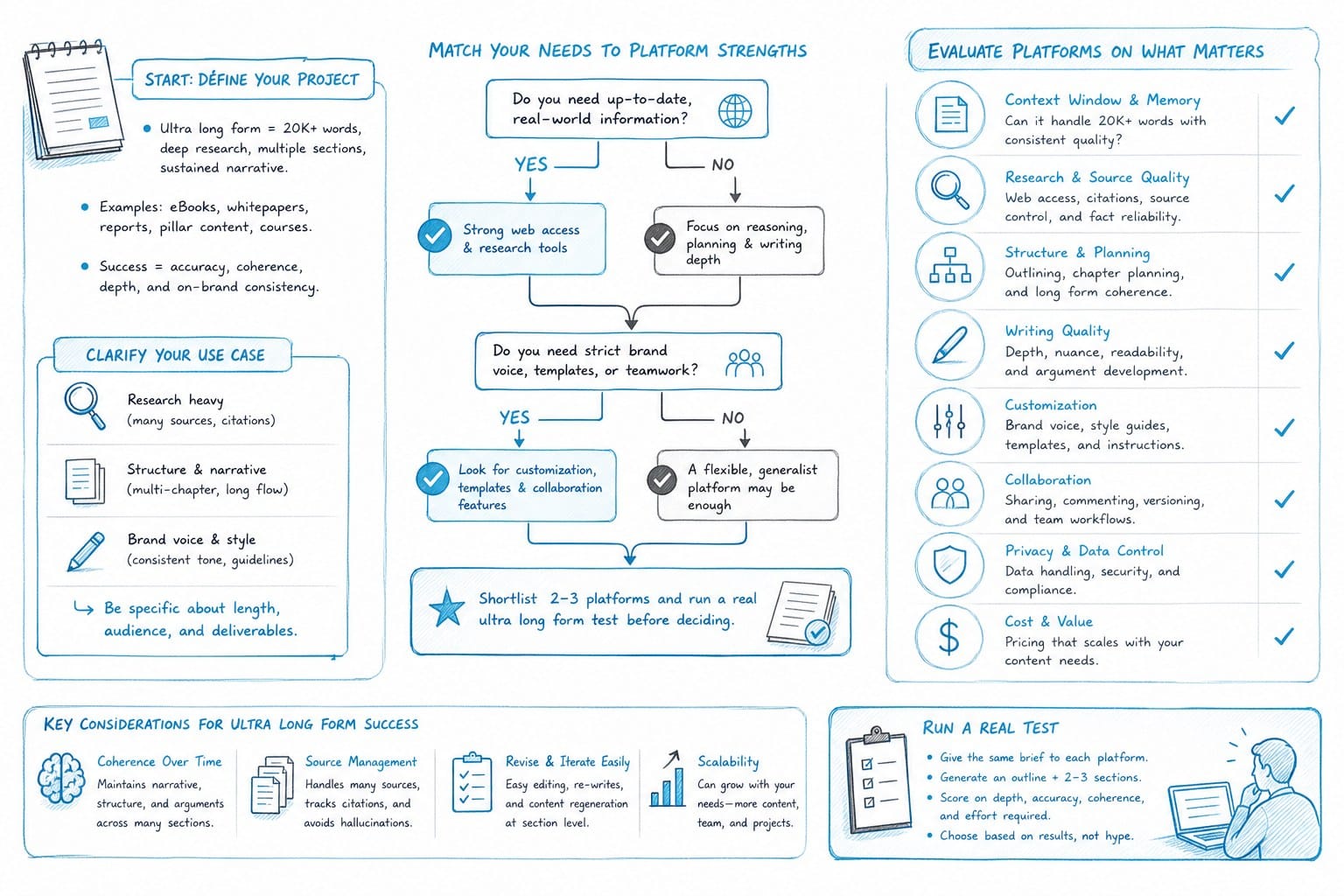
Here is what to evaluate specifically when ultra long form output is your target.
Scripting capacity that holds up across long documents
Many AI writing tools hit quality limits around 1,000 to 1,500 words. The output starts strong and then degrades noticeably in coherence, tone consistency, or factual accuracy as the document gets longer. For ultra long form content, you need consistent quality across 4,000 to 6,000 words of narration. The script needs to hold together as a unified piece with a clear through-line, not feel like it was written in disconnected segments that got pasted end to end.
The difference between a platform built for long-form scripting and one that is not shows up in the transitions between sections, the consistency of tone across 5,000 words, and the way the script builds toward a satisfying conclusion rather than just stopping. Ask yourself, when reviewing a platform's output: does this sound like one narrator telling one story, or does it sound like different writers covering different topics in the same document? The first is what you want. The second will cost you retention.
Some platforms also impose hard character or word limits per generation request, which forces you to generate long scripts in chunks and manually stitch them together. That stitching process introduces inconsistencies and adds significant time. Look for platforms that can handle the full script length in a structured single workflow.
Automated B-roll matching at scale
A 30-minute video needs significantly more visual variety than a 5-minute clip. The ratio of required footage to video length does not shrink as videos get longer. If anything, it gets harder to maintain visual interest across 30 minutes than across 5, because viewers become more aware of repeated imagery as the runtime extends.
Platforms that require you to manually search and place every clip are workable for short videos but become a genuine bottleneck for ultra long form production. The tool should intelligently match stock footage to script content across the full length of the video, handling the visual layer as a complete workflow rather than requiring manual intervention for each individual clip.
Data visualization capabilities matter significantly in this category. If you are covering topics that involve numbers, rankings, geographic data, or historical timelines, having built-in map generation, chart creation, and timeline tools means you can add those professional visual layers without exporting to separate design software, building graphics manually, and importing them back. That round-trip between tools adds hours to a production that is already large in scope. Platforms with these capabilities built in are a meaningful advantage for documentary-style content specifically.
Voice quality that holds up across 30 minutes
Listening to an AI voice for 30 or 40 minutes is a different experience than listening for four minutes. Viewers are more sensitive to unnatural pacing, odd emphasis, or robotic pronunciation when they are committing that much time. Small quirks that are easy to overlook in a short video become noticeable patterns in a long one, and those patterns erode retention.
The best platforms offer multiple voice options with natural-sounding delivery and let you preview the full narration before the final render, not just a 30-second sample. Some allow pace and tone adjustments by section, which is useful for ultra long form content where you might want a different energy level in an opening hook compared to a detailed analysis section midway through.
When evaluating a platform for ultra long form use, specifically test the voiceover on a 2,000-word sample, not a 300-word one. Play it back at normal speed and ask whether you could listen to this voice for 30 minutes without it becoming distracting. If the answer is uncertain, the voice will likely cost you retention in production.
End-to-end pipeline instead of a collection of single-feature tools
For ultra long form content specifically, the biggest productivity gain comes from having the entire production process inside a single platform. If you use one tool for scripting, another for voiceover, a third for B-roll sourcing, and a full desktop editing application on top of that, you spend a large amount of time on file management, format conversion, and context-switching between interfaces. Each individual tool might be good at its specific function, but the friction between them compounds at scale.
Consider the actual file movement involved: export the script as text, import it to a voice tool, export the audio file, import it to an editing tool, export video clips from a stock library, import those to the same editing tool, apply captions from a separate transcription tool, export the final file. Now multiply that across every video you produce. For short videos, the overhead is manageable. For 30-minute videos at a rate of two to four per month, it becomes a substantial time drain that limits how many videos you can realistically publish.
An end-to-end platform handles scripting, voiceover, B-roll matching and sourcing, data visualizations, captions, and final export in one connected workflow. For ultra long form content where the total production scope is large, that integration is often the difference between publishing one video per month and publishing four.
What to look for in a purpose-built platform
Kliptory was built specifically for faceless YouTube channels producing long-form and ultra long form documentary-style content. The platform covers the full production pipeline: AI scripting designed for multi-thousand-word narrations, voiceover generation, automated B-roll sourcing from licensed libraries, data visualizations including maps and timelines, caption generation, and final export. Videos ranging from 5 to 40 minutes are supported natively, which makes it one of the few tools actually designed for the ultra long form format rather than adapted from a short-form base.
For creators comparing different options in this space, the breakdown of TubeMagic alternatives for faceless YouTube creators covers how various platforms approach different aspects of automated video production and is worth reviewing if you are still evaluating which tool fits your workflow best.
Building a repeatable publishing system
Once you have a working ultra long form production workflow, scaling it comes down to topic volume and consistency. Start by identifying 10 to 20 topics in your niche that have genuine depth and clear search demand. A topic with depth means it has multiple natural sub-sections that each add something new. A topic with search demand means people are actively looking for this information on YouTube rather than just in search engines.
Plan a publishing calendar that targets one to two videos per month while you refine the workflow, then push toward two to four once the process feels reliable. Moving too fast before the workflow is stable leads to rushed videos with quality problems that damage the channel early when you can least afford it.
Each video you produce makes the next one faster. You learn where you need to give the AI more specific direction and where you can trust the initial output. You build a library of style decisions, voice preferences, and visual approaches that become defaults for future projects. The second video in a niche is noticeably faster than the first. The fifth is faster still.
The creators who succeed with ultra long form content at scale are not the ones trying to do everything manually and burning out after three videos. They are the ones who build a repeatable system, use AI to handle the production labor, and focus their own energy on topic selection, editorial direction, and publishing consistency. That is the model that turns a YouTube channel into a real content business over time.
Ready to take the next step?
If you are ready to start producing ultra long form YouTube videos without a production team, Kliptory gives you the full pipeline in one place. From scripting to final export, the platform is built specifically for the documentary-style, long-form format that drives real YouTube growth. Visit Kliptory to see how it works and start your first project.