How to Make Business Documentary Videos for YouTube

Business documentary videos are having a moment on YouTube right now. Channels that cover company origins, industry scandals, startup failures, and corporate rivalries are pulling in millions of views every month. People genuinely want to understand how the business world works, and they'll sit through a 40-minute video to get that story told well. Channels like Coffeezilla, More Perfect Union, and countless faceless documentary channels have proven that this format isn't a niche anymore. It's a lane with real staying power. So if you've been thinking about making these kinds of videos, you're looking at a real opportunity.
But here's the thing: a lot of creators treat business documentaries like news reports. They just run through facts and dates and figures, and the whole thing ends up feeling flat. They'll open with a company's founding year, list out a timeline of events, and close with a summary of what went wrong. That approach loses people in the first five minutes. A good business documentary is a story first. It has tension, characters, turning points, and stakes. The format borrows more from narrative filmmaking than it does from a business news segment. That difference in mindset changes everything about how you plan, script, and edit your video.
This guide walks you through the whole process from idea to upload. Whether you're running a faceless channel or one with your own face on camera, the core approach is the same. You need a strong story, the right visuals, and a structure that keeps viewers watching. Each section below covers one major phase of that process in enough depth that you can actually act on it. Let's get into it.
Finding and shaping your business story
A lot of you have asked about where to find good business documentary topics, and the honest answer is: they're everywhere once you start looking. Company collapses, product launches that changed an industry, legal battles between giant corporations, entrepreneurs who built something from nothing and then watched it fall apart. These stories are sitting in old news archives, court documents, podcast interviews, earnings call transcripts, and business school case studies. You just have to dig for them.
The key is finding a story with a clear arc. Something has to happen. Pressure has to build. Things either fall apart or come together, and there's usually a lesson underneath all of it. Think about what made films like 'The Social Network' or documentaries like 'Fyre' so watchable. It wasn't the business details. It wasn't the cap tables or the marketing budgets. It was the drama inside the business, the betrayals, the overconfidence, the moments where someone could have changed course and didn't. When you're picking your topic, ask yourself: is there genuine conflict here? Is there a person or group of people making high-stakes decisions under real pressure? If yes, you've got something to work with. If you're just staring at a timeline of product releases, keep looking.
Good topics often come from asking one simple question: what was everyone wrong about? The story of Blockbuster isn't really about DVD rentals. It's about a leadership team that was handed multiple chances to adapt and turned them down one by one. The story of WeWork isn't about coworking spaces. It's about how an entire industry of investors convinced themselves that a real estate company was a tech company because one charismatic person kept telling them it was. When you find the misconception at the center of a business story, you've found your narrative engine. That's the thing that makes people want to keep watching.
There are specific places to look when you're hunting for topics. The SEC's EDGAR database holds years of public filings from companies, and those filings often contain details that never made it into mainstream news coverage. Bankruptcy court records are another goldmine. When a company goes under, the legal proceedings create a paper trail of exactly what happened and who knew what. Reddit communities like r/investing, r/wallstreetbets, or industry-specific subreddits often surface stories years before major outlets cover them. Glassdoor reviews from former employees can tell you what was happening inside a company while the press releases were still saying everything was fine. Podcast interviews are especially useful because founders and executives tend to be more candid on long-form audio shows than they are in written profiles. Someone who gave a careful, guarded answer to a magazine reporter might have said something completely unguarded on a three-hour podcast three years earlier.
Once you pick a topic, you need to narrow your focus fast. A lot of first-time business documentary creators try to cover too much. They want to tell the entire 30-year history of a company in one video. That almost never works. Pick a specific chapter of the story. Pick the five years when everything went wrong, or the single product launch that defined the company's entire trajectory, or the one decision a board made on one afternoon that changed everything downstream. Tight focus makes for a tighter, better video. Viewers don't need the full biography. They need the part of the story that actually has stakes.
From there, it's research time. Pull from as many sources as you can. Old interviews, newspaper articles, SEC filings, Reddit threads from former employees, YouTube videos from the era when events were actually unfolding, podcast episodes where founders spoke candidly, and books written by journalists who covered the company closely. The more raw material you gather, the more you'll have to work with when you sit down to write. Cross-reference everything. When two sources say the same thing independently, that's your strongest material. When two sources disagree, that's often where the most interesting story lives. I personally think the research phase is where business documentaries are won or lost. Creators who cut corners here end up with thin scripts that don't hold up under scrutiny, and viewers can feel that thinness even if they can't name exactly what's wrong. We actually covered a similar research and structuring process in our piece on how to turn research into a 20-minute YouTube video if you want a deeper look at organizing everything you collect.
Once your research is gathered, you need to build a story outline before you touch the script. Take everything you've found and map it onto a simple structure: the setup, the rise, the tension point, the crisis, and the outcome. Not every business story fits neatly into that shape, but most of the best ones do. Write a one-sentence description of each phase. If you can't summarize a phase in one sentence, you don't understand it well enough yet, which means your audience won't either. That outline becomes the skeleton your script hangs on, and having it before you write saves you hours of rewriting later.
Writing a script that actually keeps people watching
Once your research is done, the script is where your documentary either comes alive or dies quietly. Business topics can feel dry if you let them, so your job as a writer is to treat every section of the script as a scene. Something needs to be at stake. Someone needs to want something, or fear something, or be making a choice they don't fully understand yet. That's what creates tension, and tension is what keeps viewers from clicking away after the first ten minutes.
Start with a hook that drops people into the middle of the action. Don't open with founding dates and founder bios. Open with the moment everything went wrong, or the day the product launched and nobody showed up, or the morning the CEO got a call that changed everything. Then pull back and say: to understand how we got here, we need to go back. That structure pulls people in before you've even explained what the video is really about. It works because it gives viewers a question to hold onto from the very first sentence. They want to know how things got to that point, and that want keeps them watching while you fill in the background.
I remember watching a business documentary on YouTube a few years ago about a fast food chain that collapsed almost overnight. The creator opened with footage of empty restaurant locations, parking lots with weeds growing through the cracks, and a voiceover that just said: 'Six months earlier, this company was worth two billion dollars.' That was it. I was locked in for the next 35 minutes. The opening didn't explain anything. It didn't tell me the company's name or its history. It just made me feel the gap between what was and what is, and that gap was interesting enough to keep me there. That's the goal of your opening. Don't inform. Intrigue.
After the hook, you move into the setup phase of your script. This is where you give viewers the context they need to understand why the story matters. Who are the main players? What was the world like before things went wrong? What did success look like for this company at its peak? Be specific here. Don't just say the company was growing fast. Say it opened 200 locations in 18 months. Don't just say the founder was ambitious. Show the specific decision that proved it, the deal they made, the speech they gave, the quote from an interview where they said something that looks completely different in hindsight. Specificity is what separates a documentary that feels researched from one that feels like a summary.
Your script also needs transitions that feel like chapter breaks. Business stories have natural phases: the founding, the early growth, the moment of peak confidence, the first warning signs, the crisis point, the scramble to respond, and the final outcome. Each phase is a new scene. Use your narration to signal when you're moving from one to the next, but do it in a way that builds anticipation rather than just announces a topic change. Instead of saying 'now let's talk about the company's expansion phase,' try something like: 'by 2014, the company had stopped worrying about survival. That turned out to be the most dangerous thing that could have happened.' That version says the same thing functionally, but it also tells viewers why they should care about what's coming next.
Pacing matters more than most new documentary creators expect. A 35-minute business documentary that maintains pace feels shorter than a 20-minute one that drags. Pace comes from the rhythm of your sentences, the timing of your visual cuts, and how quickly you move between moments of explanation and moments of action. Short sentences speed things up. Longer sentences slow things down and create weight. Use both deliberately. When you're deep in explanation mode, mixing in a short, punchy sentence reminds viewers that the story is still moving.
Dialogue, or the closest equivalent in a documentary format, also adds energy to a script. You probably won't have interview footage with the actual people involved, but you can quote them directly from written interviews, earnings calls, or court testimony. Reading a direct quote in a slightly different vocal tone signals to the viewer that they're hearing a real person speak, not just narration. When a CEO said something that looks staggeringly wrong in hindsight, quoting them word for word is almost always more powerful than paraphrasing. Let the original words do the work.
If your script is starting to feel generic or like something you've heard before, the problem is usually one of two things: either you're writing about the events instead of the people living through them, or you're explaining things instead of showing them through specific moments. Check out this breakdown on why documentary and listicle videos feel generic and how to fix it at the script level for specific things you can do in the writing itself to make your video feel original. Also think about your scene count. A 30-minute business documentary usually needs more discrete scenes than creators expect. Our guide on how many scenes a long YouTube video should have gives you a practical way to think about pacing across a longer video so you don't end up with a 10-minute section that overstays its welcome.
Finish your script with an ending that earns its conclusion. Don't just summarize what happened. Tell the viewer what it means. What does this story reveal about how businesses work, how people make decisions under pressure, or how an industry functions? The best business documentaries leave you thinking about something bigger than the company you just watched. The Enron story isn't just about one company. It's about what happens when the people who are supposed to ask hard questions stop asking them. If your ending can land on something like that, viewers will remember the video long after the details fade.
Visuals, voiceover, and putting it all together
Business documentaries live and die by their visuals. You're usually not filming original footage. You're working with stock video, historical images, screen recordings, licensed news clips, and motion graphics. The challenge is making all of that feel like it belongs together and actually supports the story instead of just filling screen time. The best business channels on YouTube are very intentional about this. Every shot either tells you something new or makes you feel something. If it's doing neither, it shouldn't be in the video.
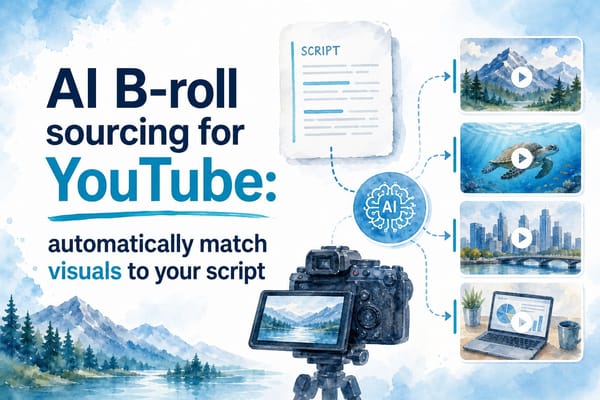
For the footage itself, you want a deliberate mix of what's called A-roll and B-roll. Your A-roll is the narration or interview footage that drives the story forward, the thing the viewer is listening to. Your B-roll is everything else: the visuals that play while the narration runs and give the viewer something to look at while they absorb information. For a business documentary, your B-roll might include footage of the company's products being used, aerial shots of cities or office buildings associated with the story, historical news clips from the era when events unfolded, recreated screen recordings showing old websites or digital ads, or animated maps showing where the company operated. The goal with B-roll isn't just to have something on screen. It's to reinforce or deepen what the narration is saying. If you're talking about a company expanding rapidly across the American South, showing a map with locations lighting up one by one is more visceral than just a generic aerial shot of a city. If you want a clear breakdown of how these two types of footage work together and when to use each, our piece on A-roll vs B-roll for YouTube documentaries lays it out well. And if you're still building your B-roll library, this guide on how to find B-roll for long-form YouTube videos has a lot of practical sourcing tips across both free and paid platforms.
Data visualization is also a central part of business storytelling, and it's one of the places where creators most often underinvest. When you're explaining revenue growth over five years, a well-made animated line chart does more in five seconds than two full minutes of narration. When you're showing how a company's stock price dropped 80 percent in six months, a visual representation of that drop hits harder than any description of it. The trick is keeping your graphics clean and simple. Too many labels, too many colors, or too much information on one chart will confuse viewers rather than help them. Every graphic should communicate exactly one thing. Make that one thing obvious, let it sit on screen long enough for viewers to absorb it, and then move on. Timing matters here too. A chart that appears two sentences too early or too late loses most of its impact because it's not synchronized with the moment in the narration when the viewer actually needs that information. We've got a full guide on how to use maps and charts in YouTube videos if you want to go deeper on designing and placing graphics effectively.
Text on screen is another tool that most business documentary creators use but few use well. Lower thirds that identify people or companies, title cards that establish time periods, and pulled quotes from key figures can all add clarity and visual variety to your video. But they work best when they're used sparingly and with purpose. If you're putting text on screen every 20 seconds, it stops being informative and starts being visual noise. Reserve your text treatments for moments when they add something the narration and visuals alone can't deliver. A pulled quote from a CEO, shown in full on screen as the narration reads it aloud, creates a different kind of emphasis than narration alone. Use that emphasis when the quote is genuinely important to the story.
Then there's the voiceover, which shapes the entire emotional register of your video. Your narration style tells the viewer how to feel before they've even processed the content. A slow, measured, slightly somber delivery makes a business story feel like a cautionary tale. A faster, more energetic delivery makes it feel exciting. A conversational, slightly wry tone can make even complex financial concepts feel accessible to someone with no business background. None of these approaches is wrong, but you need to pick the one that fits your story and commit to it fully. Switching tone halfway through a documentary creates a jarring effect that viewers notice even if they can't identify exactly why the video feels off.
If you're running a faceless channel, you'll also need to decide whether you're recording the voiceover yourself or using an AI-generated voice. Both approaches can work well when done correctly. A human voice recorded well in a treated space has natural warmth and variation that AI still hasn't fully replicated. But a high-quality AI voice is now good enough that many viewers don't notice or don't care, especially on longer videos where they're primarily focused on the story. Our breakdown of the best voiceover styles for faceless YouTube channels covers the different approaches in detail. If you're actively weighing the AI versus human decision for your channel, this comparison of AI voice generators versus human voice actors will help you make a call that actually fits your production setup and budget.
Music is the element most business documentary creators treat as an afterthought, and that's a mistake. Your background score controls the pacing and emotional texture of your video almost as much as the narration does. Tense, minimal music with low-end strings or sparse piano creates dread and anticipation. Upbeat, rhythmic tracks signal growth and momentum. Silence, used deliberately at the right moment, can be more powerful than any music cue. Build a small library of tracks that fit the emotional range of your story, and think carefully about when each one serves the moment you're editing. If you're using royalty-free music from a platform like Epidemic Sound or Artlist, spend time actually listening to the full library rather than just grabbing the first track that sounds close enough. The difference between an okay music choice and a great one is often the difference between a video that feels like a real documentary and one that feels like a YouTube video.
Once you've got your visuals and audio locked, the editing phase is about building rhythm across the full runtime of the video. Cut on the beat of the music when the story is moving quickly. Let shots breathe and linger when the story calls for weight or reflection. Match visual transitions to shifts in the narration so that the cut reinforces the idea rather than interrupting it. Business documentaries that feel cinematic are usually just documentaries where the editor was paying very close attention to timing and making small, deliberate choices at every cut. That level of care doesn't require expensive software or years of experience. It requires patience and the willingness to watch your own edit back multiple times until the rhythm feels right. Watch it without sound and ask if the visual pacing still makes sense. Then watch it without looking at the screen and ask if the audio alone tells the story. If both answers are yes, you're close to a finished video.
Ready to take the next step?
If you're ready to start building your business documentary channel, the next step is getting your workflow dialed in so you can produce consistently without burning out after your first or second video. Long-form documentary content takes real time, and the creators who stick with it are the ones who figure out a sustainable production process early on. We covered that challenge in detail in our post on how to make a 30-minute YouTube video without burning out, and it's worth reading before you dive into your first big project. When you're ready to start creating, check out Kliptory, a tool built specifically for faceless documentary-style YouTube channels that helps you go from research and script to finished video without the usual chaos of juggling a dozen different apps and tabs. Drop a comment below and tell me what business story you're thinking about covering first. I'd love to hear what's on your list.