
Pay Per 1,000 Views on YouTube: What Creators Actually Earn

If you've ever wondered why some YouTubers seem to make a living off their channel while others barely scrape together enough for a coffee, the answer usually comes down to one thing: how much they earn per 1,000 views. That number is called CPM, which stands for cost per mille. It's basically what advertisers pay YouTube to show their ads 1,000 times. But here's the catch — creators don't actually take home that full amount.
The figure creators actually receive is called RPM, or revenue per mille. YouTube keeps 45% of ad revenue and pays creators the remaining 55%. So if a channel has a CPM of $10, the creator walks away with roughly $5.50 for every 1,000 views. That gap confuses a lot of new creators who expect their earnings to match the CPM number they see in YouTube Studio.
So what does that look like in real dollars? The average RPM across YouTube sits somewhere between $1.50 and $4 per 1,000 views, though this varies wildly depending on your niche, your audience's location, and the time of year. A gaming channel might pull in $1 to $2 per 1,000 views, while a finance channel could easily hit $10 or more. Understanding what drives that number is key if you want to grow your income on the platform.
What actually determines your RPM
A lot of you have asked about this, and honestly it's one of the most misunderstood parts of YouTube monetization. Your RPM isn't a fixed number. It shifts based on several factors, and some of them are completely outside your control.
Your niche is probably the biggest driver. Advertisers pay more to reach people who are likely to spend money on specific products. Finance, real estate, business, and tech channels attract high-paying advertisers because the audiences are valuable to companies selling credit cards, software, or investment products. Entertainment, vlogs, and general lifestyle content tend to attract lower ad rates because the audience is broader and less targeted.
Where your audience lives also matters a huge amount. Views from the United States, Canada, Australia, and the United Kingdom are worth more than views from countries where advertisers spend less. A channel with 100,000 views from the US will almost always out-earn a channel with the same number of views from regions where advertiser budgets are smaller. If you've built an international audience, this is worth paying attention to.
The time of year plays a role too. Ad spending spikes in the fourth quarter, especially October through December, because companies are pushing holiday sales. Many creators notice their RPM jump 30% to 50% during that window. January tends to be a tough month because ad budgets reset and spending drops sharply. Knowing this can help you plan your content calendar around when your earnings are likely to be highest.
Real earning examples across different niches
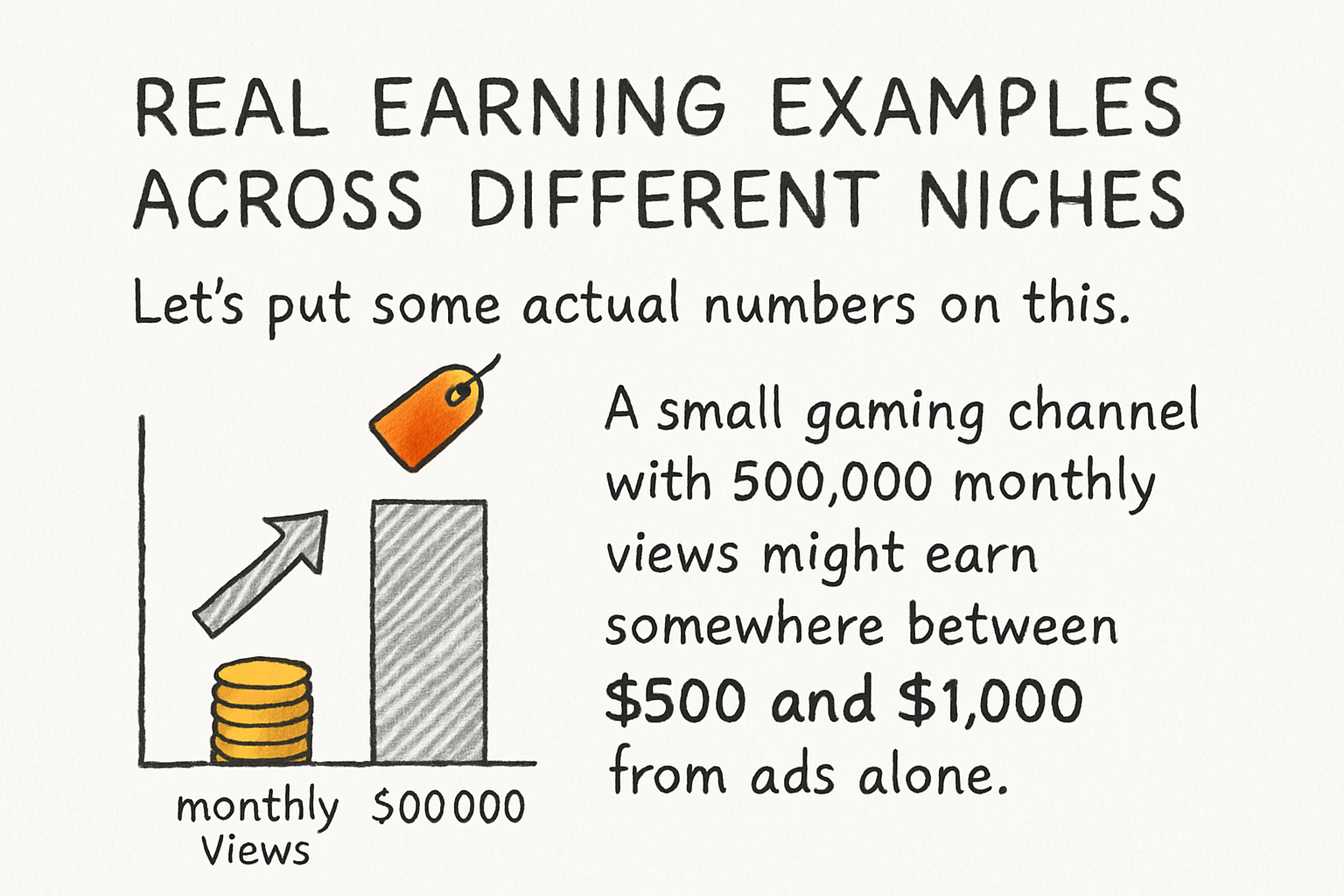
Let's put some actual numbers on this. A small gaming channel with 500,000 monthly views might earn somewhere between $500 and $1,000 from ads alone. That works out to roughly $1 to $2 RPM, which is pretty typical for gaming content. It's not nothing, but it's also not a full-time income for most people living in a high-cost city.
A personal finance channel with the same 500,000 monthly views could earn anywhere from $4,000 to $7,000, sometimes more. Finance CPMs are consistently among the highest on the platform because companies in that space pay serious money to get in front of people who are actively thinking about money. I personally think the gap between high-CPM and low-CPM niches is the single most underrated factor new creators overlook when they plan their channels.
I remember chatting with a friend who runs a cooking channel. She was pulling 800,000 views a month and felt frustrated because her earnings weren't matching what she'd expected. Once we looked at her RPM together, it was sitting around $1.80. Her audience was engaged, but food content doesn't command the same ad rates as finance or software. She eventually added a sponsored segment to her videos, which made a bigger difference than any change to her ad settings.
This is also why understanding how YouTube actually counts and processes views matters. If you're not sure how that works on the back end, our piece on how YouTube views work breaks it down clearly. Not all views are equal when it comes to ad delivery, and some views don't generate any ad revenue at all.
How to increase what you earn per 1,000 views
The good news is you're not stuck with whatever RPM YouTube assigns you. There are real ways to move that number up over time, and most of them don't require you to change your entire channel.
One of the most effective approaches is making longer videos. Videos that are at least eight minutes long allow creators to place mid-roll ads, which means more ad slots per video. More ad slots generally mean higher earnings per view. Watch time also signals to YouTube's algorithm that your content is worth promoting, which leads to more views overall. We've covered this in detail in our guide on YouTube watch hours, and it's worth reading if you want to understand how time-on-video connects to your earnings.
You can also attract a higher-value audience by tweaking your content topics. If you run a broad lifestyle channel, adding content about budgeting, tech products, or home improvement can bring in viewers that advertisers are willing to pay more to reach. You don't have to overhaul your entire brand. Even a few videos in a higher-CPM space can raise your overall RPM over time.
Beyond ads, smart creators treat ad revenue as just one stream of income. Sponsorships, memberships, merchandise, and affiliate links can each add a significant chunk on top of what YouTube pays directly. A channel earning $2 RPM from ads but running regular brand deals might be making two or three times more per 1,000 views than their YouTube Studio dashboard shows. Ads are a starting point, not a ceiling.
Ready to take the next step?
If you're serious about growing your channel and making more from every view, the first step is understanding your numbers. Start by keeping a close eye on your RPM in YouTube Studio and notice what changes when you post in different topics or at different times of year. Small shifts in strategy can add up fast. Got questions about your own earnings or something you've noticed on your channel? Drop them in the comments below. And if you're looking for tools to help you build your channel smarter, check out Kliptory to see how it can support your growth.